 News




Article
Power Distribution & Last-Mile Access Building a Smarter, Stronger and More Reliable Distribution Network
Power Distribution & Last-Mile Access Building a Smarter, Stronger and More Reliable Distribution Network
![]() By
Samuel Raj 22-October-2026


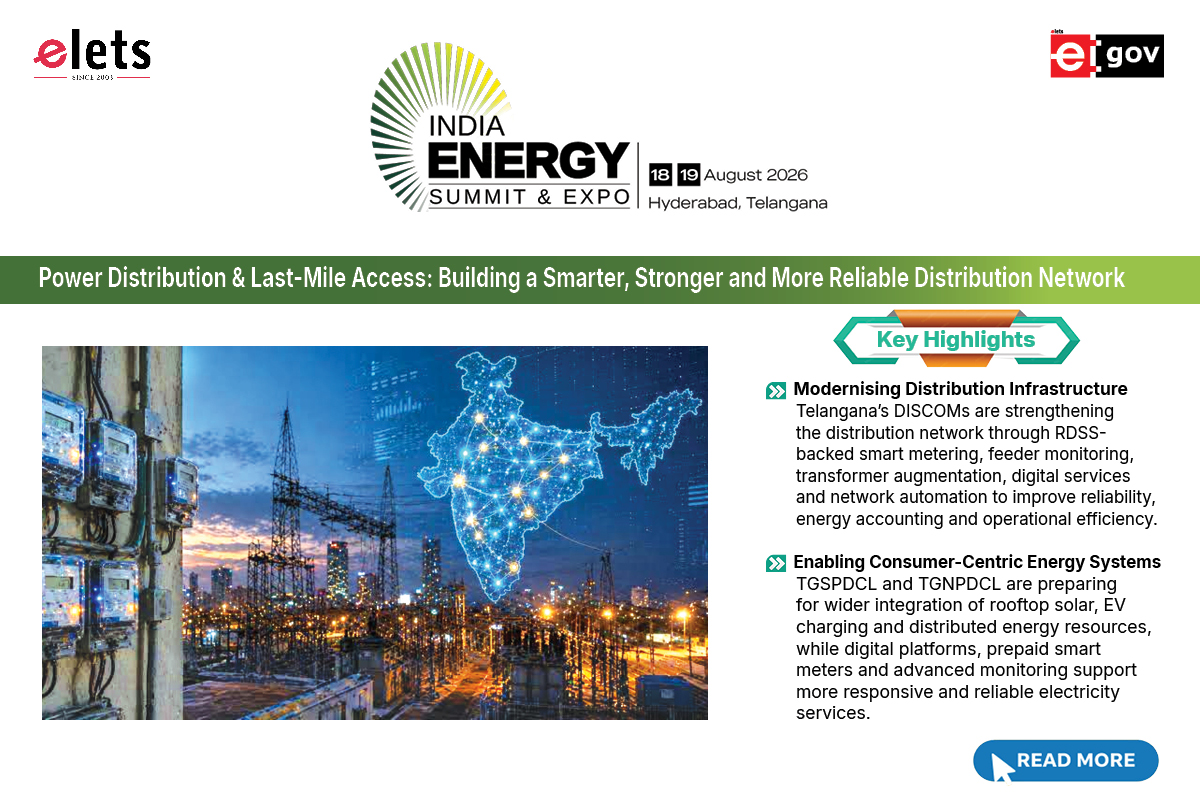
India’s power sector has undergone a remarkable transformation over the past decade. While generation capacity has crossed 480 GW and renewable energy continues to expand rapidly, the real test of the electricity sector lies beyond generation—at the distribution level. The distribution network is the interface between the power sector and consumers, determining whether electricity generated at power plants ultimately reaches homes, industries, farms and commercial establishments reliably, efficiently and affordably.
Distribution companies (DISCOMs) have historically been regarded as the weakest link in India’s electricity value chain. High Aggregate Technical and Commercial (AT&C) losses, mounting financial liabilities, ageing infrastructure, power theft and operational inefficiencies have constrained their ability to deliver quality power. Recognising this challenge, both the Government of India and state governments have shifted their focus towards modernising distribution infrastructure, improving financial sustainability and creating consumer-centric electricity services.

Telangana presents an interesting example of this transition. Since its formation in 2014, the state has consistently invested in strengthening distribution infrastructure, ensuring uninterrupted supply and expanding digital consumer services. Today, the reforms undertaken by Telangana Southern Power Distribution Company Limited (TGSPDCL) and Telangana Northern Power Distribution Company Limited (TGNPDCL) demonstrate how reliable distribution has become an important enabler of industrial growth, urban development and rural prosperity.
Distribution Reforms Move to Centre Stage

Electricity distribution has traditionally accounted for the largest share of losses within India’s power sector. While generation and transmission have witnessed substantial improvements in efficiency over the past two decades, many distribution utilities continue to struggle with operational losses, inadequate infrastructure and weak financial performance.
To address these structural challenges, the Government of India launched the Revamped Distribution Sector Scheme (RDSS) in July 2021. The scheme aims to improve operational efficiency, reduce losses and enhance the financial viability of distribution utilities through infrastructure upgrades, smart metering and digitalisation. Projects worth nearly ₹2.83 lakh crore have been sanctioned under the scheme, including approximately ₹1.53 lakh crore for loss-reduction works and ₹1.31 lakh crore for smart metering. The national objective is to reduce AT&C losses to 12–15 per cent while eliminating the gap between the Average Cost of Supply (ACS) and Average Revenue Realised (ARR).
“The responsibility for the energy ecosystem primarily rests on the distribution and transmission system, which can be likened to the nervous system of our body, responsible for circulating blood throughout the entire body. Similarly, the transmission and distribution system is crucial in distributing energy throughout various parts of the country.” – Bhaskar Sarkar, Chief Executive Officer, TP Northern Odisha Distribution Ltd.
The infrastructure component extends well beyond replacing conductors. It includes augmentation of substations, installation of new distribution transformers, feeder segregation, underground cabling in selected urban areas, SCADA-based monitoring systems, Distribution Management Systems (DMS) and advanced network automation. Together, these interventions are expected to improve supply reliability while enabling utilities to manage increasingly complex electricity networks.
Smart Metering Changes the Distribution Landscape
Smart metering has emerged as one of the most significant reforms in India’s distribution sector. Unlike conventional meters, smart meters enable two-way communication between consumers and utilities, allowing real-time monitoring of electricity consumption, remote meter reading, outage detection and improved billing efficiency.
Under RDSS, smart metering has been sanctioned for 19.79 crore consumer meters, 52.53 lakh distribution transformers and over 2.05 lakh feeders across 28 States and Union Territories. As of December 2025, 3.90 crore smart meters had been installed under RDSS, while total installations under various programmes had crossed 5.28 crore nationwide.
Beyond improving billing accuracy, smart meters help utilities detect power theft, reduce commercial losses, improve demand forecasting and enable time-of-day tariffs. For consumers, they offer greater transparency through digital consumption records, mobile applications and online payment platforms.
Emphasizing the importance of future-ready networks, Bhaskar Sarkar, Chief Executive Officer, TP Northern Odisha Distribution Ltd. notes that “In light of the increasing intermittent energy supply from different regions, enhancing the transmission system’s efficiency, resilience, and proactiveness is essential. We can use emerging technologies such as Data Analytics to address the current shortcomings and transform the system to achieve this goal.”
Quality Power Becomes a Consumer Expectation
The conversation around electricity distribution has gradually shifted from mere electrification towards quality of supply. Today’s consumers expect uninterrupted electricity, faster complaint resolution, accurate billing and digital access to utility services.
The central government’s rural electrification programmes, including Deen Dayal Upadhyaya Gram Jyoti Yojana (DDUGJY) and Saubhagya, have substantially expanded electricity access over the past decade. However, universal connectivity alone does not guarantee reliable electricity. Distribution infrastructure must continuously evolve to support increasing household appliance ownership, electric mobility, digital infrastructure and industrial expansion.
Utilities are therefore investing in automated substations, outage management systems, feeder monitoring and predictive maintenance. SCADA-enabled control centres now provide operators with real-time visibility across urban distribution networks, enabling quicker fault identification and restoration.
Consumer-Centric Distribution Services
Digital transformation is reshaping how consumers interact with electricity utilities.
Most leading DISCOMs now provide integrated digital services including online applications for new connections, bill payments, complaint registration, outage notifications, service requests, load enhancement and rooftop solar approvals. Mobile applications and consumer portals have significantly reduced physical visits to utility offices while improving service delivery.
Artificial Intelligence and data analytics are also being deployed for demand forecasting, network planning, transformer health monitoring and revenue protection. Digitalisation is gradually transforming distribution companies from traditional utilities into technology-enabled service providers.
Telangana’s Distribution Model
Among Indian states, Telangana has consistently emphasised reliable electricity as a foundation for economic growth. Since statehood, substantial investments have been made in substations, transmission lines, distribution infrastructure and feeder strengthening to support uninterrupted power supply across urban and rural areas.
The state provides 24×7 quality power to domestic, commercial and industrial consumers, while continuing its round-the-clock free electricity supply for agriculture through dedicated feeder infrastructure. This has supported industrial expansion, IT parks, pharmaceutical manufacturing, data centres and urban development, particularly in Hyderabad.
Recognising the need for further modernisation, the Telangana Cabinet approved participation in the Government of India’s RDSS in 2026. The programme will introduce prepaid smart meters for all consumer categories except agricultural connections while strengthening distribution infrastructure through Centre-State funding.
“Since the inception of Telangana as a state, we have added the generation capacity from 7,000 MW to 17,000 MW and solar capacity from 74 MW to 5,100 MW. The entire solar generation is commissioned at the load site and we have not built any single transmission line or added any transformation capacity for achieving the 5,100 MW of solar generation.” T. Jagath Reddy, Director (Transmission), Transmission Corporation of Telangana Limited (TS TRANSCO)
TGSPDCL: Driving Digital Distribution
TGSPDCL serves Hyderabad and several rapidly growing districts where electricity demand continues to rise due to urbanisation, commercial development and industrial expansion.
The utility has increasingly focused on digital consumer services. Applications for new service connections, title transfers, rooftop solar net-metering, bill payments and consumer grievances are now processed through digital platforms, reducing turnaround times and improving service delivery. Utility management has also prioritised faster disposal of pending service requests and preventive maintenance to minimise supply interruptions.
The utility is also preparing for large-scale deployment of smart prepaid meters under RDSS, which will enhance billing efficiency, improve energy accounting and strengthen demand-side management. The integration of advanced metering infrastructure is expected to improve operational visibility while supporting future time-of-day tariffs and distributed energy resources.
Hyderabad’s rapidly expanding rooftop solar installations further increase the importance of intelligent distribution systems. Net-metering enables consumers to become “prosumers”—simultaneously consuming and supplying electricity to the grid—requiring utilities to adopt smarter load management practices.
TGNPDCL: Strengthening Rural Distribution
TGNPDCL serves northern Telangana, covering districts with significant agricultural activity alongside growing industrial clusters and urban centres.
Its priorities differ from those of urban utilities. Infrastructure strengthening, agricultural feeder management, rural electrification, voltage improvement and transformer augmentation remain central to operations.
Continuous investments in feeder strengthening, distribution transformers and rural network expansion have supported reliable supply across remote areas while improving service quality for domestic consumers and agriculture. Dedicated agricultural feeder management has enabled better monitoring of farm power consumption and strengthened subsidy accounting.
The utility is also expected to benefit from RDSS-supported smart distribution infrastructure, digital metering and feeder monitoring systems as Telangana moves towards wider implementation of the programme.
Rooftop Solar Creates a New Distribution Paradigm
The rapid expansion of rooftop solar is fundamentally changing electricity distribution. Distribution companies are no longer responsible only for delivering electricity—they must increasingly manage two-way power flows as consumers generate their own electricity.
Net-metering policies encourage households, institutions, commercial buildings and industries to install rooftop solar systems while exporting surplus electricity to the grid. This improves renewable energy adoption but also requires sophisticated grid management, voltage regulation and forecasting capabilities.
For Telangana, rooftop solar complements the state’s broader renewable energy ambitions while reducing peak demand on urban distribution networks. Distribution utilities will therefore play an increasingly important role in integrating decentralised generation, battery storage and electric vehicle charging infrastructure.
The Road Ahead
India’s power distribution sector is entering a period of structural transformation. Smart metering, digital utilities, automated substations, artificial intelligence, predictive maintenance and consumer-centric services are gradually replacing conventional utility operations. Financial sustainability remains an important challenge, but reforms under RDSS are creating the foundation for more efficient and resilient distribution companies.
Distribution reforms are equally important for ensuring that both conventional and renewable sources operate efficiently. As Dr. P. Anbalagan, Chairman & Managing Director, Maharashtra State Power Generation Company (MAHAGENCO), points out, “Though renewable energy is taking the lead, other parallel sources of energy generation are going to remain there for the next three to four decades. Therefore, operational efficiency and cost reduction are very crucial for smooth and effective energy transition.”
For Telangana, the next phase of reforms will be defined by digital distribution, smart infrastructure and greater integration of distributed renewable energy. The modernisation initiatives being undertaken by TGSPDCL and TGNPDCL, together with the state’s commitment to reliable 24×7 supply, position Telangana among the states actively preparing for the next generation of electricity distribution.
As India’s electricity demand continues to rise alongside renewable energy deployment, electric mobility and industrial growth, the strength of the country’s power sector will increasingly depend not only on how much electricity it generates, but on how efficiently and reliably it reaches every consumer. Modern distribution networks, backed by digital technologies and consumer-focused services, will therefore remain central to India’s energy transition.
—————————————————————————————————————————
Written by: Abhineet Kumar | Elets News Network

Be a part of Elets Collaborative Initiatives. Join Us for Upcoming Events and explore business opportunities. Like us on Facebook , connect with us on LinkedIn and follow us on Twitter, Instagram.
"Exciting news! Elets technomedia is now on WhatsApp Channels Subscribe today by clicking the link and stay updated with the latest insights!" Click here!