 News




Article
Hydrogen Economy Telangana’s Green Hydrogen Ambition Powers the Next Energy Transition
Hydrogen Economy Telangana’s Green Hydrogen Ambition Powers the Next Energy Transition
![]() By
Samuel Raj 19-October-2026


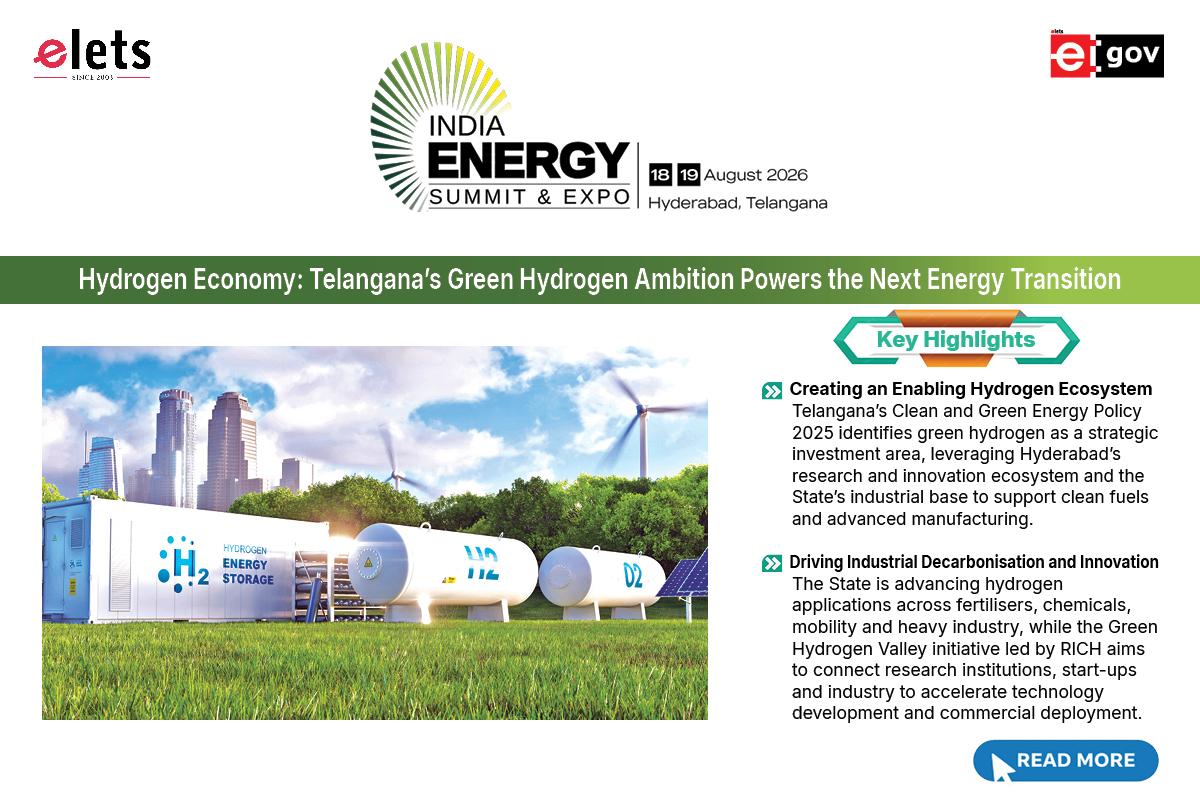
For decades, the conversation around India’s energy transition revolved around expanding renewable power generation. Solar parks, wind farms and grid modernisation have significantly altered the country’s electricity landscape. Today, however, the focus is shifting beyond power generation to decarbonising industries that remain heavily dependent on fossil fuels. Green hydrogen has emerged as one of the most promising solutions for this challenge, offering opportunities to transform manufacturing, heavy transport, refining, fertilisers and other hard-to-abate sectors.
As India pursues its ambition of becoming a global hub for green hydrogen, states are expected to play a decisive role in translating national policy into industrial investments. Telangana has taken an early step in this direction through the Telangana Clean and Green Energy Policy, 2025, which identifies green hydrogen as a strategic area for investment and industrial development. By combining policy support with its established industrial base and Hyderabad’s innovation ecosystem, the State is seeking to build an enabling environment for the emerging hydrogen economy.

A Policy Framework for the Hydrogen Economy
The Telangana Clean and Green Energy Policy, 2025 reflects the State’s broader objective of accelerating clean energy adoption while creating new opportunities for industrial growth. Unlike earlier renewable energy policies that primarily focused on electricity generation, the new policy expands its scope to include emerging technologies such as green hydrogen and its derivatives.

The policy promotes investments across the hydrogen value chain, covering green hydrogen production, electrolyser manufacturing, fuel-cell manufacturing, storage infrastructure, transportation, green ammonia, green methanol and hydrogen refuelling stations. To encourage early adoption, the State has proposed a range of incentives, including capital support for hydrogen production facilities, manufacturing units and refuelling infrastructure, alongside concessions relating to electricity duty, transmission and wheeling charges, land allocation and project facilitation.
This policy approach is significant because hydrogen projects require substantial upfront investment and long gestation periods. By reducing project costs and simplifying approvals, Telangana aims to improve investor confidence while attracting industries looking to diversify into clean fuels and advanced manufacturing.
Hyderabad’s Innovation Ecosystem Creates a Natural Advantage
Policy alone cannot create a hydrogen economy. The development of commercially viable hydrogen technologies depends equally on research, innovation, skilled manpower and collaboration between academia and industry.
In this regard, Hyderabad offers Telangana a distinct advantage.
The city has evolved into one of India’s leading centres for research, engineering and technology development. Institutions such as IIT Hyderabad, CSIR-Indian Institute of Chemical Technology (IICT), the University of Hyderabad, and BITS Pilani, Hyderabad Campus, together with innovation platforms like T-Hub, have created a strong ecosystem for deep-tech research and industrial innovation.
An important addition to this ecosystem is the Green Hydrogen Valley initiative being anchored by the Research and Innovation Circle of Hyderabad (RICH) with support from the Department of Science and Technology, Government of India. The initiative aims to create a collaborative platform involving research institutions, start-ups and industries to accelerate hydrogen technologies and their commercial deployment. Initially, it focuses on sectors such as fertilisers, mobility and cement while developing implementation models that can be replicated elsewhere in the country. RICH also serves as the programme management unit for the consortium and is preparing the detailed project framework for implementation.
The significance of such initiatives lies in their ability to bridge the gap between laboratory research and industrial adoption. As hydrogen technologies evolve, partnerships between research organisations, technology developers and industry will be essential for reducing costs and improving commercial viability.
Building on Telangana’s Industrial Strengths
Green hydrogen has applications across a wide range of industries, and Telangana’s diversified industrial base positions it well to benefit from this transition.
The State is recognised as a major centre for pharmaceuticals, bulk drugs, speciality chemicals, precision engineering, electronics and advanced manufacturing. Many of these industries are energy intensive and face increasing pressure to reduce their carbon footprint while remaining globally competitive.
Green hydrogen offers an alternative energy source for industrial processes where direct electrification is technically difficult or economically unviable. Refineries can use green hydrogen to replace fossil fuel-based hydrogen in refining operations. Fertiliser manufacturers can integrate green ammonia into production processes. The steel and cement sectors can progressively adopt hydrogen-based technologies to reduce emissions, while chemical industries can utilise green hydrogen as an industrial feedstock.
The policy emphasis on developing hydrogen production alongside renewable energy projects also creates opportunities for integrated industrial ecosystems, where clean electricity, hydrogen production and manufacturing operate within the same industrial clusters. Such integrated development can improve operational efficiency, reduce logistics costs and strengthen supply chain resilience.
At the same time, hydrogen is expected to play an increasingly important role in clean mobility. While battery-electric vehicles are well suited for passenger transport and shorter routes, hydrogen fuel cells offer potential for buses, heavy commercial vehicles and long-haul freight operations that require higher payloads, faster refuelling and longer operating ranges. Telangana’s policy support for hydrogen refuelling infrastructure reflects an effort to prepare for these emerging applications.
National Mission Driving the Hydrogen Economy
Telangana’s efforts are being reinforced by the Government of India’s National Green Hydrogen Mission, which provides the policy framework and financial support needed to establish a domestic green hydrogen ecosystem. Approved with an outlay of ₹19,744 crore, the Mission aims to position India as a global producer, consumer and exporter of green hydrogen while accelerating industrial decarbonisation.
The Mission has set an ambitious target of producing 5 million metric tonnes (MMT) of green hydrogen annually by 2030, supported by nearly 125 GW of additional renewable energy capacity. The programme is expected to unlock investments exceeding ₹8 lakh crore, reduce dependence on imported fossil fuels and generate over six lakh employment opportunities across manufacturing, engineering, renewable energy and associated industries.
Implementation has already gathered pace. Under the Strategic Interventions for Green Hydrogen Transition (SIGHT) programme, the Government has awarded incentives for 3,000 MW of electrolyser manufacturing capacity to 15 companies, creating the foundation for indigenous manufacturing and reducing dependence on imported electrolysers. The Ministry of New and Renewable Energy has also introduced a Green Hydrogen Certification Scheme, providing a uniform framework for certifying green hydrogen and its derivatives, an essential step towards developing a credible domestic and export market.
The Government is simultaneously supporting the creation of hydrogen hubs, pilot projects and storage infrastructure to accelerate commercial adoption. Green hydrogen production capacities have been allocated under the Mission, while projects covering green ammonia production, refinery operations, hydrogen-powered mobility and green steel are demonstrating the technology’s commercial potential across multiple sectors.
Hydrogen Creating New Industrial Opportunities
Green hydrogen is increasingly being viewed not merely as a clean fuel but as a catalyst for industrial transformation.
Globally, countries are investing in hydrogen to decarbonise sectors where electrification alone cannot achieve emission reductions. For Telangana, this creates opportunities to strengthen industries that already form the backbone of the State’s economy.
The pharmaceutical and speciality chemical sectors, where Telangana enjoys national leadership, are expected to benefit from cleaner industrial processes and low-carbon manufacturing pathways. Engineering companies can participate in manufacturing electrolysers, storage systems, pipelines and associated equipment, while electronics manufacturers can contribute to control systems, sensors and power electronics required for hydrogen infrastructure.
Hydrogen also opens new avenues for innovation in mobility. Fuel-cell buses, heavy commercial vehicles, mining equipment and logistics fleets are emerging as promising applications where battery technologies may face operational limitations. As the hydrogen ecosystem matures, demand for storage technologies, compression systems, refuelling infrastructure and specialised engineering services is also expected to increase.
For Telangana, these developments extend beyond energy security. They represent opportunities to attract advanced manufacturing, develop specialised supply chains and create high-value employment across engineering, clean technology and research-intensive industries.
Hyderabad Can Anchor India’s Hydrogen Innovation
While large-scale hydrogen production will depend on renewable energy resources and industrial demand, innovation will remain central to reducing costs and improving commercial viability.
Hyderabad’s research ecosystem offers Telangana a strategic advantage in this regard.
The presence of premier academic institutions, national laboratories, deep-tech start-ups and industry-led innovation platforms creates opportunities for collaborative research across hydrogen production technologies, fuel cells, electrolysers, storage materials and industrial applications.
The proposed Green Hydrogen Valley, facilitated by the Research and Innovation Circle of Hyderabad (RICH), reflects this collaborative approach by bringing together government, research institutions, start-ups and industry to accelerate technology development and commercial deployment. Such initiatives can help translate scientific research into commercially viable products while strengthening India’s indigenous hydrogen capabilities.
Innovation will also play a critical role in addressing current challenges associated with hydrogen production costs, storage technologies, transportation infrastructure and end-use efficiency. Continued investment in research and development will therefore remain essential for improving competitiveness and expanding industrial adoption.
BoxNational Green Hydrogen Mission
Hydrogen for Net Zero
|
The Road Ahead
The global hydrogen economy is still in its formative stages, but the direction is clear. Governments are increasingly viewing green hydrogen as a strategic resource capable of strengthening energy security, reducing industrial emissions and creating new manufacturing opportunities.
For Telangana, the foundation has already been laid. The Telangana Clean and Green Energy Policy, 2025 provides a supportive policy framework, while Hyderabad’s research ecosystem and the State’s diversified industrial base offer significant advantages in developing hydrogen technologies and applications. The challenge now lies in translating policy intent into commercially viable projects through timely investments, industry participation and institutional collaboration.
Equally important will be the creation of industrial demand. The long-term success of the hydrogen economy will depend not only on producing green hydrogen but also on building integrated ecosystems where renewable energy generation, hydrogen production, manufacturing, storage, transportation and industrial consumption evolve together.
As India advances towards its green hydrogen ambitions, states that successfully combine policy support, research capabilities and industrial competitiveness are likely to emerge as leaders in this new energy landscape. Telangana has taken important first steps in this direction. The next phase will be defined by implementation, innovation and partnerships that transform policy into productive industrial growth.
Green hydrogen is no longer simply an environmental aspiration. It is fast becoming an industrial and economic opportunity. For Telangana, it represents a chance to reinforce its position as one of India’s leading destinations for clean technology, advanced manufacturing and sustainable industrial development. As the national hydrogen ecosystem expands over the coming decade, the State has the potential not only to contribute to India’s energy transition but also to shape its future trajectory.
Written By: Abhineet Kumar | Elets News Network

Be a part of Elets Collaborative Initiatives. Join Us for Upcoming Events and explore business opportunities. Like us on Facebook , connect with us on LinkedIn and follow us on Twitter, Instagram.
"Exciting news! Elets technomedia is now on WhatsApp Channels Subscribe today by clicking the link and stay updated with the latest insights!" Click here!