 News
News






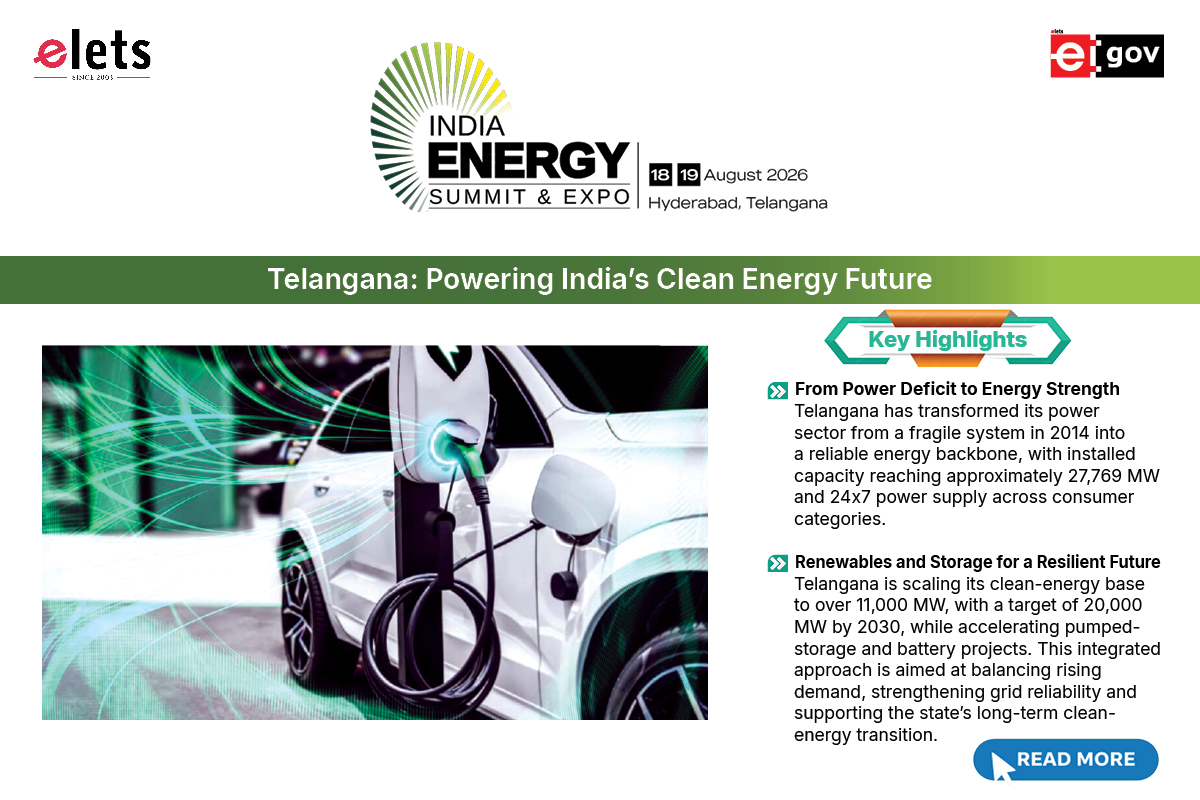
Eleven years after its formation, Telangana has turned electricity from a chronic constraint into a defining strength of its growth story. When the state was carved out in June 2014, it inherited a fragile power system. Long hours of load-shedding were common. The agrarian economy went without reliable irrigation supply. Installed capacity stood at barely over 18,000 MW, shared across a newly split grid.
Telangana’s installed power generation capacity has grown to approximately 27,769 MW. Its transmission backbone has been rebuilt almost from scratch. The state now provides continuous 24×7 three-phase power to every category of consumer: domestic, industrial and agricultural.

This cover story examines how Telangana built that capacity, from thermal mega-projects and a resilient grid to an accelerating renewable energy push, and what the road to 2047 looks like for a state betting its industrial future on power.
“Energy is the real currency of a modern economy.”

– A. Revanth Reddy, Chief Minister, Telangana
India’s Clean Energy Momentum
Telangana’s energy story unfolds against the backdrop of India’s own rapid clean energy transition. As of June 2026, India’s cumulative renewable energy capacity had reached approximately 288.58 GW. Total non-fossil fuel capacity, including nuclear, touched 297.36 GW, according to figures presented to Parliament by the Ministry of New and Renewable Energy. India crossed the milestone of 50 percent non-fossil cumulative installed capacity in June 2025, five years ahead of its Paris Agreement commitment, and now ranks third globally in renewable energy installed capacity.
Solar power leads the national mix at over 162 GW installed. The country added a record 55.29 GW of non-fossil capacity in FY 2025-26 alone, the highest annual addition in its history. India is targeting 500 GW of non-fossil capacity by 2030. Between FY2014 and FY2026, the renewable sector attracted USD 45.72 billion in FDI, alongside roughly Rs 12.32 lakh crore deployed by domestic financial institutions. Telangana sits within this national momentum not merely as a beneficiary but as an active contributor, through scale, policy innovation and industrial demand.
Generation: From Deficit to Surplus
Telangana’s generation story is anchored by the Yadadri Thermal Power Station, a five-unit, 4,000 MW ultra-mega project being built by TGGENCO at Veerlapalem in Nalgonda district. The project carries an estimated cost of Rs 30,000 crore and technical support from BHEL. Two 800 MW units, together 1,600 MW, have already been commissioned and dedicated to the nation. Bhatti Vikramarka has confirmed that monthly and weekly execution targets are being tracked to bring the remaining units online.
Alongside Yadadri, the NTPC-operated Telangana Super Thermal Power Project at Ramagundam has added further scale to the state’s coal-based capacity. Its first two 800 MW units were commissioned in 2023 and 2024, part of an eventual 4,000 MW plan.
Backing this thermal expansion is Singareni Collieries Company Limited, which has been steadily raising coal production, from 1.80 million tonnes per day toward a targeted 2.20 million tonnes per day, to ensure uninterrupted fuel supply to state thermal plants. SCCL is also diversifying into renewables, advancing a 500 MW wind farm project spread across five districts including Vikarabad and Adilabad.
Telangana’s total contracted generation capacity, spanning its own plants and long-term power purchase agreements, now stands at approximately 20,520 MW. Installed capacity within the state has crossed 27,769 MW. Peak power demand, the most direct indicator of economic momentum, has climbed sharply: from around 15,000 MW in 2023 to 18,548 MW in the summer of 2026. Officials are preparing for demand to exceed 19,000 MW in the upcoming Rabi and summer seasons. Over the past decade, electricity demand in the state has grown at a compound annual growth rate of nearly 9.77 percent, among the fastest in the country.
Transmission: A Grid Built for Reliability
“Electricity is the backbone of Telangana’s economic growth. Industries, services, AI, data infrastructure and modern agriculture all depend on reliable and affordable power.”
– Shri Mallu Bhatti Vikramarka, Hon’ble Deputy Chief Minister & Energy Minister, Government of Telangana
Behind this rising demand curve lies a transmission network that officials describe as setting the benchmark among Indian state utilities. Over the last eleven years, TGTRANSCO has expanded its 400 kV transmission lines from a modest 600 km to more than 7,070 km. Today the state’s grid includes 29 substations at 400 kV, 105 substations at 220 kV, and 254 substations at 132/33 kV, a network exceeding 5,000 circuit kilometres in total transmission line length.
Around 15 gas-insulated substations have been established, including a four-level voltage facility in the heart of Hyderabad that integrates 400 kV, 220 kV, 132 kV and 33 kV systems within a compact five-acre urban footprint. A triple-layered transmission ring has been built around Hyderabad to secure reliable power evacuation for the capital region. This infrastructure has enabled the state to absorb a record peak demand of 17,162 MW without disruption, and to integrate close to 6,000 MW of solar power into the grid, largely through load-side connections that required no additional transmission build-out. A further 2,469 MW of solar capacity is under construction.
To meet the anticipated 2026 surge, Southern Power Distribution Company is establishing 72 new substations and installing 8,384 new distribution transformers. Northern Power Distribution Company is adding 31 new substations and 5,280 transformers. Expansion of EHT/33/11 kV lines and power transformer capacities at 33/132/220/400 kV substations is underway across the state to reinforce grid resilience ahead of peak seasons.
Distribution: Reliability as a Welfare Commitment
Telangana’s distribution utilities have sustained one of the country’s most extensive welfare-linked power delivery models. The state continues to provide 24×7 free electricity to over 30 lakh agricultural pump-set connections, alongside 200 free units monthly for economically weaker households. Chief Minister Revanth Reddy has reaffirmed this commitment even as power consumption has risen from 15,000 MW to 18,000 MW on the back of expanding economic activity.
To strengthen transparency in power procurement for agriculture and irrigation, the government has proposed a dedicated Rythu Discom. It would draw on surplus renewable energy to serve farm-sector demand more efficiently, easing the financial burden on existing distribution utilities. For the past eight years, this combination of infrastructure investment and planning has ensured what officials describe as uninterrupted 24-hour power supply across consumer categories, a marked departure from the deficit conditions the state inherited at formation.
Renewable Energy: Scaling Toward 20 GW
Telangana’s renewable energy base has expanded substantially. The state’s installed clean energy capacity now comprises roughly 7,889 MW of solar power, 2,518 MW of hydropower, 771 MW of distributed renewable energy, and 221 MW from other renewable sources such as wind, bringing total renewable capacity to over 11,000 MW. Additional pumped storage projects are under active development. Other assessments place installed solar capacity above 4,800 MW and hydro capacity above 2,400 MW, reflecting the pace of continuous capacity addition across reporting periods.
The state’s renewable potential remains substantially untapped. Telangana is estimated to hold 20.41 GW of solar potential and up to 25 GW of wind potential at 120-metre hub height, according to Deputy CM Vikramarka. Under its Clean Energy 2025 policy, the government has set a target of 20,000 MW of renewable capacity by 2030, built on decentralised, distributed solar installations spread across more than 180 locations statewide. This is a deliberate departure from the concentrated solar-park model favoured elsewhere, undertaken to ease land acquisition and improve local grid integration. TGREDCO, the nodal agency for renewable programmes, continues to roll out rooftop solar tenders at scale, including a recent aggregated 46,705 kW rooftop solar programme covering nearly 9,937 government schools across all 33 districts.
Energy storage has become a parallel priority. The state has attracted major private investment in pumped storage hydropower. Sun Petrochemicals signed a Rs 45,500 crore MoU at the World Economic Forum in Davos to develop three pumped storage projects in Nagarkurnool, Mancherial and Mulugu districts, with a combined capacity of 3,400 MW. These will be complemented by downstream integrated solar plants of 5,440 MW capacity, expected to generate over 7,000 construction-phase jobs. Separately, Megha Engineering and Infrastructure Limited has committed to a 2,160 MW pumped storage project and a 1,000 MWh battery energy storage system under a broader Rs 13,000 crore investment package. TGGENCO is also progressing two hydro-irrigation projects on the Godavari river, the 240 MW Sammakka Sagar and 320 MW Sitamma Sagar, designed to combine power generation with irrigation stabilisation for over 1.78 lakh hectares of farmland.
Investment and Industrial Growth
Energy has become a magnet for capital in its own right. At the World Economic Forum in Davos in January 2025, Telangana signed a series of energy and industrial MoUs, including with Skyroot Aerospace for a Rs 500 crore private rocket manufacturing facility. This positions Hyderabad as an emerging space-technology hub powered by the state’s expanding grid. NTPC has separately committed roughly Rs 80,000 crore toward solar and wind projects in the state, part of a broader plan to develop up to 2.5 GW of wind capacity.
This investment momentum is closely tied to Telangana’s industrial and digital economy. The state was the first in India to launch a dedicated Data Centre Policy, offering land at subsidised cost and lease-rental subsidies, while committing to dual power grid networks to guarantee uninterrupted supply for power-intensive data infrastructure. Industries Minister D. Sridhar Babu has highlighted Hyderabad’s emergence as a fast-growing IT hub attracting global investment, with two additional IT parks planned in the city’s suburbs alongside HITEC City. Deputy CM Vikramarka has directly linked this industrial expansion, spanning AI infrastructure, electric vehicles, urbanisation and modern agriculture, to the state’s projection that peak power demand will double within the next decade.
The Road to 2047
Telangana’s energy planners are now working backward from 2047. Deputy Chief Minister Vikramarka has outlined a long-term roadmap projecting that the state will require over 1,39,310 MW of installed power capacity by 2047 to sustain a targeted 13 percent annual GSDP growth rate on the path to a $3 trillion economy. The plan assumes electricity consumption must rise at least 10 percent annually to match that ambition. Nearer term, the state’s own bottom-up estimates, factoring in urbanisation, data centres, EV adoption and irrigation needs, project demand growing at around 8.5 percent a year. That translates into a requirement of roughly 65,000 MW by 2035, figures officials say run ahead of Central Electricity Authority projections calibrated at the national level.
Meeting this trajectory will require addressing real infrastructure gaps candidly acknowledged by the government itself. Vikramarka has pointed to a current shortfall of nearly 780 MW in solar capacity and close to 4,000 MW in energy storage. He has cautioned that while thermal and wind sources can bridge demand through 2028, continued underinvestment in storage could widen the gap to 8,500 MW. This is why battery energy storage systems and pumped hydro storage have moved to the centre of state policy, both to firm up intermittent renewable generation and to ensure that low-cost solar power generated during the day is not wasted for want of storage. As Vikramarka put it, “cheaper solar power is wasted without storage,” a framing that has driven the state’s pursuit of the Sun Petrochemicals and MEIL storage investments.
Grid reliability, in this framing, is inseparable from economic security. Officials estimate that a major grid disruption could cost the state Rs 1,500 to 2,000 crore a day in economic activity, affecting hospitals, transport, telecom, defence establishments and data centres. This is why continued investment in transmission redundancy and substation capacity remains a policy priority even as generation and renewable targets dominate headlines.
Chief Minister Revanth Reddy has framed this energy transition in generational terms. Within the next five years, he has indicated, almost no industry or factory will remain within Hyderabad’s core urban area. Manufacturing will be relocated to peri-urban zones powered by renewable grids, a plan intended to improve urban air quality while meeting climate commitments. The state’s Renewable Purchase Obligation targets, mandated under the Ministry of Power’s September 2025 notification, add regulatory urgency to this shift. Non-compliance now attracts financial penalties, reinforcing the business case for faster renewable adoption across industry.
IRENA’s Renewable Energy Statistics 2026 places India third worldwide in installed renewable capacity, a national achievement to which Telangana has been a steady contributor through its solar, wind and hydro build-out. As the state pursues its 20 GW renewable target by 2030 and its 139 GW generation vision for 2047, the emerging model is one of parallel investment: thermal capacity to anchor baseload reliability, aggressive renewable and storage expansion to meet climate commitments and RPO obligations, and a modernised transmission-distribution backbone capable of absorbing both.
For a state that inherited a fragile grid in 2014, the arc of the last decade tells its own story. From 18,069 MW of installed capacity to a projected 139 GW ambition for 2047, the numbers reflect a working thesis articulated repeatedly by the state’s leadership: in Telangana’s growth story, power is not a support function. It is the foundation itself.
——————————————————
Written by: Abhineet Kumar | Elets News Network

Be a part of Elets Collaborative Initiatives. Join Us for Upcoming Events and explore business opportunities. Like us on Facebook , connect with us on LinkedIn and follow us on Twitter, Instagram.
"Exciting news! Elets technomedia is now on WhatsApp Channels Subscribe today by clicking the link and stay updated with the latest insights!" Click here!