 News
News




Article
Building the Hydrogen ECONOMY Global Lessons and India’s Advantage
Building the Hydrogen ECONOMY Global Lessons and India’s Advantage
![]() By
eletsnetzerofinal2025 14-August-2026
By
eletsnetzerofinal2025 14-August-2026


Over the past two days, discussions on energy transition have largely centred on green energy and, in particular, green hydrogen. Wind and solar can be regarded as the foundational pillars of the renewable ecosystem, technologies that have matured, scaled and paved the way for deeper decarbonisation. Building on that foundation, it is important to examine the international landscape of green hydrogen and assess India’s position within this rapidly evolving global framework.
Green hydrogen is no longer a distant or experimental concept. It has become a central pillar in global decarbonisation strategies, particularly in regions seeking to balance energy security, industrial competitiveness and climate commitments. Developments across Europe, North America and Asia highlight both lessons and opportunities for India.

The European Union’s Structured Green Hydrogen Strategy
The European Union formally articulated its hydrogen strategy in July 2020, marking a decisive shift towards establishing a green hydrogen economy across member states. The objective was clear: accelerate hydrogen production, develop supporting infrastructure and integrate hydrogen into Europe’s broader clean energy transition.

The EU approach rests on three principal pillars.
1. Investment and Funding Mechanisms
The EU has mobilised substantial financial resources through major funding instruments such as the EU Recovery Fund and Horizon Europe. These resources are directed towards infrastructure development, research institutions, pilot projects and innovation ecosystems. Universities, research centres and private enterprises operate within a coordinated framework to accelerate hydrogen-related advancements.
The focus extends beyond production technologies to system integration, storage, transportation and end-use applications. Institutions such as the Fraunhofer Society in Germany have committed significant financial and intellectual resources to advancing hydrogen technologies. Research programmes are structured with a long-term outlook, anticipating large-scale commercial viability.
2. Regulatory Framework and Cross-Border Cooperation
The EU has prioritised the creation of a supportive regulatory environment to enable cross-border hydrogen trade. Through harmonised standards and market mechanisms, Europe aims to build an integrated hydrogen market that enhances energy security and reduces dependence on external fossil fuel imports.
Cross-border infrastructure, including pipelines, refuelling stations and storage facilities, is being developed to facilitate seamless hydrogen transport. The European Clean Hydrogen Alliance plays a coordinating role in fostering collaboration among governments, industry and research institutions.
The broader strategic vision is twofold:
- Position Europe as a global leader in hydrogen research, development and innovation
- Collaborate with cost-effective production regions such as India to scale manufacturing and supply
Germany: Technology Leadership Over Manufacturing
Germany is among the most active EU member states in hydrogen development. Nearly every federal state has initiated green hydrogen programmes. Regions such as Lower Saxony and cities including Münster and Osnabrück have emerged as hubs for start-ups and research initiatives.
Also Read | “France Sees India as a Key Partner in Shaping the IMEC”
Germany’s strategy emphasises technological leadership rather than large-scale manufacturing. Given the high cost structure, cost-competitive mass production may not be viable domestically. Instead, priority is given to advanced electrolysers, storage technologies and system integration solutions.
Recent advancements in pump technologies integrated with electrolysers reflect this innovation-led approach. By focusing on intellectual property and engineering capability, Germany
seeks to export high-value technology while partnering with other regions for scaled production.
France, Spain And The Netherlands: Diversified Approaches
France has concentrated on industrial applications of green hydrogen, particularly for decarbonising heavy industries. Spain and the Netherlands, benefiting from abundant wind and solar resources, are investing significantly in hydrogen production linked to renewable expansion.
Southern Europe’s solar capacity and Northern Europe’s wind potential create favourable conditions for large-scale hydrogen deployment. This geographical advantage strengthens Europe’s ambition to build a competitive hydrogen ecosystem.
The Nordic Model: Innovation-Driven Ecosystems
Beyond central Europe, the Nordic region comprising Norway, Sweden, Denmark and Finland has become an active participant in hydrogen research and innovation. Agencies such as Innovation Norway and Innovation Finland provide funding to research institutes, start-ups and private entrepreneurs.
Despite relatively small populations, Nordic countries have demonstrated that targeted innovation policies and structured funding mechanisms can catalyse dynamic hydrogen ecosystems. Many emerging enterprises in the region are direct beneficiaries of public innovation grants.
Taken together, Western, Central and Nordic Europe currently represent one of the most comprehensive hydrogen development programmes globally, spanning research, pilot projects and infrastructure planning.
North America: Policy Uncertainty
North America, particularly the United States, has witnessed substantial hydrogen-related developments. However, political shifts and changing administrative priorities introduce uncertainty into long-term hydrogen policy direction. Federal support mechanisms and regulatory frameworks remain subject to variation, influencing investment trajectories.
Asia’s Emerging Hydrogen Ambitions
Asia is also investing heavily in hydrogen. Japan and South Korea have positioned hydrogen at the centre of their energy security strategies. In South Korea, specialised institutes, including those in Busan, are advancing research and international collaborations, including engagement with Indian institutions.
These developments underline hydrogen’s evolution into a truly global endeavour that transcends regional and geopolitical boundaries.
India’s Strategic Advantage
While Europe and parts of Asia lead in research and pilot-scale development, India possesses a structural advantage in large-scale manufacturing and cost-effective production.
India is:
- The third-largest renewable energy market globally
- Among the top four wind energy markets
- A country with substantial solar potential and expanding renewable infrastructure
In addition, India benefits from a large skilled workforce and comparatively lower production costs. These factors create the conditions for positioning the country as a global manufacturing hub for green hydrogen and associated technologies.
While Europe may lead in research and incubation, India has the potential to lead in scaled deployment and exports.
Offshore Wind: Opportunity And Constraints
For green hydrogen to scale effectively, renewable energy capacity must expand substantially. Offshore wind represents a promising avenue. However, practical challenges remain.
An offshore wind turbine rated at 8 to 10 megawatts may have blade lengths approaching 120 metres. Current constraints include limited domestic raw material availability, logistical and supply chain limitations for transporting oversized components, and port infrastructure readiness for offshore installations.
Even onshore wind presents transportation challenges. A 6-megawatt turbine with 92-metre blades requires specialised logistics infrastructure that is not yet uniformly developed across the country.
Ambitious offshore wind targets have been discussed for 2030, yet practical implementation will depend on addressing these structural constraints.
Renewable Targets And Realities
Under international commitments aligned with COP26, India has pledged to achieve 500 gigawatts of renewable energy capacity. Current wind capacity stands at approximately 48 gigawatts.
Achieving the remaining capacity within a compressed timeframe would require annual additions of 12 to 15 gigawatts of wind energy, presenting a significant challenge given supply chain and manufacturing limitations.
Solar energy, however, is expanding at a considerably faster rate. Rapid solar deployment can support large-scale electrolysis projects and accelerate green hydrogen production.
The Manufacturing Moment For India
The convergence of policy ambition, renewable expansion and rising global demand creates a strategic opportunity.
India’s advantages include:
- Cost-effective manufacturing ecosystems
- Strong domestic demand potential
- Expanding renewable capacity
Policy Initiatives Under The Ministry Of New And Renewable Energy
With stable policy frameworks and strengthened supply chains, India can transition from a renewable energy market to a global exporter of green hydrogen.
The Road To 2030 And Beyond
The coming years will be decisive. Europe is likely to continue leading in research and technological innovation. However, large-scale commercial success will depend on cost-effective production, an area where India is well-positioned.
By 2030, key structural developments are expected:
- Continued expansion of wind and solar capacity
- Growth in domestic hydrogen demand
- Development of export-oriented hydrogen corridors
- Strengthening of manufacturing and supply chains
The integration of renewable expansion with hydrogen production will shape India’s global standing.
Conclusion: India As A Global Hub
The hydrogen landscape is evolving rapidly. Europe leads in research and regulatory integration. Nordic countries demonstrate innovation-driven ecosystems. Asia is scaling investment. North America remains dynamic.
Within this global context, India holds a strategic opportunity. With policy alignment, infrastructure readiness and manufacturing scale-up, the country can emerge as a leading producer and exporter of green hydrogen.
The foundation in wind and solar capacity is already in place. The next phase involves translating technological collaboration into industrial leadership. By 2030, India has the potential to establish itself as a global hub for green hydrogen, contributing significantly to both national growth and the broader clean energy transition.
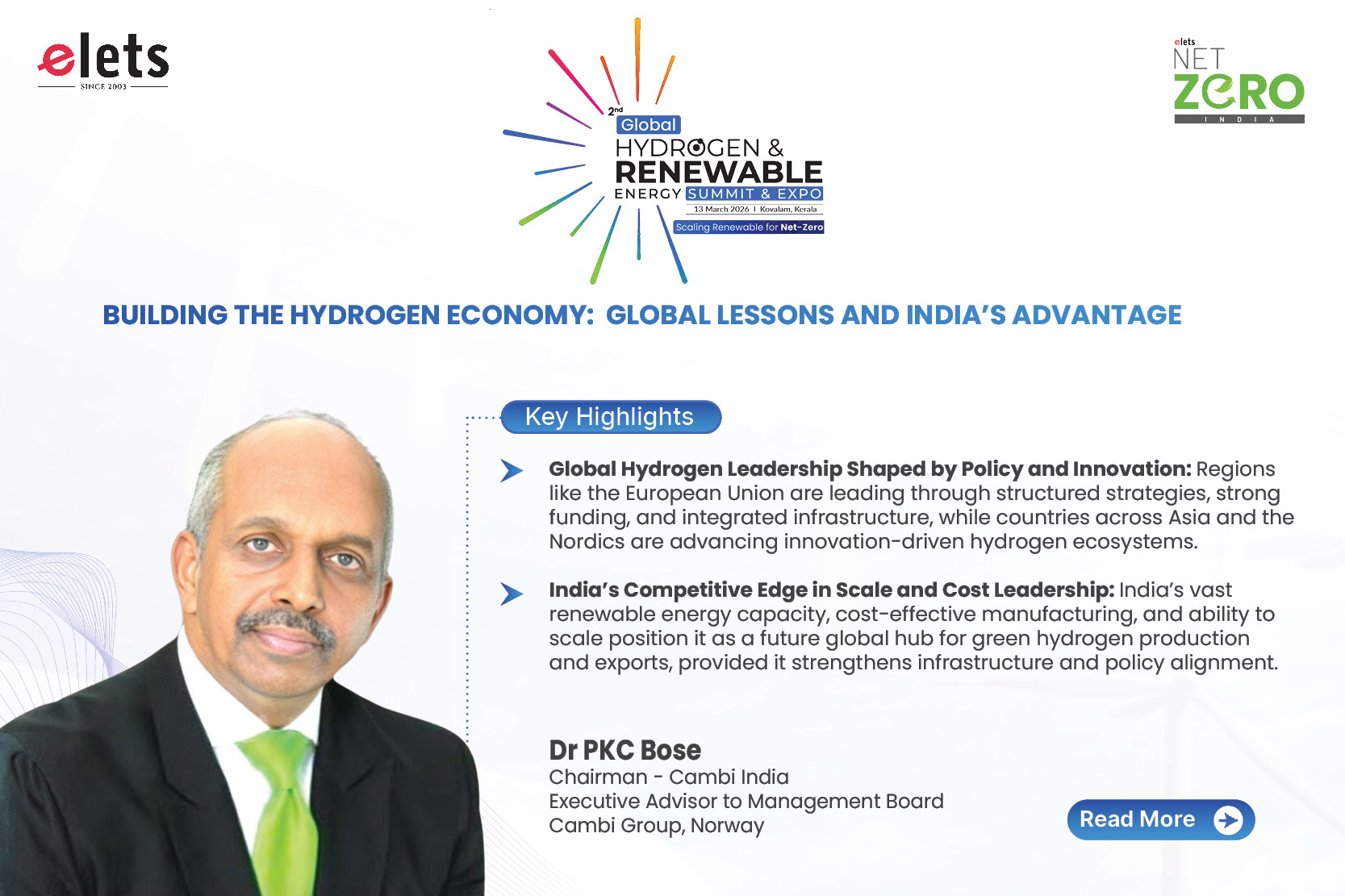
Insights shared by: Dr. PKC Bose, Chairman – Cambi India & Executive Advisor to Management Board, Cambi Group Norway, at the Global Hydrogen & Renewable Energy Summit 2025, held on 12 March, in Kochi, Kerala.

Be a part of Elets Collaborative Initiatives. Join Us for Upcoming Events and explore business opportunities. Like us on Facebook , connect with us on LinkedIn and follow us on Twitter, Instagram.
"Exciting news! Elets technomedia is now on WhatsApp Channels Subscribe today by clicking the link and stay updated with the latest insights!" Click here!