 News
News






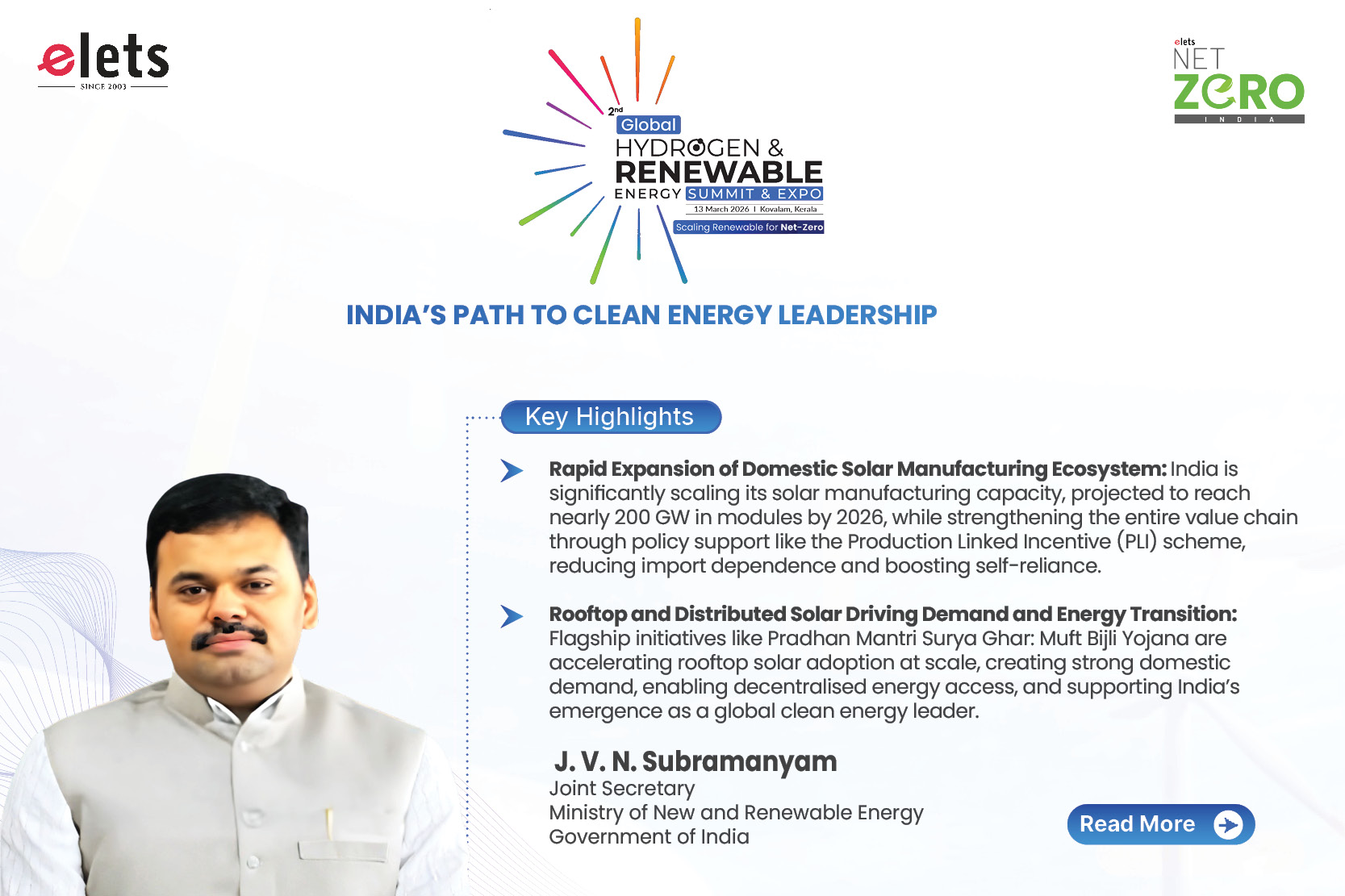
India’s renewable energy transition is gaining strong momentum, supported by policy reforms, expanding solar manufacturing, and ambitious national targets. J. V. N. Subramanyam, Joint Secretary, Ministry of New and Renewable Energy, Government of India, in an exclusive interview with Nijhum Rudra of Elets News Network, discusses India’s solar manufacturing growth, the impact of the Pradhan Mantri Surya Ghar: Muft Bijli Yojana, and emerging opportunities in rooftop and floating solar. Edited excerpts:
India has made significant progress in solar manufacturing in recent years. How do you see the sector evolving?

Over the past three to four years, and especially during the last two years, India has witnessed substantial progress in solar manufacturing. At present, the country has approximately 66 gigawatt of solar module manufacturing capacity and around
28 gigawatt of solar cell manufacturing capacity. Further expansion is already underway.
We expect that by the end of 2026, India will reach close to 200 gigawatt of solar module manufacturing capacity and around 40 to 45 gigawatt of solar cell manufacturing capacity. At the same time, significant efforts are being made to strengthen the upstream segments of the value chain, including ingot, wafer, and polysilicon manufacturing.

These components were included under the Production Linked Incentive scheme introduced a few years ago. The government is also working on specific interventions to support the development of polysilicon and ingot manufacturing so that specialised firms can enter the sector. The broader objective is to ensure that India becomes self-reliant across the entire solar manufacturing value chain.
In addition, the government has taken policy measures to support domestic manufacturing. For instance, the recent Union Budget exempted certain raw materials used in solar manufacturing, such as sodium antimonate and other components, from Basic Customs Duty. The aim is that by 2030, India should have a complete clean technology manufacturing value chain, with minimal dependence on imports.
The Pradhan Mantri Surya Ghar: Muft Bijli Yojana has received considerable attention. How is the scheme contributing to solar growth in India?
The Pradhan Mantri Surya Ghar: Muft Bijli Yojana is currently the largest rooftop solarisation program undertaken anywhere in the world. The scheme aims to provide rooftop solar systems to ten million households across the country.
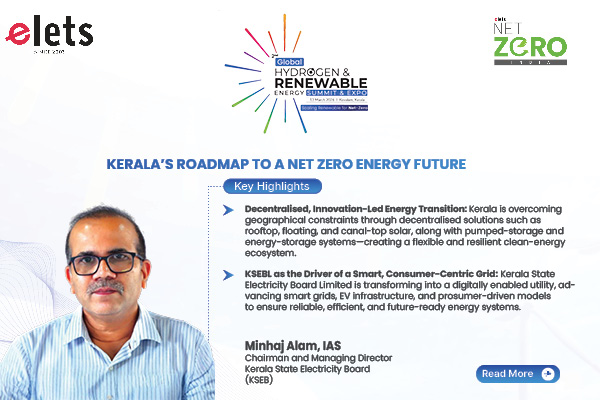
Also Read | Kerala’s Roadmap to a Net Zero Energy Future
What makes the initiative remarkable is both its scale and speed of implementation. Before the scheme was launched, India had installed approximately eight lakh rooftop solar systems over a period of nearly ten years. However, within just two years, the number of installations has reached about thirty-one lakh households.
The pace of implementation has also accelerated significantly. Initially, it took approximately one hundred and eighteen days to achieve the first five lakh installations. Today, installations are happening at a much faster rate, with around one lakh rooftop systems being installed every thirteen days.
Many states have contributed significantly to this progress, since the implementation of rooftop solar programs largely happens at the state level. While the progress has been encouraging, we are not satisfied yet. Our goal remains to ensure that ten million households across India benefit from rooftop solar systems, enabling them to generate their own clean energy.
Floating solar projects are also gaining attention. How is the ministry approaching this emerging segment?
Floating solar represents another important area of opportunity in India’s renewable energy transition. At present, the country has installed around seven hundred megawatt of floating solar capacity.
However, according to assessments by the National Institute of Solar Energy, India has a potential of nearly one hundred and eighty gigawatt in floating solar installations. When compared to this potential, the current capacity is still very limited.
As India continues to expand its renewable energy targets, land availability will increasingly become a constraint. While the country aims to achieve five hundred gigawatt of non fossil fuel capacity by 2030, long term projections aligned with the net zero pathway indicate that India could reach six thousand gigawatt of renewable energy capacity by 2070, with solar contributing more than four thousand gigawatt.
In such a scenario, floating solar projects can play a critical role. These installations can be developed on reservoirs, inland waterways, and even abandoned mining areas. We have already seen examples in places like Rajasthan where such opportunities exist.
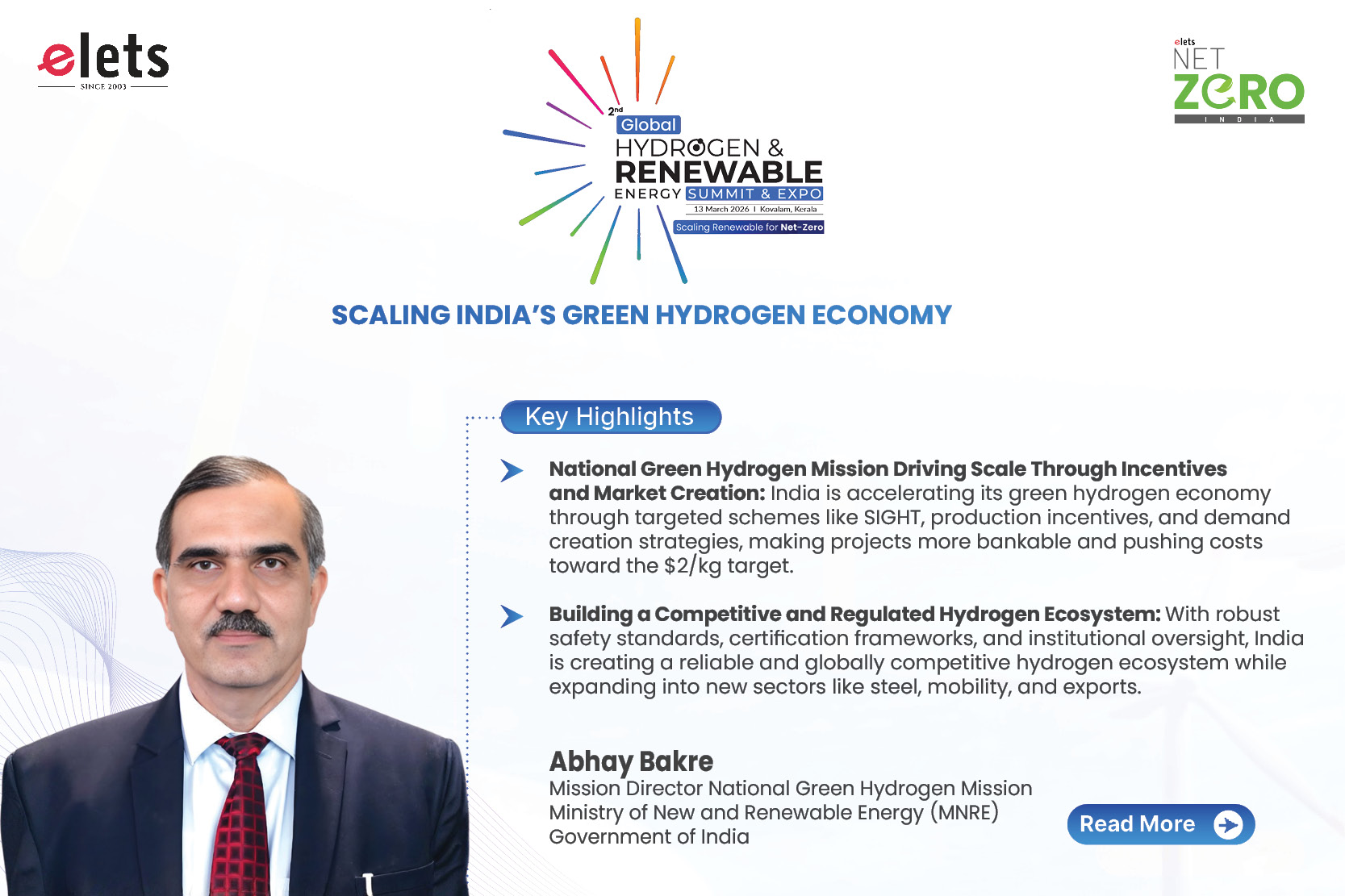
Also Read | Scaling India’s Green Hydrogen Economy
Public sector enterprises such as NHPC, along with state partners and private sector participants, will play an important role in implementing floating solar projects. The ministry is working on policy support and frameworks that can help accelerate the deployment of floating solar systems across the country.
What policy and regulatory measures are supporting India’s renewable energy manufacturing ecosystem?
India’s renewable energy progress has been driven by a combination of policy measures rather than a single intervention. Key initiatives include the Approved List of Models and Manufacturers, which promotes domestic manufacturing, as well as Basic Customs Duty measures that protect local industry. The Production Linked Incentive scheme has also played an important role in encouraging integrated solar manufacturing.
Beyond manufacturing support, the government has also focused on strengthening infrastructure. Programs such as the Green Energy Corridor are being implemented to enhance transmission capacity across renewable-rich states. This enables efficient evacuation of renewable power across the national grid.
At present, India’s total installed power capacity is around five hundred and twenty gigawatt, out of which nearly one hundred and forty gigawatt comes from solar energy. Of this solar capacity, approximately thirty-five to forty gigawatt is generated from distributed sources.
Going forward, distributed renewable energy will continue to grow rapidly. Government programs such as PM Kusum, which is one of the largest solar pump initiatives in the world, along with rooftop solar schemes and increasing participation from the commercial and industrial sector, are expected to accelerate this growth.
Ultimately, the renewable energy transition in India is being driven by a partnership between the government, the private sector, and empowered consumers. This collaborative model will play a crucial role in achieving the country’s renewable energy targets of five hundred gigawatt and beyond.
Kerala has been actively promoting distributed renewable energy. How do you view the state’s progress?
Kerala has demonstrated impressive progress in the deployment of distributed renewable energy, particularly in rooftop solar installations. Despite being a relatively small state with high population density, Kerala has consistently ranked among the top states in rooftop solar adoption, often securing fourth or fifth position nationally.
This achievement reflects the strong commitment of the state government and the effective role played by implementing agencies such as ANERT and the Kerala State Electricity Board. Their coordinated efforts have ensured that renewable energy solutions reach households at the grassroots level.
The regulatory framework and institutional support in Kerala have also contributed significantly to this success. It is encouraging to see how the state has been able to expand renewable energy access and bring clean energy directly to consumers.
What role do knowledge platforms and industry forums play in strengthening the renewable energy ecosystem?
Knowledge platforms and industry forums play an important role in highlighting best practices and sharing insights from different states and sectors. Analytical reports and publications that examine developments in renewable energy can provide valuable perspectives for policymakers, industry leaders, and stakeholders.
By documenting successful initiatives and innovations, such platforms help facilitate collaboration and knowledge exchange. Highlighting best practices across states can also inspire further progress and strengthen the overall renewable energy ecosystem in the country.
We must move from reliance to self-reliance, from consumption to creation. Technology, appropriate business models, transparent policies, and active public participation will collectively determine our success. I am convinced that if we sustain this integrated and inclusive approach, Kerala can emerge as a global model for clean energy transformation.
Our journey is ambitious, but it is achievable. With collaboration, innovation, and commitment, we can build a cleaner, greener, and energy-secure future—not only for Kerala, but as an example for the world.

Be a part of Elets Collaborative Initiatives. Join Us for Upcoming Events and explore business opportunities. Like us on Facebook , connect with us on LinkedIn and follow us on Twitter, Instagram.
"Exciting news! Elets technomedia is now on WhatsApp Channels Subscribe today by clicking the link and stay updated with the latest insights!" Click here!