 News





News
Beyond LPG: Why India Must Electrify Its Kitchens and Industries
Beyond LPG: Why India Must Electrify Its Kitchens and Industries
![]() By
Samuel Raj 02-November-2026


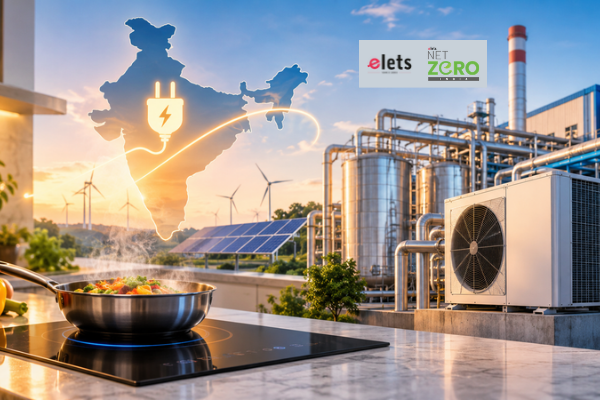
In March, when shipping through the Strait of Hormuz came to a standstill, Indian households found themselves lining up for cooking gas, while induction cooktops vanished from shelves in numerous markets nationwide. With India relying on imports for approximately 60% of its LPG, and nearly 90% of those deliveries traversing the strait, it became evident that a distant conflict had repercussions on our kitchens and manufacturing sectors within just a few weeks.
Electricity presents a viable solution to mitigate that vulnerability. The NITI Aayog’s report, Scenarios Towards Viksit Bharat and Net Zero, outlines the magnitude of the upcoming transition. In its vision for a net-zero future, the contribution of electricity to final energy is projected to surge from 21 % in 2025 to an impressive 60 % by 2070, while the fuel import expenditure is expected to plummet from around 4 percent of GDP to a mere 0.2 percent. This positions electrification as a pivotal element of both economic resilience and national security. India boasts a robust clean energy foundation: by 2025, it emerged as the fourth-largest global producer of clean electricity. However, the manner in which we pursue electrification is just as crucial as the decision to embark on it.

Programs spearheaded by the Bureau of Energy Efficiency (BEE) achieved remarkable savings of 53.6 million tonnes of oil equivalent in 2023-24. This same level of commitment and rigour should now steer our electrification efforts. A couple of key areas to focus on are industrial heating processes and kitchen electrification.
Manufacturing facilities account for nearly half of India’s total energy consumption, primarily sourced from on-site combustion of coal, oil, and gas. In contrast, electricity fulfils only about 25% of the energy requirements for Indian industries, while in China, this figure is close to 50%. Bridging this gap could significantly reduce India’s fuel imports, facilitate the decarbonisation of industries, and assist exporters in complying with carbon border regulations like the EU’s CBAM.

When it comes to industrial heat, there’s a tremendous opportunity for improvement, and heat pumps are the ideal solution. Operating similarly to an air conditioner in reverse, a heat pump extracts heat from air, water, or waste streams and transfers it to where it’s needed. In the Indian context, air-source heat pumps can provide 2.5 to 4 units of heat for every unit of electricity consumed, whereas an electric boiler can only deliver one unit at most. Replacing a coal boiler with an electric one increases the grid’s heat demand, but a heat pump can satisfy the same requirement using significantly less electricity.
Nearly 50% of the thermal energy utilised by Indian MSMEs is required at temperatures below 250°C, primarily for applications such as steam generation, hot water production, washing, and drying. A significant portion of this demand falls within the operational capacity of heat pumps. Industries like dairies, food processing, textiles, pharmaceuticals, hospitality, and healthcare rely heavily on this energy, which is predominantly sourced from coal, diesel, or gas boilers.
The same principle applies in kitchens. Induction cooktops are highly efficient, transferring most of their energy directly to the cookware, whereas gas flames waste a considerable amount of energy to the surrounding environment. The potential for transition is substantial, as surveys indicate that merely 4% of households currently possess an induction cooktop.
The market faces three significant hurdles: cost, confidence, and supply. Heat pumps are pricier than traditional boilers, and the return on investment is slow, especially with high industrial electricity rates and low fuel prices. Consumers struggle to assess the potential savings. Alarmingly, almost 90% of heat pumps in India are imported from China, making the market vulnerable to supply disruptions that electrification aims to mitigate.
The first challenge to tackle is confidence. Currently, manufacturers provide efficiency ratings based on American, European, or Chinese testing standards. This creates confusion for buyers, as they cannot effectively compare these claims due to differing international benchmarks. However, India has successfully navigated similar challenges in the past. The Bureau of Energy Efficiency (BEE) established a trusted star labelling system that consumers recognise. To foster trust in heat pumps, we need standards tailored to Indian conditions, clear minimum performance criteria, BIS certification, and a star label that enables consumers to compare products and their claims. Efforts are already in progress to achieve this.
In light of the LPG shortage, the government has postponed the implementation of mandatory star labelling for induction cooktops until January 2027 to ensure a steady supply. It is crucial to establish standards before demand spikes again, preventing a frantic buying spree that could lead to homes and factories being filled with inferior products. The benefits of this approach would be significant and energy-efficient: reduced reliance on imported fuel, decreased energy costs for MSMEs, minimised need for new generation capacity, and the development of a robust domestic manufacturing sector for a burgeoning global market.

Be a part of Elets Collaborative Initiatives. Join Us for Upcoming Events and explore business opportunities. Like us on Facebook , connect with us on LinkedIn and follow us on Twitter, Instagram.
"Exciting news! Elets technomedia is now on WhatsApp Channels Subscribe today by clicking the link and stay updated with the latest insights!" Click here!