 News




Article
Transmission Grid & Network Modernisation Building Telangana’s Grid for Renewable Integration and Rising Demand
Transmission Grid & Network Modernisation Building Telangana’s Grid for Renewable Integration and Rising Demand
![]() By
Samuel Raj 19-October-2026


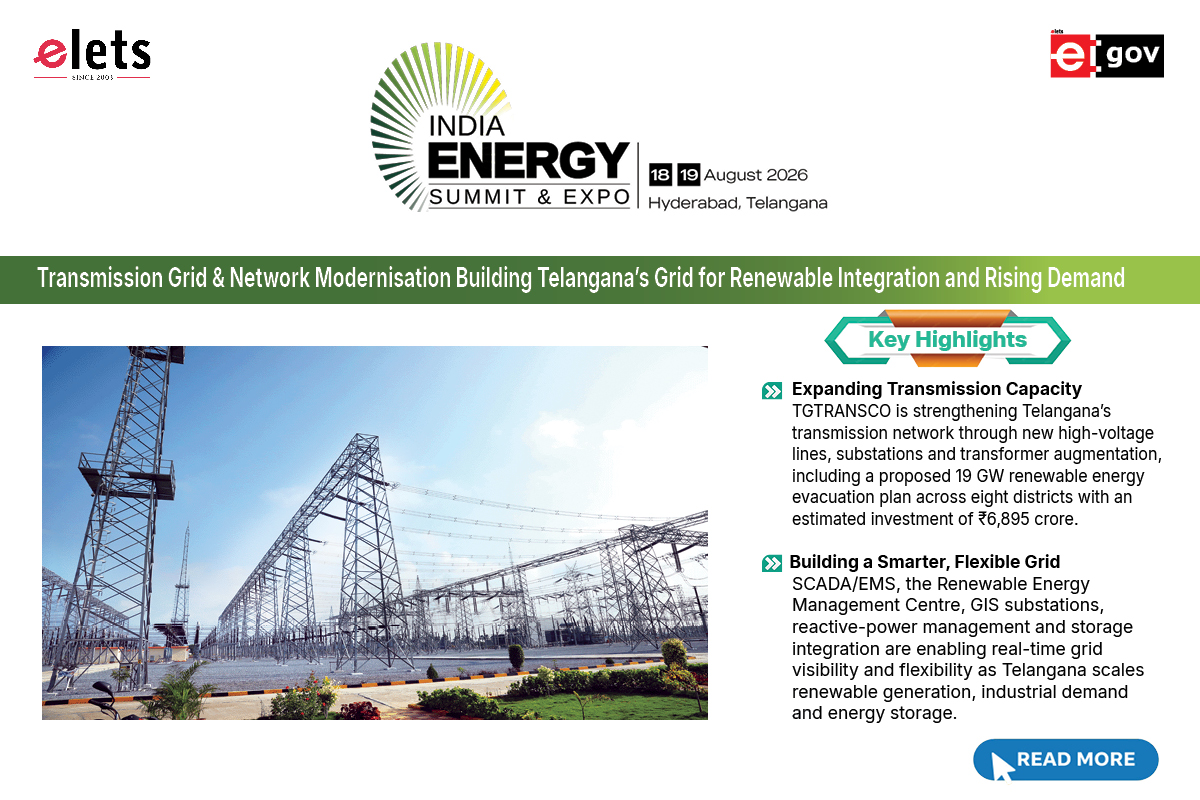
Telangana’s electricity system is entering a phase in which transmission infrastructure is becoming as important as generation capacity. Rapid growth in renewable energy, rising industrial and urban demand, the emergence of storage projects and increasing digitalisation of grid operations are changing the requirements of the State’s transmission network. The Transmission Corporation of Telangana Limited (TGTRANSCO), as the State Transmission Utility, is therefore moving towards a grid that is not only larger, but also more flexible, observable and capable of integrating variable renewable generation.
The scale of the existing network provides the starting point. As of March 31, 2024, Telangana’s transmission system comprised 33 substations at 400 kV, including PGCIL substations, 103 substations at 220 kV and 252 substations at 132 kV. The State had 28,445 circuit km of extra-high-voltage transmission lines and a total transmission capacity of about 409,782 MVA.
The network now has to accommodate a substantially more complex electricity system. Solar generation varies through the day, storage can alter the timing of power flows, and new industrial loads can create concentrated demand at specific locations. Telangana’s transmission planning is consequently shifting from conventional capacity expansion towards a combination of network strengthening, renewable evacuation, digital monitoring, reactive-power management and flexible grid operation.
A Transmission Network Under Expansion
TGTRANSCO’s approved resource planning for the fifth control period, covering FY2024-25 to FY2028-29, provides a clear indication of the scale of investment required. The plan envisages one new 400 kV, 12 new 220 kV and 35 new 132 kV substations during the period. It also includes 449 circuit km of 220 kV lines and 1,614.23 circuit km of 132 kV lines, along with transformer augmentation and additional reactive-power compensation.

The plan also provides for substantial transformation-capacity additions. Across the five-year period, new substations are planned to add 1,320 MVA at 400 kV, 2,482 MVA at 220 kV and 2,939.5 MVA at 132 kV. Existing substations are also scheduled for transformer augmentation, including 1,930 MVA at 220 kV and 2,403 MVA at 132 kV.
The investment is being directed towards both system expansion and system improvement. One example is the planned 400/220 kV Integrated Steel Plant substation in Khammam district, with a proposed capacity of 2×500 MVA. A 400 kV line connecting the Julurupadu substation to the proposed steel-plant substation is also part of the plan.
Such projects demonstrate how transmission planning is increasingly being linked to the location of new industrial loads. A transmission network cannot simply follow demand after it emerges; it must anticipate major loads and establish adequate capacity in advance.
Preparing the Grid for Renewable Power
Renewable integration is perhaps the most significant change influencing Telangana’s transmission planning. Solar and wind generation can be located far from major consumption centres, while their output varies according to weather conditions. Transmission infrastructure must therefore perform two functions simultaneously: evacuate electricity from renewable-rich areas and maintain grid stability when renewable output changes.
The Green Energy Corridor (GEC) framework was created precisely to address this challenge. The Ministry of New and Renewable Energy explains that the programme was conceived after studies found inadequate transmission infrastructure near potential large-scale renewable generation sites. The broader GEC framework includes both intra-state and inter-state transmission systems, along with Renewable Energy Management Centres and supporting grid infrastructure.
Telangana’s next major requirement is reflected in its proposed Green Energy Corridor Phase-III transmission plan. In August 2025, the State sought central approval for proposals prepared by TGTRANSCO to evacuate 19 GW of renewable energy across eight districts, at an estimated project cost of ₹6,895 crore. The renewable energy zones had initially been identified at 13.5 GW across five districts and were subsequently expanded to 19 GW after consultations involving SECI and TGREDCO and assessment of land availability and renewable potential.
The proposal is particularly significant because the planned renewable zones are expected to accommodate a combination of solar, wind and pumped-storage projects. This means the transmission network will increasingly have to manage not only conventional generation and solar injection, but also two-way and time-shifted flows associated with storage.
It is important to distinguish this proposed Telangana GEC-III programme from the Centre’s currently notified Intra-State GEC Phase-II scheme, which covers seven other States. Telangana’s 19 GW proposal is therefore best described as the State’s proposed GEC-III transmission programme rather than as part of the existing GEC-II scheme.
From Conventional Substations to Digital Grid Infrastructure
Physical infrastructure alone cannot provide the level of control required by a modern electricity system. As the number of generation sources and the variability of power flows increase, grid operators need continuous visibility of network conditions.
TGTRANSCO’s existing SCADA/EMS infrastructure at the State Load Despatch Centre in Hyderabad provides this digital layer. The system was upgraded with GE technology in 2015 and includes seven Data Concentrator Cum Protocol Converter (DCPC) stations located at Mamidipally, Ramagundam, Warangal, Veltoor, Shankarpally, Nagarjunsagar and Malkaram. These stations receive data from remote terminal units and transmit real-time information to the SLDC through fibre-optic and other communication networks.
SCADA is important because it allows operators to observe and control grid assets without relying exclusively on field intervention. Real-time information on voltage, loading, switching status and other parameters can support quicker operational decisions, particularly during disturbances or periods of rapidly changing renewable generation.
TGTRANSCO’s transmission plan also includes GIS substations and XLPE cable systems in the twin cities, reflecting the specific requirements of densely built urban areas. Its FY2025-26 plan proposed 577 circuit km of 400 kV lines, 1,006 circuit km of 220 kV lines and 871.87 circuit km of 132 kV lines, along with seven 400 kV, eight 220 kV and 22 132 kV substations.
The combination of GIS, underground or high-capacity cable systems, SCADA and automated monitoring is particularly relevant to Hyderabad, where land availability, right-of-way constraints and high load density make conventional network expansion more difficult.
The Renewable Energy Management Centre
Another important component of Telangana’s digital grid architecture is the Renewable Energy Management Centre (REMC).
The Ministry of Power sanctioned the establishment of an REMC in Telangana in December 2019 as part of the Green Energy Corridor programme. The system is designed to support forecasting and scheduling of renewable generation, real-time tracking and coordination with the State Load Despatch Centre. The Centre is also intended to integrate with SCADA systems so that renewable generation can be managed as part of overall grid operations.
The project was taken over by TGTRANSCO on January 18, 2024, following physical completion. Telangana’s SLDC filing records the project as having been implemented by Power Grid Corporation of India Limited, with forecasting and weather services forming part of the operational support arrangement.
For a State with rapidly increasing solar generation, this capability has practical importance. Accurate forecasts allow system operators to anticipate changes in renewable output and plan conventional generation, reserves, storage and power flows accordingly.
Storage Changes the Role of the Grid
Energy storage introduces another layer of complexity. Unlike conventional generation, a battery can operate as both a consumer and a source of electricity. Pumped-storage facilities similarly absorb electricity when energy is available and generate when demand or system requirements increase.
This makes transmission planning increasingly connected with storage planning. A renewable project may require evacuation capacity during periods of high generation, while a storage facility can alter when that power enters the grid.
Telangana’s proposed GEC-III renewable zones include pumped-storage projects, making storage evacuation an integral part of the proposed transmission architecture. At the same time, TGTRANSCO’s resource plan includes additional reactive-power compensation, with 230 MVAR of reactors/capacitors planned across the 132 kV and 220 kV systems during FY2024-25 to FY2028-29.
Reactive-power management is particularly important as the grid expands and power flows become more dynamic. Maintaining appropriate voltage levels is essential for both reliability and efficient transmission.
Inter-State Connectivity and Grid Flexibility
Telangana’s transmission network does not operate in isolation. Its connection with the wider Southern Region allows electricity to move across State boundaries and provides access to power from generation sources outside Telangana when required.
At the national level, transmission expansion has significantly increased inter-regional transfer capability. The Ministry of Power reported inter-regional transmission capacity of 1,18,740 MW as of April 2025, alongside a national transmission network of about 4,94,732 circuit km and 13,50,953 MVA of transformation capacity.
For Telangana, stronger inter-state connectivity provides an additional layer of system flexibility. It can support power exchanges between regions, improve utilisation of generation assets and help manage variations in renewable output.
The value of such connectivity becomes greater as the State’s own renewable capacity expands. A robust transmission system can move surplus renewable electricity to demand centres while enabling the system to draw power from other sources when renewable generation falls.
The Road Ahead
The next phase of Telangana’s transmission development will be shaped by three interconnected requirements: capacity, flexibility and visibility.
Capacity will come from new high-voltage lines, substations and transformer augmentation. Flexibility will increasingly depend on storage, reactive-power management and stronger interconnections. Visibility will come from SCADA, REMC, forecasting systems and increasingly digital substations.
The scale of planned investment indicates that Telangana is preparing for this transition. The five-year resource plan already provides for dozens of new substations and more than 2,000 circuit km of 220 kV and 132 kV lines, while the proposed GEC-III programme seeks to create evacuation infrastructure for 19 GW of renewable capacity.
The challenge now is execution. Transmission projects involve land acquisition, right-of-way, equipment procurement, environmental clearances, coordination with generation developers and synchronisation with demand growth. Delays can create bottlenecks even when generation capacity is available.
Telangana’s transmission strategy is therefore moving towards a more integrated model in which generation planning, renewable zones, storage, industrial demand and digital grid management are considered together. TGTRANSCO’s task is not simply to build more lines, but to create a network capable of handling a more diverse and dynamic power system.
As Telangana expands renewable generation and prepares for higher electricity demand, the strength of its transmission grid will determine how effectively that capacity can reach consumers. The emerging combination of high-voltage corridors, renewable evacuation infrastructure, digital monitoring, forecasting, storage integration and stronger substations provides the foundation for a more resilient State grid. The next test will be turning these plans into operational assets at the pace required by Telangana’s changing energy landscape.

Be a part of Elets Collaborative Initiatives. Join Us for Upcoming Events and explore business opportunities. Like us on Facebook , connect with us on LinkedIn and follow us on Twitter, Instagram.
"Exciting news! Elets technomedia is now on WhatsApp Channels Subscribe today by clicking the link and stay updated with the latest insights!" Click here!