 News




Article
Singareni Collieries Company Limited (SCCL) From Coal Producer to Energy Enterprise
Singareni Collieries Company Limited (SCCL) From Coal Producer to Energy Enterprise
![]() By
Samuel Raj 22-October-2026


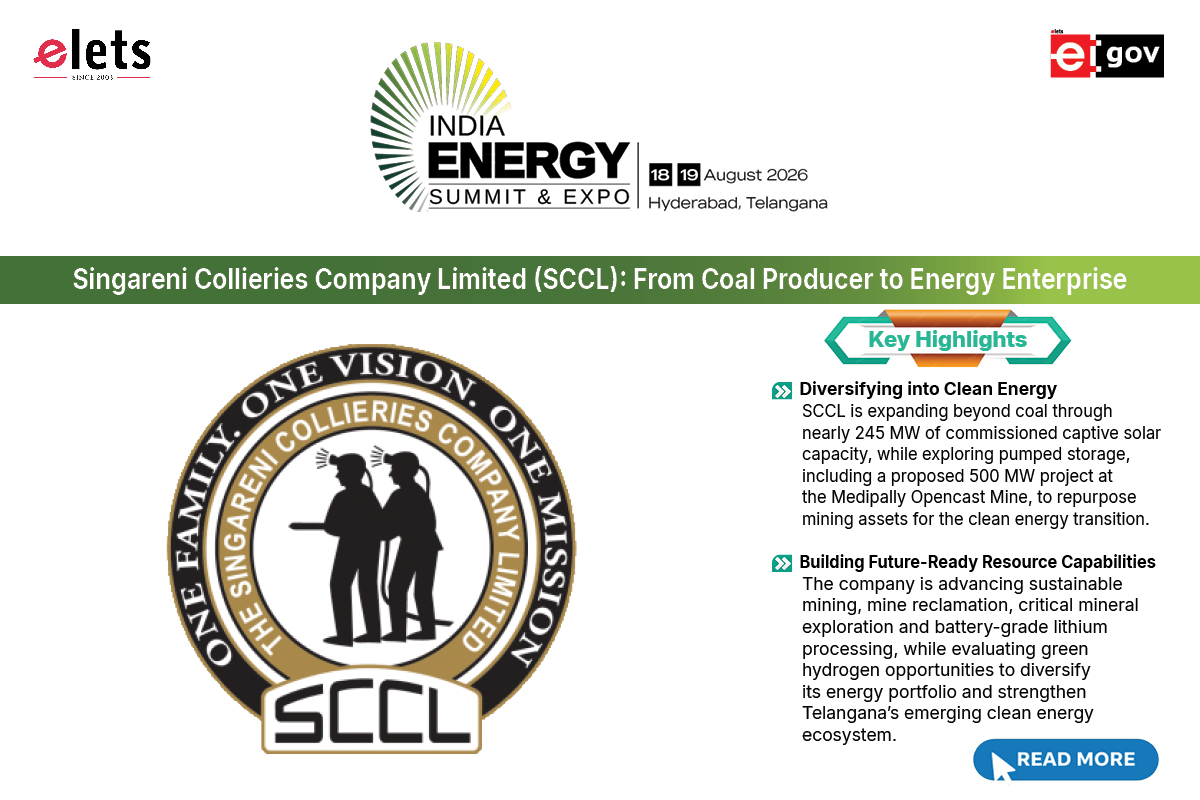
For more than 135 years, Singareni Collieries Company Limited (SCCL) has been an important part of Telangana’s industrial and economic growth. From fuelling thermal power plants and supporting manufacturing industries to employing mining regions, the public sector enterprise has played a defining role in the state’s growth story. Jointly owned by the Government of Telangana (51 %) and the Government of India (49 %), SCCL today operates dozens of underground and opencast mines across the state and remains one of India’s largest coal producers.
But the energy sector is entering a new phase. India’s commitment to achieving net-zero emissions by 2070, rapid growth in renewable energy, the increasing need for energy storage and the global demand for critical minerals are reshaping how energy companies plan for the future. Coal will continue to remain important for India’s energy security, yet companies that depend solely on conventional mining will eventually face new economic and environmental challenges.

Recognising this shift, SCCL has begun redefining its role. Rather than moving away from coal overnight, the company is gradually expanding into renewable energy, energy storage, sustainable mining, mineral exploration and cleaner technologies. This balanced approach reflects Telangana’s broader vision of ensuring energy security while preparing for a low-carbon future. If sustained over the coming years, SCCL’s transformation could become one of the most significant examples of how a traditional public sector mining company can evolve into a diversified energy enterprise.
More Than a Coal Company
Despite the rapid expansion of renewable energy, coal continues to generate nearly 3/4th of India’s electricity. Industries such as steel, cement and manufacturing also rely heavily on a stable supply of domestic coal. For Telangana, SCCL remains a strategic asset, supplying fuel to thermal power stations that support both industrial activity and household electricity demand.

However, the long-term direction of the energy sector is changing. Renewable energy costs continue to decline, investors increasingly prioritise environmentally responsible businesses and governments are introducing policies aimed at reducing emissions without compromising energy security.
For SCCL, diversification is therefore not about replacing coal; it is about reducing future business risks. The company understands that while coal will remain relevant for decades, future growth opportunities will increasingly come from renewable power, energy storage, sustainable resource management and new mineral value chains.
Solar Parks: Transforming Mining Land into Renewable Assets
One of the clearest signs of SCCL’s transition is its growing investment in solar energy. The company has already commissioned nearly 245 MW of solar power capacity for captive use and is adding several hundred megawatts more as part of its renewable energy expansion plans.
Unlike many renewable developers that require large tracts of new land, SCCL possesses a unique advantage. Vast areas associated with mining operations, including reclaimed land, unused company property and non-operational sites, can be converted into solar parks without affecting agriculture or urban development.
This creates multiple benefits simultaneously. Solar power reduces electricity costs for mining operations, lowers dependence on grid power and helps reduce operational carbon emissions. More importantly, it demonstrates how land that once supported fossil fuel extraction can continue contributing to India’s energy future in an entirely different way.
For Telangana, where renewable energy capacity continues to expand rapidly, SCCL’s solar projects complement the state’s broader clean energy ambitions while making productive use of existing assets.
Pumped Storage and Former Mine Sites
As solar and other variable renewable sources expand, energy storage will become increasingly important. SCCL is exploring the possibility of using exhausted mine pits for pumped-storage development.
The proposed 500 MW pumped storage project at the Medipally Opencast Mine in the Ramagundam region represents an example of how former mining assets could be repurposed for the State’s emerging energy infrastructure.
Pumped storage works by using electricity during periods of surplus generation to move water to an elevated reservoir. When electricity demand rises, the stored water is released through turbines to generate power.
Repurposing exhausted mine sites in this manner could give previously productive mining assets a new economic function. It also offers a potential link between SCCL’s existing land resources and Telangana’s growing requirement for flexible energy storage.
Making Mining More Sustainable
Coal mining will continue to remain an important part of SCCL’s operations. This makes improvements in mining efficiency and environmental management particularly important.
The company has adopted mechanisation, improved mine planning and digital monitoring systems across its operations. Environmental management measures include dust suppression, plantation programmes and monitoring of mining impacts.
Water management is another important area. Treated mine water can be used for industrial and community requirements, reducing dependence on freshwater sources in mining regions.
Such measures are increasingly important as mining operations are assessed not only by production volumes but also by their impact on land, water and surrounding communities.
Giving Mining Land a New Purpose
Mine closure is becoming an important component of SCCL’s long-term planning. Once coal reserves are exhausted, the future use of mining land can determine whether these areas remain environmental liabilities or become productive assets.
Progressive reclamation, backfilling, slope stabilisation, plantation and ecological restoration can help prepare former mining areas for subsequent uses.
Depending on site conditions, reclaimed land could support:
- Renewable energy projects
- Water conservation infrastructure
- Forestry and ecological restoration
- Industrial and logistics facilities
- Community development
Such an approach can extend the economic and social value of mining regions beyond the productive life of individual mines.
Preparing for the Next Mining Economy
The global shift towards electric mobility, battery manufacturing and renewable energy has significantly increased demand for critical minerals such as lithium, copper, cobalt and rare earth elements.
Recognising this opportunity, SCCL has begun expanding its expertise beyond coal mining. The company has secured exploration opportunities for gold and copper resources and is actively evaluating prospects in the critical minerals sector.
One of its most significant initiatives is its partnership to establish a battery-grade lithium refinery in Telangana. While India currently imports most processed lithium materials, such projects can strengthen domestic supply chains for electric vehicles and energy storage systems.
For SCCL, entering the critical minerals segment represents a logical extension of its mining expertise. Rather than depending entirely on thermal coal, the company is positioning itself to participate in the resource economy that will support the next generation of clean technologies.
Green Hydrogen: A Long-Term Opportunity
Although still at an early stage in India, green hydrogen is expected to become an important fuel for industries such as steel, fertilisers, chemicals and heavy transport.
SCCL may not yet be producing green hydrogen commercially, but several of its existing strengths could support future participation. Large land holdings, expanding solar capacity, industrial infrastructure and engineering capabilities provide a strong foundation for developing integrated renewable energy projects.
As renewable electricity generation grows, surplus solar power from company-owned projects could eventually support hydrogen production through electrolysis. While this remains a long-term opportunity, it demonstrates how SCCL’s investments today can create flexibility for tomorrow’s energy economy.
Reducing Carbon While Strengthening Energy Security
For a coal company, carbon reduction does not simply mean producing less coal. It also means making operations cleaner, improving efficiency, and investing in low-carbon technologies alongside conventional businesses.
SCCL’s transition strategy already incorporates several initiatives aimed at lowering its environmental footprint:
- Expansion of captive solar power generation
- Development of pumped storage projects
- Improved energy efficiency across mining operations
- Scientific land reclamation and afforestation
- Better water management and recycling
- Exploration of future clean energy technologies
Collectively, these initiatives help reduce operational emissions while maintaining the reliable coal production that India’s power sector continues to require.
A Diversification Strategy Built for the Future
Unlike some international mining companies that are rapidly moving away from fossil fuels, SCCL is pursuing a more balanced transition. Coal will continue to support India’s electricity needs for the foreseeable future, but the company is simultaneously building capabilities in renewable energy, energy storage, sustainable mining and strategic minerals.
This diversified model reduces dependence on a single business while creating new revenue opportunities. It also enables SCCL to make productive use of its engineering expertise, skilled workforce and extensive land resources.
For Telangana, the benefits extend beyond the company itself. New investments in clean energy and mineral processing have the potential to create employment, attract industries and strengthen the state’s position as an emerging energy and manufacturing hub.
From Coal Producer to Integrated Energy Enterprise
SCCL’s evolution is significant for Telangana because the company possesses a combination of land resources, mining expertise, industrial infrastructure and an established workforce that can support diversification into emerging areas of the energy economy.
The company’s investments in solar power, exploration of pumped storage, mine reclamation and interest in mineral value chains indicate a gradual broadening of its traditional role.
The transition will require careful project selection, technological expertise, investment and strong environmental management. It will also require clear differentiation between projects that are operational, those under development and those that remain exploratory.
For Telangana, SCCL’s next phase could therefore extend beyond coal production towards a more diversified energy and natural-resource enterprise. Its ability to repurpose mining assets, develop renewable capacity and explore new mineral opportunities could help create additional economic value while supporting the State’s changing energy requirements.
—————————————————————————————————————————
Written by: Sahaj Anand | Elets News Network (ENN)

Be a part of Elets Collaborative Initiatives. Join Us for Upcoming Events and explore business opportunities. Like us on Facebook , connect with us on LinkedIn and follow us on Twitter, Instagram.
"Exciting news! Elets technomedia is now on WhatsApp Channels Subscribe today by clicking the link and stay updated with the latest insights!" Click here!