 News




Article
Telangana’s Energy Vision 2047: Building an Intelligent, Renewable-Powered Future Through AI
Telangana’s Energy Vision 2047: Building an Intelligent, Renewable-Powered Future Through AI
![]() By
Samuel Raj 27-November-2026


India’s energy transition is entering a phase in which the challenge extends beyond expanding renewable energy capacity. The next frontier lies in building an electricity ecosystem that can anticipate demand, respond to changing supply conditions, optimise costs and use data to make better decisions. As artificial intelligence (AI), smart meters, connected infrastructure and predictive analytics reshape the power sector, the future of energy will depend as much on intelligence and flexibility as it does on generation capacity.
Telangana’s vision for 2047 offers a compelling perspective on this transformation. The state is preparing for a future in which electricity demand could grow nearly eightfold, renewable energy could account for 90% of its energy mix, and digital technologies could become integral to the entire power value chain. These ambitions reflect a broader shift in energy governance: from managing electricity through conventional systems to building a responsive, data-driven and increasingly intelligent grid.

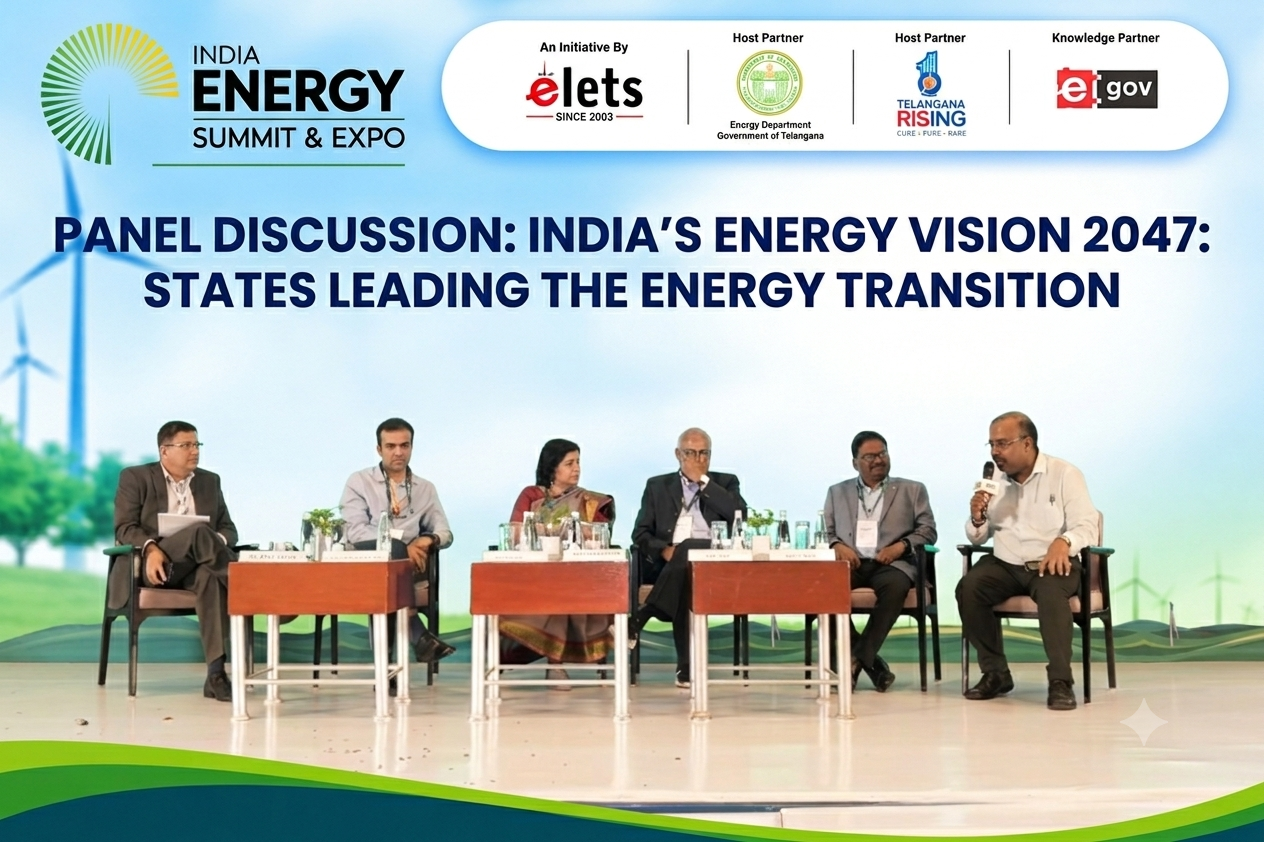
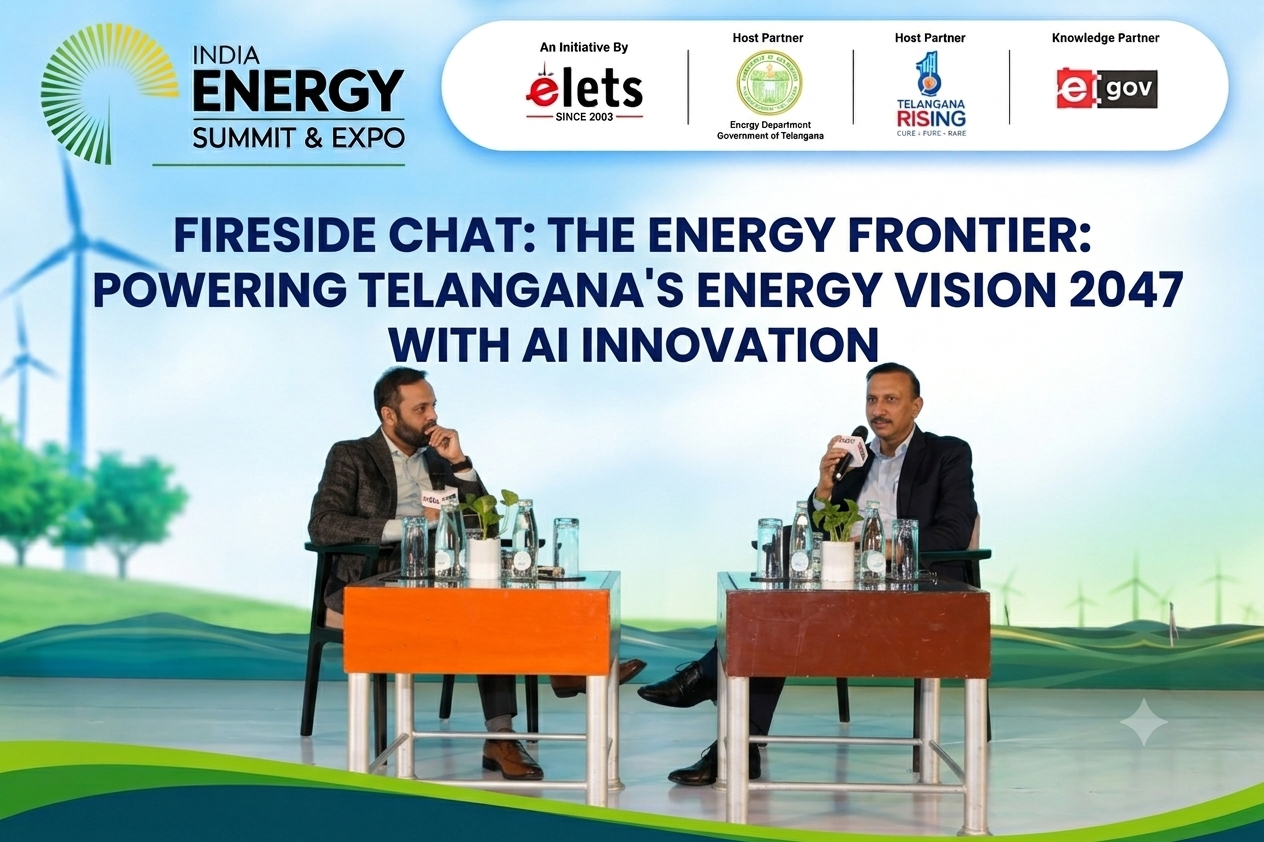
The discussion featuring Navin Mittal, Special Chief Secretary for Telangana’s Energy Department, highlighted a central principle for the coming decades: the transition to clean energy must go hand in hand with the transformation of the systems that generate, transmit, distribute and consume electricity.
Telangana’s 2047 Vision: Meeting an Eightfold Rise in Energy Demand
Long-term energy planning is inherently uncertain. Technological breakthroughs, changing consumption patterns, industrial expansion and new energy sources can alter the assumptions underpinning forecasts within a few years. India’s renewable energy trajectory itself demonstrates how quickly expectations can change.

As discussed during the summit, India initially committed to achieving a 40% share of non-fossil energy capacity by 2030 under its climate commitments. The speaker noted that the country approached that milestone earlier than anticipated, subsequently raised its ambition to 50%, and is now looking towards an even higher renewable contribution. The broader lesson is that energy strategies must remain ambitious while being flexible enough to incorporate technological and economic developments.
For Telangana, the scale of the challenge is particularly significant. According to the vision outlined by Mittal, the state’s peak electricity demand, which reached approximately 18.5 GW in the year discussed, could rise to nearly 139 GW by 2047. Annual electricity consumption, estimated at around 90 billion units, is projected to increase to approximately 790–800 billion units.
These projections imply a fundamental transformation in the size and complexity of the state’s electricity system. Meeting such demand will require substantial investment in generation, transmission, distribution, storage and digital infrastructure. It will also demand a more sophisticated approach to planning, as conventional methods may struggle to manage a power system operating at several times its present scale.
The most ambitious element of the vision is the expectation that renewable energy could account for 90% of Telangana’s energy mix by 2047, compared with the approximately 22% renewable share cited during the discussion. Achieving this transition will require more than installing solar and wind projects. It will depend on the ability to integrate variable generation, maintain grid stability, manage demand and ensure that electricity remains affordable and reliable.
A renewable-heavy energy system must therefore be designed not only to produce clean electricity but also to use it intelligently.
Time-of-Day Tariffs: Making Demand More Flexible
One of the most important changes in a renewable-powered electricity system is the relationship between supply and demand. In a conventional model, electricity generation largely responds to consumption. As renewable energy expands, however, the availability of electricity increasingly varies according to weather and time of day.
Solar generation is typically strongest during daylight hours, while electricity demand may peak later in the evening. This mismatch can create periods when electricity is relatively inexpensive and others when supply is more constrained and costly.
Mittal highlighted the importance of time-of-day tariffs in addressing this challenge. During the discussion, he cited indicative market prices of around ₹2 per unit during some daytime periods and ₹10 or more during peak periods, with higher prices also possible in certain market conditions. These figures illustrate the price differences that can emerge across the day, although actual prices vary with market conditions and applicable limits.
Time-sensitive pricing can encourage consumers to shift discretionary consumption towards periods when electricity is more readily available. Industrial facilities, commercial establishments and electric vehicle owners could adjust their consumption patterns to benefit from lower-cost electricity while helping the grid manage demand more efficiently.
For instance, an electric vehicle owner may choose to charge during a solar-rich afternoon rather than during an evening peak. Industries with flexible operations could schedule energy-intensive activities around periods of lower prices, where operational requirements permit.
This approach can gradually transform the electricity system into a two-way relationship: supply influences demand, but demand also responds to the availability and cost of supply.
The discussion also touched on vehicle-to-grid technology, under which compatible electric vehicles could potentially return stored electricity to the grid when needed. If supported by suitable technology, commercial arrangements and regulations, this could allow electric vehicles to function not only as consumers of electricity but also as distributed storage resources.
However, such a system will require clear pricing signals, suitable charging infrastructure, consumer participation and safeguards for battery life and grid operations. Time-of-day tariffs are an important starting point, but their effectiveness will depend on whether consumers have the practical ability to change when they use electricity.
Artificial Intelligence: From Generation to Distribution
AI is increasingly becoming a practical tool for improving electricity-system performance. Its potential extends across renewable generation forecasting, predictive maintenance, demand estimation, fault detection, procurement optimisation and consumer services.
According to Mittal, Telangana’s immediate priorities for AI adoption in distribution utilities include monitoring electricity supply, demand and losses; analysing equipment failures; and improving consumer grievance management.
The first opportunity lies in gaining better visibility into the electricity network. Smart meters and other monitoring devices can provide more timely information about electricity entering the distribution system and the amount consumed. When this information is analysed effectively, utilities can identify losses, understand consumption patterns and investigate discrepancies more quickly.
The second opportunity is predictive maintenance. Distribution networks generate extensive historical information about feeder trips, transformer failures and other operational disruptions. In conventional systems, identifying recurring patterns across large volumes of records can be difficult and time-consuming. AI tools can analyse these records to highlight repeatedly failing feeders, recurring faults and locations requiring targeted intervention.
Such insights can help utilities move from reactive repairs towards preventive maintenance. Rather than responding only after an outage occurs, operators can use historical patterns and real-time information to identify risks earlier and prioritise maintenance resources.
The third opportunity lies in improving consumer services. Telangana’s distribution utilities have introduced AI-supported response systems through channels such as WhatsApp, chatbots and voice-based services. These tools can help utilities analyse repeated complaints, identify clusters of consumers experiencing similar problems and connect grievances to particular feeders or transformer areas.
During the discussion, Mittal cited an indicative reduction of approximately 25% in grievances, while noting that further outcome data would be developed. The figure should be understood as an early result reported during the conversation rather than a comprehensive assessment of AI’s impact across all consumer services.
Nevertheless, the underlying principle is important: technology should be judged by whether it resolves problems, improves service quality and delivers measurable benefits to consumers.
Quality Data Must Come Before Intelligent Decisions
AI cannot compensate for unreliable information. If the data entering a system is inaccurate, incomplete or poorly organised, even sophisticated algorithms can produce misleading results. In electricity infrastructure, where decisions affect supply reliability, costs and public services, data quality is not merely a technical concern; it is a governance priority.
Mittal identified three essential requirements: ensuring that the necessary data is available, collecting the right amount and type of information for each asset, and maintaining its accuracy.
The first requirement involves instrumentation and connectivity. Real-time monitoring is impossible when the underlying system does not provide timely measurements. Smart meters, connected equipment and reliable communication networks are therefore essential foundations for advanced analytics.
The second requirement is proportionality. Not every transformer, feeder or substation needs the same level of monitoring. A small transformer serving an agricultural area may require a different data strategy from a larger transformer supplying a dense urban neighbourhood or a major commercial facility. The cost of instrumentation must be balanced against the operational value of the information it provides.
The third requirement is data accuracy. The discussion highlighted discrepancies in the mapping of consumers to transformers, feeders and substations. Such errors can undermine fault analysis and consumer grievance management because the system may associate a complaint with the wrong location.
To address this problem, Telangana’s utilities have undertaken data-cleaning exercises, including work to verify consumer-to-transformer relationships through field-level information collection. This may appear less technologically advanced than deploying sophisticated AI models, but it is essential to making those models useful.
The lesson for utilities across India is straightforward: digital transformation must begin with dependable data architecture. Better algorithms matter, but reliable measurements, accurate asset records and clear relationships between network components are equally important.
Building an AI-Ready Government
Technology adoption within public institutions often encounters a familiar challenge: successful pilot projects do not automatically translate into organisation-wide transformation. The difference between experimentation and lasting impact lies in whether new tools become embedded in everyday operations.
Mittal argued that Telangana’s progress has been supported by building internal capabilities alongside external collaboration. The use of AI, he explained, is no longer confined to senior government officials or utility leadership. Personnel at multiple levels, including directors, general managers, engineers and divisional teams, are beginning to explore the data available to them and develop practical applications.
This is an important model for technology-led governance. Leadership must establish the direction, but implementation cannot remain a top-down exercise. Employees who understand the operational challenges of substations, feeders, transformers and consumer services often possess the practical knowledge needed to identify where digital tools can make a difference.
Collaboration with academia, startups, industry and technology providers can further strengthen this process. Public utilities bring operational experience and access to system-level challenges, while external partners can contribute specialised expertise, research capabilities and innovative solutions.
The most effective ecosystem is therefore one in which government leadership, internal technical capacity and external innovation reinforce one another. Technology should not become an isolated department-level initiative; it should develop into an organisational capability.
Data Centres and the Energy Paradox of AI
The growth of AI also presents a significant energy challenge. Data centres require substantial electricity for computing, cooling and supporting infrastructure. As digital services expand, their demand could place additional pressure on generation capacity, transmission networks and distribution systems.
Mittal cited interest in establishing data centres in Telangana amounting to approximately 12–13 GW. He noted that this was comparable to the state’s typical peak demand at the time of the discussion, illustrating the potential scale of the opportunity and the associated infrastructure challenge.
The issue presents a strategic dilemma. AI can improve energy efficiency, strengthen grid operations and reduce avoidable costs, but the infrastructure needed to operate AI systems can itself consume large amounts of electricity.
The answer should not be to treat data centres simply as an unavoidable burden or an unquestioned economic opportunity. Their development must be accompanied by careful planning for electricity supply, transmission capacity, cooling requirements, efficiency and access to cleaner power.
The discussion also raised the question of data sovereignty. Developing domestic data-centre capacity can help India retain greater control over critical digital infrastructure and sensitive data. However, this ambition must be supported by reliable electricity, appropriate regulation, cybersecurity and economically viable operations.
The long-term benefits will depend on whether data-centre growth can be integrated into the energy system without compromising reliability or imposing disproportionate costs on other consumers.
Predictive Maintenance and the Renewable-Heavy Grid
As renewable energy approaches a larger share of the electricity mix, forecasting and predictive maintenance will become increasingly important. Solar and wind generation are variable, while conventional power plants, transmission assets and distribution equipment must remain dependable to maintain system stability.
AI can help improve predictability across these different components. Solar output can be estimated using factors such as cloud cover, temperature, location and time of day. Wind forecasting remains challenging, but advances in data analysis and weather modelling may improve its accuracy.
Predictive maintenance also offers opportunities in thermal power generation. The discussion highlighted efforts to use AI to anticipate boiler tube leaks and disruptions in coal supply. Acoustic sensors can detect changes in sound patterns that may indicate developing equipment problems, while comparisons between operational inputs and outputs can help identify abnormalities that warrant investigation.
If faults can be detected sufficiently early, operators may be able to schedule interventions before they result in costly breakdowns or prolonged outages. The benefits could include improved plant availability, more efficient maintenance and greater predictability in electricity supply.
Smart meters and connected devices can similarly strengthen demand forecasting. Over time, combining electricity consumption patterns with relevant operational information could help utilities anticipate local demand changes more accurately.
These applications point towards a future in which grid management becomes increasingly predictive. However, automated recommendations must be validated, systems must remain secure and critical operating decisions must retain appropriate human oversight.
Conclusion: An Intelligent Grid Is the Foundation of Energy Security
Telangana’s 2047 energy vision reflects a transformation that extends beyond the replacement of fossil fuels with renewable sources. It points towards an electricity system that is cleaner, more flexible, more data-driven and better equipped to manage a substantial increase in demand.
Achieving this ambition will require significant investment in renewable generation, storage, transmission and distribution infrastructure. Equally important will be the less visible work of improving data quality, deploying suitable monitoring systems, training personnel and integrating AI into routine decision-making.
The discussion also raised the possibility of future energy technologies, including space-based solar power. While such concepts remain a longer-term prospect rather than an established solution, India’s experience in space technology and digital systems could provide a foundation for exploring emerging opportunities.
Ultimately, the success of Telangana’s energy transition will depend on its ability to connect technological ambition with practical execution. AI must deliver measurable improvements in reliability, efficiency, affordability and consumer service. Renewable expansion must be matched by grid modernisation, while the growth of energy-intensive digital infrastructure must be planned responsibly.
The central message is that the future power system cannot simply be larger; it must be smarter. For Telangana and India, an intelligent grid could become one of the most important foundations for energy security, economic growth and a sustainable future.
——————————–
Insights shared by Navin Mittal and Phani Nagarjuna at the India Energy Summit and Expo 2026, held on 18-19 August 2026, Hyderabad

Be a part of Elets Collaborative Initiatives. Join Us for Upcoming Events and explore business opportunities. Like us on Facebook , connect with us on LinkedIn and follow us on Twitter, Instagram.
"Exciting news! Elets technomedia is now on WhatsApp Channels Subscribe today by clicking the link and stay updated with the latest insights!" Click here!