 News




Article
Telangana’s Energy Transition: Building the Economy of the Future Through Clean Power and Innovation
Telangana’s Energy Transition: Building the Economy of the Future Through Clean Power and Innovation
![]() By
Samuel Raj 26-November-2026


There was a time when discussions on energy largely revolved around one question: where will the next megawatt of electricity come from? Today, that question is no longer sufficient. We must also ask how clean that electricity will be, how it will be stored, how intelligently it will be transmitted and how efficiently it will reach consumers. More importantly, we must consider what new industries, businesses and economic opportunities can emerge around it.
I believe this shift captures the true meaning of the energy transition. It is not simply about changing the sources from which we generate electricity. It is about transforming the architecture of our economy. At Telangana, we are approaching this transition with precisely that ambition. Our objective is not limited to installing more solar panels or wind turbines. We want to create an integrated energy ecosystem that brings together renewable power, energy storage, modern transmission networks, electric mobility, green hydrogen, manufacturing and digital technology.

This transformation is particularly important as Telangana prepares for its next phase of economic growth. We have set our sights on building a $3 trillion economy by 2047. Our cities are expanding, manufacturing is growing, and Hyderabad is emerging as a major destination for data centres, artificial intelligence infrastructure and advanced industries. All these developments will require substantial and reliable electricity.
This presents us with a distinctive challenge: we must decarbonise our power system while expanding it rapidly enough to support economic growth. We cannot choose between development and sustainability. We must achieve both.

Scaling renewable energy while strengthening flexibility
Our renewable energy roadmap reflects this commitment. We are working towards nearly 20,000 MW of solar capacity by 2030 and more than 26,000 MW by 2035. Wind energy, which currently has a relatively smaller presence in Telangana, is also expected to grow substantially.
However, our experience and the experience of energy systems around the world have taught us an important lesson: renewable energy without flexibility cannot deliver a complete energy transition. Solar generation follows the availability of sunlight, while electricity demand continues into the evening. Wind generation also fluctuates depending on weather conditions. The challenge, therefore, is not only to generate clean electricity but to make it available whenever consumers need it.
This is why energy storage will become one of the most important pillars of our strategy. We are looking at both battery energy storage systems and pumped storage projects. Our roadmap envisages storage capacity rising to around 3,800 MW by 2030 and nearly 8,000 MW by 2035.
For me, the real measure of a modern electricity system is not how much power it can generate when conditions are favourable. It is whether electricity is available when a citizen, farmer or industrial consumer actually needs it. Storage will help us bridge the gap between renewable generation and demand, improve grid flexibility and strengthen the reliability of our electricity system.
Building an intelligent, digitally connected grid
Alongside renewable generation and storage, the electricity grid itself is undergoing a major transformation. Traditionally, the grid was viewed primarily as an engineering network connecting power plants with consumers. Tomorrow’s grid will increasingly operate as a digital and intelligent system.
Millions of generation and consumption points will need to communicate with one another. Solar panels, batteries, electric vehicles, homes, industries, substations and power plants will become interconnected elements of a much larger energy ecosystem.
Telangana has a unique advantage in this area because of Hyderabad’s established capabilities in information technology, artificial intelligence, electronics, advanced manufacturing and research. The same city that develops software solutions for the world can also develop the intelligence required to operate the electricity grid of the future.
Consider the possibilities. Artificial intelligence could forecast electricity demand at a neighbourhood or street level. Predictive systems could identify transformers likely to fail before an actual breakdown occurs. Energy storage systems could respond automatically to fluctuations in renewable generation, while industries could adjust their electricity consumption intelligently when power becomes scarce or expensive.
The convergence of electrons and algorithms will be one of the defining opportunities of the coming decade. I believe Hyderabad should be at the centre of this transformation.
There is also an important paradox that we must recognise. Artificial intelligence can help make electricity systems more efficient, but AI itself requires enormous quantities of electricity. The global expansion of data centres and AI infrastructure is creating an entirely new category of power demand.
For Hyderabad, this presents both an opportunity and a responsibility. If we can provide reliable, affordable and increasingly green electricity, we will strengthen the city’s competitiveness as a destination for data centres, AI companies and advanced industries. Our plans already include a 100 MW renewable energy facility to support a proposed AI data centre at Bharat Future City. This reflects the direction in which we want to move: digital infrastructure and clean energy infrastructure must grow together.
Clean energy is no longer only an environmental priority. It is becoming essential economic infrastructure.
Manufacturing the energy transition
I strongly believe that India cannot remain merely a consumer of the global energy transition. We must also manufacture it.
Solar equipment, wind turbines, batteries, power electronics, electrolyser technologies, electric vehicle charging systems and advanced grid technologies represent significant industrial opportunities. These are not simply components required for renewable energy projects. They can form the foundation of new manufacturing industries, supply chains, research activities and skilled employment.
Telangana wants to attract companies that manufacture these technologies within the state. Our policies are designed to support this ambition through incentives, including capital support for solar and wind manufacturing, SGST reimbursement and electricity duty exemptions.
However, investors require more than financial incentives. They look for policy certainty, predictability, access to land and infrastructure, and the ability to move projects forward without unnecessary delays. We have built a reputation for facilitating investments and accelerating approvals through mechanisms such as the Telangana State Industrial Project Approval and Self-Certification System (TS-iPASS).
My message to industry is straightforward: do not look at Telangana merely as a market for clean energy. Look at it as a place from which you can build clean energy businesses for India and the world.
We want to create an environment where companies can establish manufacturing facilities, develop technologies, collaborate with research institutions and build long-term businesses. The transition will create far greater economic value if we develop the industries behind clean energy rather than focusing only on installed capacity.
Green hydrogen and the next generation of industries
Our ambition also extends beyond electricity. Green hydrogen, green ammonia, methanol and sustainable aviation fuels can help transform sectors that are difficult to electrify directly.
Our roadmap envisages green hydrogen production of more than 400,000 tonnes annually by 2030, with further growth expected by 2035. This ambition should not be understood simply as a target for producing hydrogen. Around every emerging technology, an entire industrial ecosystem can develop.
That ecosystem includes equipment manufacturers, engineering companies, logistics providers, researchers, startups and skilled professionals. It creates opportunities across the value chain, from technology development and infrastructure to transportation and end-use applications.
The states that recognise this opportunity early will capture much more economic value than those that focus only on producing a particular fuel or installing a certain amount of capacity.
We must therefore think beyond individual projects. Our objective should be to build an ecosystem that encourages innovation, manufacturing, research and employment around emerging clean energy technologies.
Making the transition meaningful for people
While discussing investment, technology and capacity targets, we must not lose sight of the most important consideration: energy policies are ultimately about people.
A successful energy transition cannot be measured only in megawatts installed or tonnes of carbon emissions avoided. We must also measure it through the jobs created, farmers supported, industries made more competitive, businesses enabled and families receiving dependable electricity.
Agriculture remains particularly important to Telangana. Distributed renewable energy, solarisation and more efficient agricultural power use can reduce pressure on the electricity system while opening new opportunities for farmers. We must ensure that the benefits of clean energy reach rural communities as well as cities and industrial centres.
Electric mobility is another area where the boundaries between the power and transport sectors are increasingly disappearing. As electric vehicles become more common, charging infrastructure will become an essential part of the energy ecosystem.
Telangana currently has fewer than 1,000 electric vehicle charging stations. Our roadmap envisages expanding this network to around 6,000 by 2030 and 12,000 by 2035. Achieving these targets will require coordinated planning across electricity distribution, transport infrastructure, technology and investment.
This is precisely why we must plan the transition as an integrated ecosystem rather than treating renewable energy, transportation, manufacturing and digitalisation as separate policy areas.
Partnerships and investment will determine the pace of change
The scale of investment required for this transformation is simply too large for governments to undertake alone. The role of government must therefore evolve. Instead of attempting to do everything itself, government must enable an ecosystem in which different stakeholders can contribute capital, technology, knowledge and execution capabilities.
Industry must bring investment and implementation expertise. Technology companies must bring innovation. Financial institutions must develop suitable financing instruments. Universities must generate knowledge, while startups must be encouraged to experiment with new solutions. Governments must provide the policy framework and infrastructure that allow these contributions to come together.
Instruments such as green bonds, blended finance, carbon markets and private investment will become increasingly important in mobilising the resources required for the energy transition.
I believe the transition will succeed only when public purpose and private enterprise reinforce each other. We need long-term partnerships that move beyond announcements and translate investment commitments into projects on the ground.
This is also why platforms such as the India Energy Summit and Expo 2026 are important. The energy sector can no longer operate in silos. Renewable energy cannot be discussed without storage. Generation cannot be planned without transmission. Electric vehicles cannot grow without charging infrastructure. Green hydrogen cannot be produced sustainably without renewable electricity. Data centres cannot expand without reliable power, and none of these developments can progress without finance.
The purpose of a summit must therefore go beyond speeches and presentations. Conversations must lead to partnerships, and partnerships must ultimately lead to projects.
Telangana’s invitation to investors and innovators
I want to extend a clear invitation to investors, entrepreneurs, technology companies, scientists and innovators: come to Telangana. Bring your technologies, ideas and ambitious projects. Bring us the difficult problems that need solutions.
You will find a government willing to engage, a strong technology ecosystem, talented young people, significant energy opportunities and a state determined to execute its development plans.
India’s energy transition will not take place only in conference rooms or through international declarations. It will happen on the ground—in our states, cities, factories and farms, and through millions of decisions made by citizens and businesses.
Telangana intends to be at the forefront of this transformation. We want to demonstrate that clean energy and economic growth are not competing objectives. When planned and implemented properly, one can become the engine of the other.
From renewable energy and storage to intelligent grids, green hydrogen, electric mobility and clean manufacturing, we are building the foundation of Telangana’s next economy.
Our ambition is not merely to consume the energy of the future. We want to create it, store it, manufacture the technologies behind it, manage it intelligently and build new prosperity around it.
This transformation will require the collective commitment of government, industry, investors, technology providers, researchers and citizens. If we work together, we can build an energy ecosystem that supports Telangana’s economic aspirations while contributing to India’s larger development goals.
I invite all our partners to join us in this journey. Let us turn our energy ambitions into tangible projects, our policies into opportunities and our investments into lasting prosperity. Together, we can power not only Telangana’s future but also India’s future.
——————————–
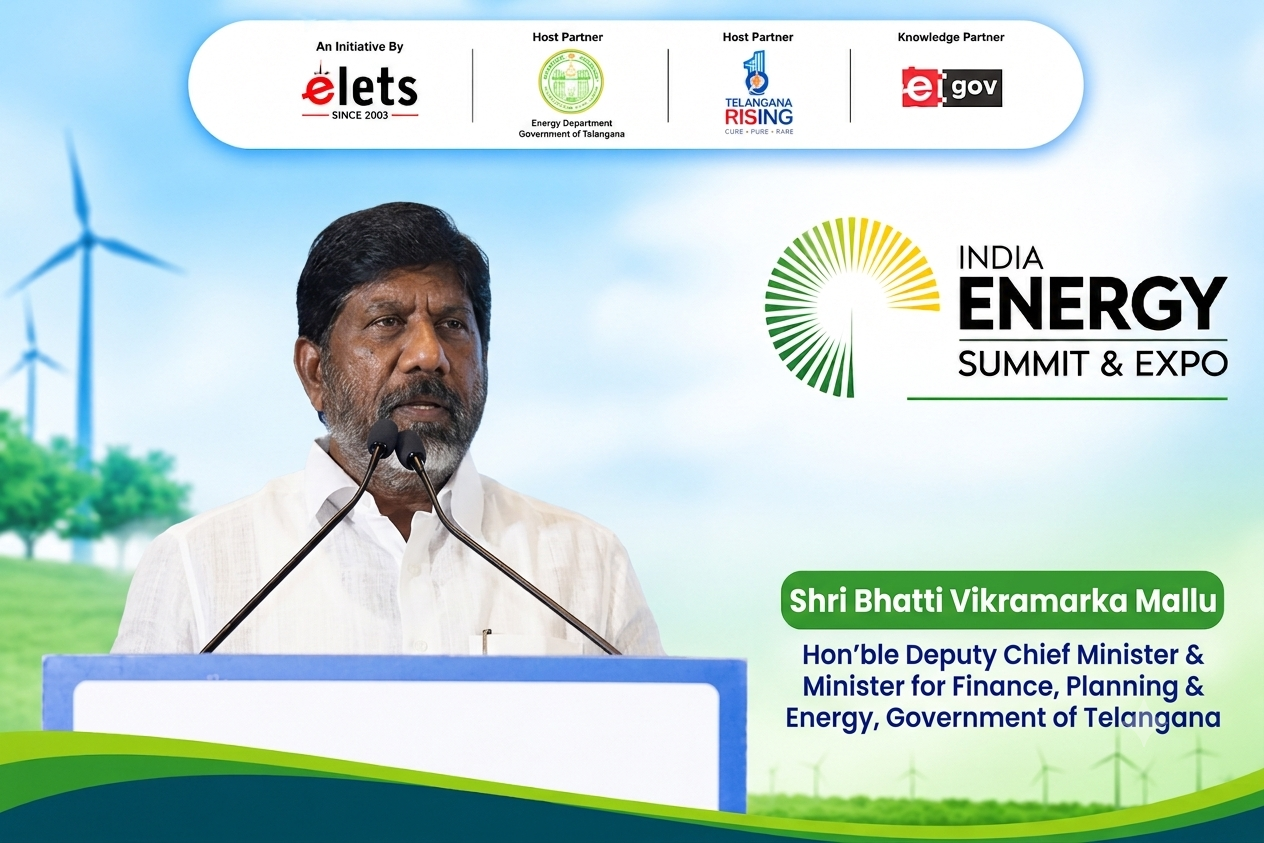
Insights shared by Shri Bhatti Vikramarka Mallu, Hon’ble Deputy Chief Minister & Minister for Finance, Planning & Energy, Government of Telangana, at the India Energy Summit and Expo 2026, held on 18-19 August 2026, Hyderabad

Be a part of Elets Collaborative Initiatives. Join Us for Upcoming Events and explore business opportunities. Like us on Facebook , connect with us on LinkedIn and follow us on Twitter, Instagram.
"Exciting news! Elets technomedia is now on WhatsApp Channels Subscribe today by clicking the link and stay updated with the latest insights!" Click here!