 News




Article
Telangana’s Next Growth Story Will Be Powered by Green Energy: Why Industry and Government Must Move Together
Telangana’s Next Growth Story Will Be Powered by Green Energy: Why Industry and Government Must Move Together
![]() By
Samuel Raj 26-November-2026


When I look at Telangana’s economic journey and its ambitions for the coming decade, I see a state approaching a significant inflection point. The foundations for growth have already been established through strong policy direction, infrastructure development, institutional capability and effective execution. However, the next phase of economic expansion will demand a different kind of infrastructure, one that will determine how successfully the state can attract new industries, support emerging technologies and strengthen its position in the global economy.
That infrastructure is power.

The world is entering a new industrial growth cycle driven by artificial intelligence (AI), data centres, global manufacturing facilities and increasingly energy-intensive industries. These developments will require enormous amounts of reliable electricity. For Telangana, this presents both an opportunity and a responsibility. The state has demonstrated its ability to anticipate economic changes and build the infrastructure needed to support them. Now, it must ensure that its energy ecosystem evolves at the same pace as its industrial ambitions.
I believe the next chapter of Telangana’s growth will be defined by how effectively green energy and industrial expansion move together.

Policy Clarity and Execution Have Built Telangana’s Growth Story
One of the most important reasons behind Telangana’s economic progress is the combination of policy clarity, institutional capability and execution. These factors, supported by enabling infrastructure and a favourable social and cultural environment, have helped the state establish itself as an attractive destination for investment.
The earlier phase of growth was largely driven by the services sector, particularly information technology, alongside manufacturing. The state recognised the infrastructure requirements of these industries and worked towards creating an environment that could support their expansion.
The results are reflected in Telangana’s economic ambitions. The state aspires to become a trillion-dollar economy over the next decade and reach a three-trillion-dollar economy by 2047. Its economic output is already significantly higher than what its population share might suggest.
However, the drivers of the next growth cycle will be different. AI, global manufacturing facilities and data centres are emerging as major contributors to industrial expansion. These sectors require infrastructure that is fundamentally different from what supported the earlier IT and services-led growth phase.
In this new environment, electricity will become one of the most critical determinants of competitiveness. The state and the country need power now, and they need it at scale.
This is why I believe energy must be treated as a strategic economic infrastructure priority rather than simply another sectoral requirement.
Green Energy Policy Is Also an Economic Growth Policy
Telangana’s new green energy policy, announced last year, reflects an understanding of the changing relationship between energy and economic development. In particular, making green open access available to strategic sectors and emerging industries is a significant step.
I would argue that this is not merely an energy policy. It is an economic growth policy.
When industries have access to renewable electricity, they gain an opportunity to manage their energy requirements while strengthening their sustainability commitments. For global manufacturers and technology companies, access to reliable and cleaner power is increasingly becoming an important consideration when deciding where to establish operations.
This is particularly relevant as international businesses look for locations that can support their long-term energy needs. Green power availability can therefore become a competitive advantage for Telangana, helping the state attract investment, create employment and expand its industrial base.
The timing of this policy shift is equally important. Renewable energy is moving towards a stage where it can increasingly contribute to dependable power supply, although the transition to a fully reliable base-load system still requires progress in storage, grid infrastructure and system integration.
The challenge before us is to accelerate this transition while ensuring that industrial growth does not face energy constraints.
The Emerging Demand from AI and Data Centres
The growing demand for electricity from artificial intelligence and data centres is one of the most important developments that the energy sector must prepare for.
As a global company working with hyperscalers across different markets, we have a close view of how rapidly digital infrastructure is expanding. Our digital portfolio currently stands at approximately 6.2 GW, with most of this capacity located in the United States.
However, I believe this is only the beginning.
Several research estimates point towards data centre capacity reaching approximately 5–10 GW by 2030 and 10–20 GW by 2035. In my personal assessment, the actual requirement could be considerably higher. I would go as far as suggesting that global data centre capacity could exceed 100 GW by 2035.
The reason is simple: the world is still underestimating the scale of the digital transformation that lies ahead. AI applications, cloud computing and the growing use of digital services will require significantly more computing infrastructure. That infrastructure, in turn, will require enormous quantities of electricity.
Hyderabad has already been recognised as an emerging data centre destination in India. This presents an opportunity for Telangana to build on its existing strengths in technology and infrastructure.
But attracting data centre investment will require more than land availability and connectivity. Energy availability, reliability and sustainability will be equally important. Data centres operate with continuous power requirements, and their energy systems must be designed to support uninterrupted operations.
This is where the relationship between renewable energy and industrial development becomes particularly important. Telangana must ensure that its green energy ecosystem can support the scale and consistency of electricity demand that these facilities will create.
Why Industry Must Take Responsibility for Execution
While the state has an important role in creating the policy and regulatory environment, industry must also recognise its responsibility.
I believe the private sector must contribute through technology deployment, investment and execution. It is not enough for companies to express interest in renewable energy or participate in policy discussions. We must demonstrate a long-term commitment by developing projects, implementing technologies and helping build the infrastructure required for the next phase of growth.
The question I often ask myself is: why does the state need industry?
The answer is straightforward. The state needs us to implement technologies. It needs us to execute projects. It needs us to make long-term commitments and contribute the capabilities required to turn policy ambitions into measurable outcomes.
At the same time, industry must be able to expect regulatory certainty and continued policy support from the government. Grid modernisation, predictable regulations and clarity in implementation will be essential to ensuring that investors can participate confidently in this long-term journey.
As a global company, we see regulatory changes as a process of regulatory evolution. The energy ecosystem is changing, and policies must evolve alongside it. Renewable energy is still progressing towards becoming a fully dependable base-load source. Until that happens, there will naturally be questions around grid integration, reliability and the regulatory framework.
The objective should not be to avoid regulatory evolution but to ensure that it takes place through consultation, clarity and a shared understanding between government and industry.
Making Renewable Energy a Reliable Power Source
One of the central challenges facing the renewable energy sector is the need to make clean electricity available when industries require it, not merely when generation conditions are favourable.
Solar and wind energy have transformed the power generation landscape, but their variable nature creates challenges for continuous industrial consumption. Storage technologies, grid modernisation and better power management will therefore be essential.
For energy-intensive sectors such as AI and data centres, the distinction between renewable generation and reliable renewable supply is particularly important. These facilities cannot depend solely on intermittent generation. They need an energy system that can provide consistent electricity throughout the day and night.
This requires coordinated investments across generation, storage and transmission infrastructure. It also requires regulatory frameworks that recognise the changing nature of energy demand and encourage new solutions.
I am confident that the industry and the state can work together to address these challenges. Telangana has demonstrated its ability to make timely policy decisions and create an enabling environment for investment. The next task is to translate that intent into execution at scale.
Telangana Is a Long-Term Commitment for Industry
Our association with Telangana is not new. This is our home state, and our journey here began more than a decade ago. Our first project in the portfolio, developed in 2014 under the state’s 2014 policy, was established in Telangana.
Today, our global portfolio stands at approximately 40 GW. Our Indian headquarters and a significant part of our talent pool are based in Hyderabad. These connections make our relationship with the state much deeper than a conventional business presence.
We see ourselves as long-term participants in Telangana’s development journey. Our commitment is to remain invested, contribute to the state’s energy ambitions and support the infrastructure needed for its next phase of economic growth.
This is also why the current opportunity is so significant. The state is ready, the industry is ready, and the demand for power is growing. What is required now is sustained cooperation and the ability to execute at the pace the opportunity demands.
The Time to Unlock Telangana’s Next Growth Phase Is Now
I believe Telangana is approaching a defining moment. Its established strengths in technology, manufacturing, policy development and infrastructure provide a strong foundation. The emerging demand from AI, data centres and global factories creates an opportunity to build an even more ambitious economic future.
Green energy can become one of the strongest enablers of this transformation, provided we approach it as an integral part of economic planning.
The state must continue to provide regulatory clarity, modernise its grid and create an environment that encourages investment. Industry must respond with technology, capital, execution capability and long-term commitment. Both sides must recognise that the energy transition is a shared responsibility.
I have always believed that if you can dream and execute, meaningful transformation becomes possible. Telangana has demonstrated this through its journey so far. The next phase will require the same confidence, backed by the ability to anticipate change and act decisively.
For us, the message is clear: this is the time to unlock the opportunity. The demand for power is growing, the industrial landscape is changing, and green energy is becoming central to competitiveness.
We are committed to being part of this journey for the long term. Telangana has the ambition, the policy intent and the capability to get it right. We believe in that vision, and we are ready to grow alongside the state.
——————————–
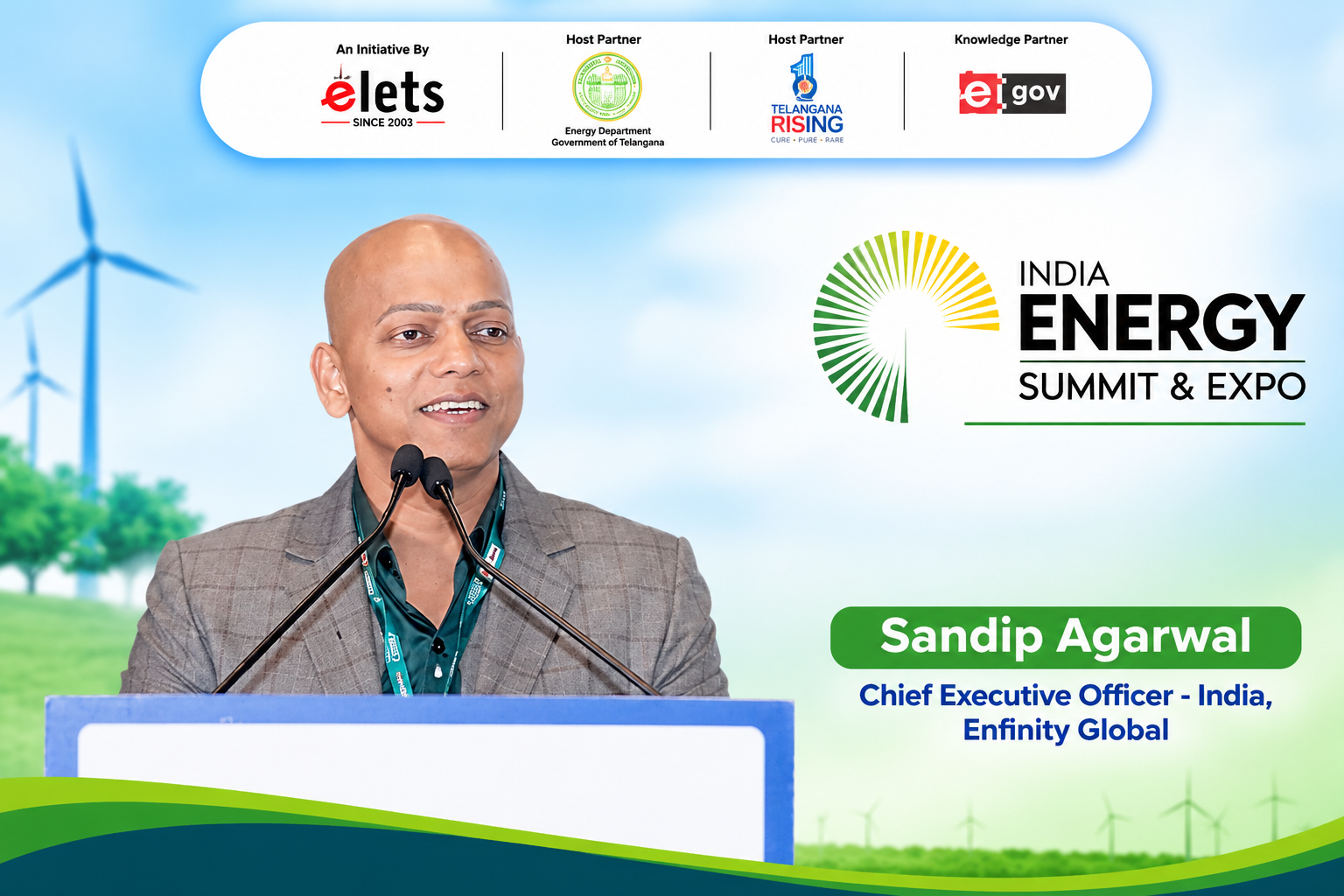
Insights shared by Sandip Agarwal, Chief Executive Officer – India, Enfinity Global , at the India Energy Summit and Expo 2026, held on 18-19 August 2026, Hyderabad

Be a part of Elets Collaborative Initiatives. Join Us for Upcoming Events and explore business opportunities. Like us on Facebook , connect with us on LinkedIn and follow us on Twitter, Instagram.
"Exciting news! Elets technomedia is now on WhatsApp Channels Subscribe today by clicking the link and stay updated with the latest insights!" Click here!