 News




India’s energy transition is entering a phase where the central challenge is no longer simply how much renewable energy we can generate, but how effectively we can store, distribute and consume it. As solar and wind capacity expand, we must also rethink the way our power systems operate, particularly during non-solar hours, when the availability of renewable electricity becomes limited and the cost of power can rise significantly.
The discussions at this summit have reinforced my belief that India’s next phase of energy transformation must focus on practical solutions that connect renewable generation with storage, agricultural consumption, decentralised power systems and cooperation between states. We need to look beyond individual projects and develop an integrated approach that delivers affordable, reliable and sustainable electricity.

I see five major opportunities that deserve greater attention: accelerating pumped storage projects, expanding floating solar, shifting agricultural electricity consumption towards daytime hours, promoting solarisation at the farm and feeder levels, and strengthening cooperation between states.
Pumped Storage: An Opportunity We Cannot Afford to Delay

One of India’s most significant opportunities lies in pumped storage projects (PSPs). As renewable energy generation increases, particularly from solar sources, we will need dependable storage solutions to ensure electricity remains available when the sun is not shining. Pumped storage can play an important role in addressing this challenge by storing energy and making it available during periods of higher demand.
The potential is substantial. Himachal Pradesh has an identified pumped storage potential of approximately 24 GW. Telangana, too, has identified around 31 projects with a cumulative potential of nearly 20 GW. These opportunities need to be translated into projects at the earliest.
However, there is an important economic consideration. The cost of developing pumped storage projects is likely to increase over time. Construction requires cement, steel, labour, machinery and engineering services, and the costs associated with these inputs generally rise as infrastructure development progresses.
Battery storage, on the other hand, is witnessing a downward cost trend. This creates two contrasting trajectories: the cost of pumped storage infrastructure is moving upwards, while battery costs are expected to become more competitive.
For this reason, I believe India and its states must front-load pumped storage investments. Delaying these projects by five, ten or fifteen years could make them considerably more expensive and reduce their attractiveness compared with alternative technologies.
There is another important dimension. A substantial share of the expenditure on pumped storage projects remains within the domestic economy. Cement and steel are produced in India, labour and engineering services are available locally, and much of the required turbine manufacturing capability also exists within the country. Every rupee invested in these projects therefore supports domestic industries, employment and engineering capabilities.
I have also suggested that the Union Government consider directing Viability Gap Funding (VGF) towards pumped storage projects rather than concentrating it on battery projects. Batteries have a strong advantage in terms of implementation speed and are becoming cheaper, while pumped storage requires a longer development period, generally around three to five years. Batteries may be deployed in approximately six months in suitable circumstances, making them useful when immediate storage capacity is required. But this speed should not come at the cost of delaying long-term infrastructure that can serve the country for decades.
Floating Solar Can Unlock Underused Water Resources
The second major opportunity is floating solar. States such as Himachal Pradesh have the advantage of perennial rivers and streams, which support hydropower generation. Many other states do not have the same geographical conditions and must explore alternative ways of expanding renewable energy capacity.
I believe reservoirs created through irrigation and other water infrastructure projects offer considerable potential. Instead of viewing these water bodies only as resources for irrigation and water management, we should also recognise their ability to support floating solar installations.
NTPC’s 100 MW floating solar project at Ramagundam provides an important example. Floating solar can offer a higher Capacity Utilisation Factor (CUF) than conventional ground-mounted solar projects, although its initial capital cost is generally higher.
This additional cost has been one of the reasons why floating solar has not expanded as quickly as its potential would suggest. However, the Union Government’s new support programme for floating solar combined with battery storage creates an opportunity to address this challenge. The programme, as discussed, provides financial support of up to approximately Rs 1 crore for eligible projects involving floating solar and two-hour battery storage.
For Telangana, this makes several projects considerably more attractive. The higher generation potential of floating solar, combined with financial support, can improve project economics and encourage greater investment. We are actively working towards preparing projects that can take advantage of this opportunity.
Time-of-Day Tariffs Must Reshape Agricultural Power Consumption
The third area that requires attention is the time-of-day tariff regime. The cost of electricity varies significantly between solar and non-solar hours. During the daytime, when solar generation is abundant, power can be available at considerably lower prices. During evening hours, when solar generation declines and demand remains high, electricity can become much more expensive.
Telangana has been actively optimising its power procurement costs through the Indian Energy Exchange. Although our state accounts for around 3 per cent of India’s population and approximately 5 per cent of its electricity consumption, our participation in the exchange is significantly higher, averaging around 12–13 per cent.
This gives us the flexibility to procure electricity when market prices are favourable. During daytime hours, solar power can sometimes be purchased at less than Rs 2 per unit, with prices occasionally falling much lower in particular market slots.
We have also been working to make our thermal power stations more flexible so that generation can be reduced when cheaper solar electricity is available. Some of our plants are already operating at around 47–48 per cent of their capacity, and we are examining whether this can be brought down further, potentially towards 40 per cent.
I believe India must increasingly focus on improving the flexibility of thermal power plants. If other countries are able to operate their plants at much lower levels, we should also examine what can be achieved through appropriate technical and operational adjustments.
This becomes particularly important when we consider agricultural electricity consumption. Traditionally, several states have scheduled agricultural power supply during the night because overall demand from other consumer categories is lower at that time. However, the availability of abundant and cheaper solar power during the day creates a strong economic case for shifting agricultural consumption towards daytime hours.
This transition will require improvements in transmission and distribution infrastructure. The grid must be capable of handling the revised demand profile. But the benefits could be substantial, particularly for distribution companies, which can reduce their power procurement costs by making greater use of inexpensive daytime solar electricity.
Taking Solarisation Directly to Farms and Agricultural Feeders
The fourth opportunity is to expand solarisation at the farm and agricultural feeder levels. Rather than depending entirely on large, centralised power generation and long-distance transmission, we should increasingly explore decentralised renewable energy systems that supply electricity closer to where it is consumed.
Telangana is working towards solarising agricultural feeders and enabling existing farms to depend more on locally generated solar electricity. We also want to encourage new agricultural connections to adopt solar-based solutions wherever feasible.
To develop this approach, we have analysed agricultural feeder demand patterns at the substation level. Using artificial intelligence, we examined electricity consumption across different months and hours of the day. This helped us understand how the solar generation profile could be aligned with agricultural demand and how battery storage could support supply beyond daylight hours.
Our assessment indicates that approximately six hours of battery storage would be useful. This is because evening electricity prices are already high for several hours, and we expect this challenge to become more significant as demand grows.
By combining daytime solar generation with six-hour battery storage, we can create a more balanced supply profile. Our broader plan for Telangana involves approximately 13 GW of solar capacity and 30 GWh of battery storage.
We intend to implement this in phases. The first phase is expected to involve around 3 GW of solar capacity and 7.5 GWh of battery storage. The objective is to develop these systems in a decentralised manner, supplying electricity at the 11 kV or 33 kV level wherever possible.
This approach can reduce the need to transmit electricity over long distances, first stepping it up to 132 kV, 220 kV or 400 kV and subsequently stepping it down for local consumption. By generating and supplying power closer to agricultural demand, we can reduce transmission and distribution losses.
Our estimates suggest that this model could deliver energy efficiency improvements of approximately 9–10 per cent through lower network losses. This is an important opportunity for India, and I believe feeder-level solarisation, including initiatives under programmes such as PM-KUSUM, must be accelerated.
State Cooperation Can Make the Energy Transition More Efficient
Finally, I want to emphasise the importance of cooperation between states. India’s energy resources are distributed unevenly. Some states have strong solar potential, others have hydropower resources, while some have significant opportunities for pumped storage. Instead of approaching these opportunities independently, states should identify complementarities and develop partnerships.
Telangana, for instance, is working on two hydropower projects in Himachal Pradesh. Our state generation company is preparing the Detailed Project Reports, and we expect to move towards the procurement process once the reports are finalised. Himachal Pradesh has the natural advantage of perennial water resources, and Telangana can participate in developing projects that utilise this potential.
Similarly, Rajasthan and Gujarat have considerable advantages in solar energy. Telangana, meanwhile, has identified substantial potential in pumped storage. Our ambition is to develop the state as a major pumped storage hub in India and work with other states that require storage capacity.
Such partnerships can help states access resources that may not be available within their own geographical boundaries. They can also improve the utilisation of renewable energy, strengthen grid reliability and create opportunities for shared investment.
Building an Integrated Energy Future
India’s energy transition will require more than adding renewable capacity year after year. We must build the infrastructure that allows renewable electricity to be stored, transmitted and consumed efficiently. Pumped storage, floating solar, battery systems, agricultural feeder solarisation and flexible power generation must become interconnected elements of our energy strategy.
At the same time, we must recognise that every state has a different resource profile and a different set of requirements. Collaboration can help us combine these strengths and create solutions that are economically viable and technically sustainable.
My central argument is simple: we must act early where infrastructure costs are likely to rise, use technology where it can improve efficiency, shift consumption towards periods of abundant renewable generation and take power generation closer to the point of consumption.
The opportunity before India is enormous. What we need now is timely execution, forward-looking planning and stronger cooperation between states, public institutions and private sector participants. If we can bring these elements together, we can build an energy system that is not only cleaner but also more affordable, resilient and better equipped to meet India’s growing electricity needs.
——————————–
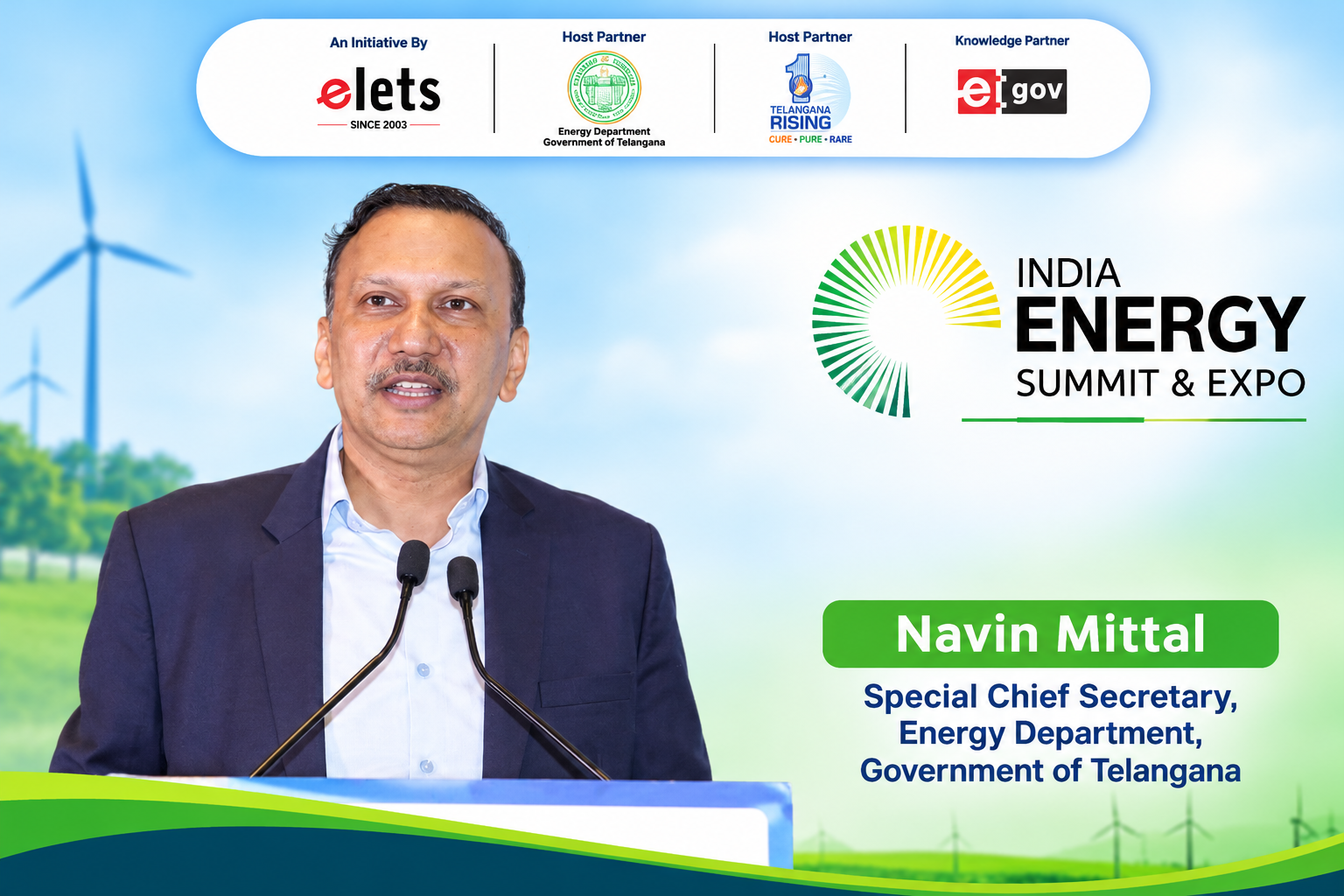
Insights shared by Navin Mittal, Special Chief Secretary, Energy Department, Government of Telangana , at the India Energy Summit and Expo 2026, held on 18-19 August 2026, Hyderabad

Be a part of Elets Collaborative Initiatives. Join Us for Upcoming Events and explore business opportunities. Like us on Facebook , connect with us on LinkedIn and follow us on Twitter, Instagram.
"Exciting news! Elets technomedia is now on WhatsApp Channels Subscribe today by clicking the link and stay updated with the latest insights!" Click here!