 News




Article
India’s AI Revolution Is an Energy Revolution: Building an Intelligent and Sovereign Power Grid
India’s AI Revolution Is an Energy Revolution: Building an Intelligent and Sovereign Power Grid
![]() By
Samuel Raj 26-November-2026


Thousands of years ago, on the battlefield of Kurukshetra, a deeply conflicted Arjuna stood amid the uncertainty and turmoil of an impending war. In the tenth chapter of the Bhagavad Gita, Lord Krishna reveals his divine manifestations, or Vibhuti, to Arjuna. Among these revelations is a profound statement: “I am the radiant energy of the radiant.”
For centuries, India’s philosophical traditions have understood energy as something far greater than a commodity to be consumed or a resource to be extracted. Energy has represented the force that animates life, sustains civilisation and shapes human destiny. Today, as we stand at the intersection of artificial intelligence and the energy transition, I believe we are witnessing a return to this fundamental understanding. Energy is once again emerging as the foundation of intelligence, innovation and progress.

As India gathers momentum in its technological and economic transformation, we are standing on a new kind of battleground. The currency of power is changing. It is no longer simply about generating electricity to light homes, operate factories or power turbines. Every algorithm we train, every sovereign AI model we deploy and every inference an AI system performs consumes physical energy. The AI revolution, therefore, is fundamentally an energy revolution.
And energy is becoming the real bottleneck.

The physical limits of the AI revolution
For years, Silicon Valley has operated on the belief that software can transform every industry, computing capacity can scale continuously and intelligence can be improved by increasing the number of parameters in a model. However, the physical world is reminding us that technological ambition cannot escape the laws of energy, infrastructure and resource availability.
The next generation of artificial intelligence will require enormous amounts of electricity. Training a frontier AI model could require approximately five gigawatts of power, equivalent to the peak output of nearly four nuclear reactors. This illustrates the scale of the energy infrastructure needed to sustain advanced computing.
The demand is not limited to model training. Global data-centre electricity consumption is projected to exceed 1,000 terawatt-hours by the end of this decade. If data centres were considered a country, their electricity consumption would place them among the world’s largest energy consumers.
The changing requirements of computing infrastructure make the challenge even more apparent. Traditional data-centre racks typically consume between 5 and 10 kilowatts. Modern AI-optimised GPU clusters, however, can demand anywhere from 30 kilowatts to more than 100 kilowatts per rack. These requirements create concentrated, round-the-clock electricity demand that many existing power grids were not designed to support.
This is particularly relevant for India. Hyderabad is rapidly emerging as a major data-centre destination, and the expansion of AI infrastructure will add another dimension to the state’s electricity requirements. We must recognise that data centres cannot be planned as isolated technology facilities. They are energy-intensive infrastructure assets that require reliable generation, resilient transmission, efficient distribution and intelligent consumption management.
The future of AI will depend as much on the availability of electricity as on the availability of computing power.
Why India must compete through efficiency and intelligence
The global response to this challenge is already taking shape. Recent announcements involving NVIDIA and major financial institutions, including BlackRock, Blackstone, Goldman Sachs, KKR, Apollo and Brookfield, point towards a financing framework of approximately $500 billion for AI infrastructure.
The scale of this investment reflects a fundamental shift in how the world views computing. Compute is no longer simply a technology requirement; it is becoming an infrastructure asset class. Building a single gigawatt of AI data-centre capacity can cost between $50 billion and $70 billion.
This brings us to an important strategic question: should India attempt to compete dollar for dollar with the world’s largest economies in this capital-intensive infrastructure race?
I believe our answer should be different. Rather than entering a brute-force capital war, India should focus on winning through efficiency, specialised intelligence and innovation. Our opportunity lies in developing energy-efficient algorithms, intelligent grid orchestration and sovereign, open AI systems.
India has an asymmetric advantage that we must use intelligently. We have a large talent pool, growing digital infrastructure, a strong technology ecosystem and the opportunity to develop solutions suited to our own energy requirements. We should build on these strengths rather than simply replicate the most capital-intensive models emerging elsewhere.
Global collaboration will be essential to this approach.
India can work with US financial markets and international infrastructure funds to co-finance renewable energy installations, renewable microgrids and advanced modular reactor projects. We can partner with Western research institutions to develop frugal AI models that deliver comparable cognitive capabilities while using fewer parameters and consuming significantly less electricity.
We must also take advantage of the growing open-weight AI ecosystem. Open-weight large language models have substantially narrowed the gap with closed frontier models in several areas. By building on these foundations, India can reduce unnecessary capital expenditure, avoid excessive vendor dependence and retain greater control over its data and technological infrastructure.
Most importantly, India must lead in developing domain-specific small language models.
The case for specialised AI in the energy sector
Generic large language models are not necessarily the right tools for solving every industrial problem. Complex power-grid anomalies, electricity distribution tariffs and substation transformer failures require specialised knowledge, accurate operational data and models trained for particular applications.
The real economic value of AI will increasingly emerge from specialised systems trained on clean, localised telemetry rather than generic chat interfaces.
For instance, a model designed to identify transformer failures must understand the operational behaviour of electrical equipment. A model supporting renewable energy generation must interpret local weather patterns, solar output and grid conditions. Similarly, a system designed to reduce distribution losses must be trained on relevant feeder-level data, consumption patterns and network information.
This is where India can create a distinctive position in the global AI ecosystem. We should move towards application-ready intelligence that solves specific problems across the energy value chain.
For Telangana, I see four high-impact innovation opportunities.
The first is power generation. We can deploy localised, satellite-based machine-learning models to make variable renewable energy more predictable. Solar generation depends on changing weather conditions, and this variability creates challenges for grid operators. By combining satellite observations with machine learning, we can improve forecasting and support the integration of renewable power into the electricity system.
The objective should be to make renewable energy more reliable and predictable, helping the grid manage fluctuations more effectively.
The second opportunity lies in transmission. India’s existing transmission corridors must carry increasing volumes of electricity as renewable generation expands and consumption rises. Dynamic line-rating algorithms can help utilities assess the actual carrying capacity of transmission lines under prevailing conditions. With appropriate monitoring and safety controls, this approach could potentially allow up to 30 per cent more power to flow through existing corridors without requiring major capital overhauls.
This is an important opportunity because improving the utilisation of existing infrastructure can complement the construction of new transmission assets.
The third opportunity is distribution. High aggregate technical and commercial losses continue to affect the efficiency of the electricity system. We can use computer vision, drone-based telemetry and smart-meter data to identify physical line tampering, monitor network conditions and detect operational irregularities.
Instead of relying only on periodic inspections, utilities can develop more automated monitoring systems. AI can help identify problems earlier, improve accountability and support more efficient distribution networks.
The fourth opportunity is storage and consumption. As electric vehicle adoption accelerates, EV batteries could become an important part of the distributed energy ecosystem. Through vehicle-to-grid automation, electric vehicles can potentially absorb surplus solar electricity during the day and feed power back into the grid during evening peak-demand periods.
This creates the possibility of virtual power plants, in which distributed batteries operate together as a coordinated energy resource. As Telangana’s EV ecosystem grows, we should begin preparing for the potential of these batteries to contribute to grid flexibility and energy storage.
Building Telangana as a proving ground for sovereign AI
Technology alone cannot deliver this transformation. We also need an institutional framework that brings together research, policy, infrastructure and implementation.
This is precisely why I see the creation of ICOM, Telangana’s sovereign AI entity, as an important step. Its purpose is to bridge the gap between academic research, institutional policymaking and implementation at population scale.
By bringing together computing infrastructure, aggregated grid datasets and impact laboratories, ICOM can help create an open proving ground for innovation. It can enable researchers, startups, technology companies and public institutions to test solutions against real-world challenges.
However, this requires active participation from every stakeholder.
I urge policymakers and senior administrators to help build practical sandboxes, streamline procurement processes and make relevant public data assets accessible for innovation. Data availability and institutional collaboration will be critical to developing AI applications that can move beyond pilot projects.
Industry leaders, meanwhile, must stop treating AI as an experimental IT expense. Artificial intelligence needs to become part of the physical infrastructure of the energy sector. It must be embedded into the way we plan, operate and maintain power plants, transmission lines, substations, transformers and distribution networks.
For startups and researchers, the opportunity is equally significant. Rather than developing incremental enterprise software, I would encourage them to work on solutions that address fundamental energy challenges. Telangana can become a partner in developing some of the world’s most energy-efficient and autonomous grid technologies.
The ambition should be to build solutions that can eventually be deployed not only across India but also in other markets facing similar challenges.
Turning today’s energy constraints into tomorrow’s opportunity
I would like to return to India’s civilisational heritage to explain why I believe this moment matters.
The story of Samudra Manthan, the cosmic churning of the ocean, offers a powerful metaphor for the transformation we are experiencing. When the devas and asuras came together to churn the ocean in search of Amrit, the nectar of immortality, the first substance to emerge was not nectar but Halahala—a fierce and destructive poison that threatened everything.
The process of transformation began with uncertainty, turbulence and an overwhelming challenge.
I see a similar situation unfolding today. The enormous energy requirements of AI, the pressure on power grids, the challenge of integrating renewable energy and the growing demand for computing infrastructure represent the Halahala of our technological transformation. These are difficult problems, but they also create an opportunity to rethink the foundations of our energy systems.
India’s history demonstrates that we have repeatedly responded to complex challenges through ingenuity, administrative leadership and intellectual capability. We have the opportunity to turn today’s constraints into a foundation for lasting prosperity.
But we must recognise that the window for action is not unlimited. The opportunity is open now, and the decisions we make in the coming years will influence our position in the global AI and energy landscape.
India does not need to match every dollar of the $500 billion being mobilised globally or replicate the most expensive hardware investments. We can build a different competitive advantage through sovereign AI, domain-specific small language models, open-weight architectures, efficient algorithms and agile governance.
Our ambition should be to develop and export some of the world’s most energy-efficient, application-ready intelligence for utilities and power systems.
The future energy ecosystem must be resilient, intelligent and sovereign. Achieving that vision will require governments to enable innovation, industries to embrace technology, researchers to solve practical problems and startups to build for the realities of the physical world.
I believe the convergence of energy and artificial intelligence offers India an opportunity to shape the next chapter of global development. If we combine our technological capabilities with our energy ambitions and institutional strengths, we can move beyond being consumers of global innovation to becoming creators of solutions for the world.
Let us turn this moment of technological churning into an era of intelligent energy, sustainable growth and shared prosperity.
——————————–
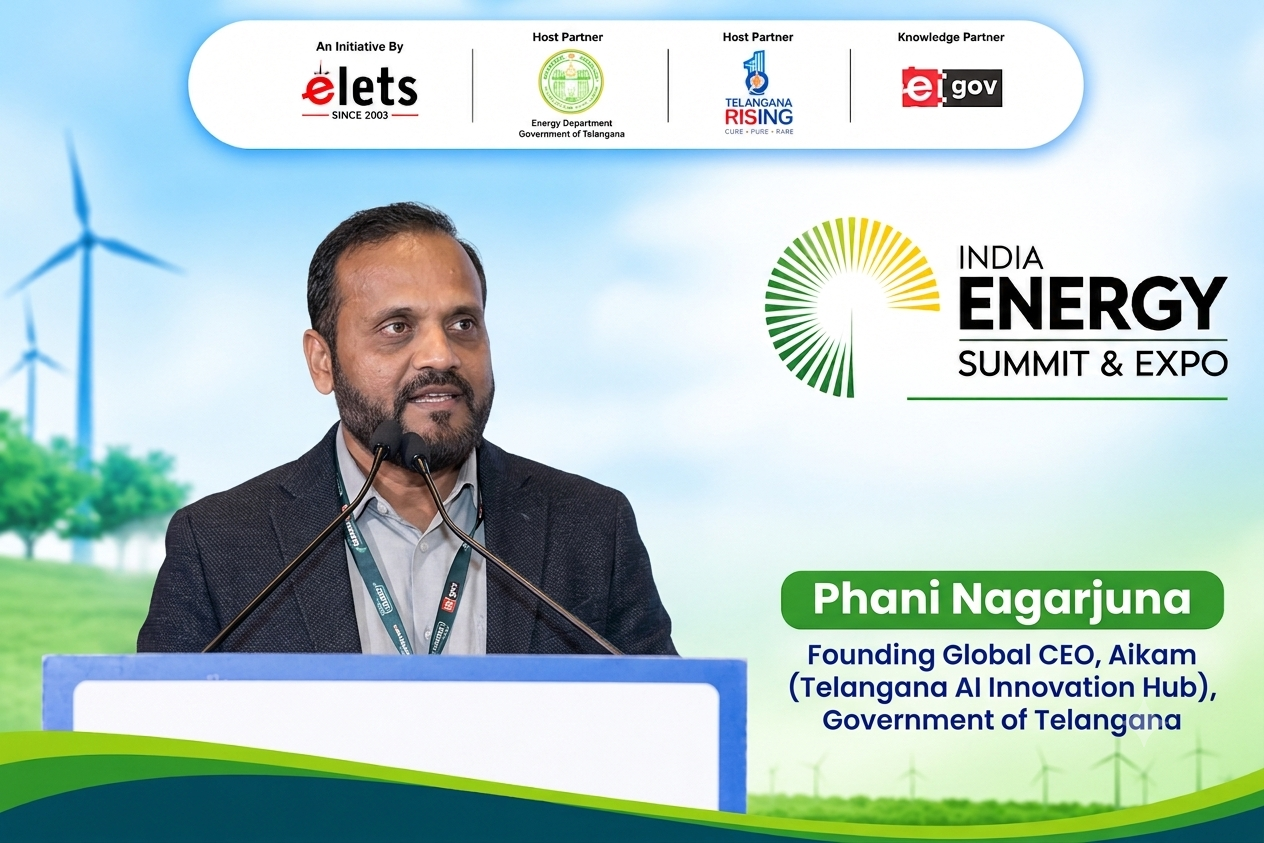
Insights shared by Phani Nagarjuna, Founding Global CEO, Aikam (Telangana AI Innovation Hub), Govt. of Telangana Undertaking, at the India Energy Summit and Expo 2026, held on 18-19 August 2026, Hyderabad

Be a part of Elets Collaborative Initiatives. Join Us for Upcoming Events and explore business opportunities. Like us on Facebook , connect with us on LinkedIn and follow us on Twitter, Instagram.
"Exciting news! Elets technomedia is now on WhatsApp Channels Subscribe today by clicking the link and stay updated with the latest insights!" Click here!