 News





Article
Green Hydrogen: Turning India’s National Mission into a Competitive Industrial Reality
Green Hydrogen: Turning India’s National Mission into a Competitive Industrial Reality
![]() By
Samuel Raj 27-November-2026


India’s green hydrogen ambitions represent an important opportunity to reshape the country’s energy future, strengthen industrial competitiveness and reduce dependence on conventional fuels. Yet, the success of this transition will not be determined by policy announcements or production targets alone. It will depend on whether green hydrogen can be produced at competitive prices, supported by reliable infrastructure, adopted by industries and backed by a skilled workforce.
The progress outlined during a presentation on India’s National Green Hydrogen Mission suggests that the country is moving beyond the planning stage. Incentives for electrolyser manufacturing, procurement tenders, refinery demand, pilot projects, certification systems and port-based green fuel initiatives are beginning to create the foundations of a domestic ecosystem. The challenge now is to connect these individual developments into a commercially sustainable industry.

In my view, green hydrogen should not be seen merely as another renewable energy initiative. It is an industrial transformation that will require coordinated action across energy, manufacturing, transport, shipping, research and skills development. India has made a promising start, but the next phase must focus on execution, affordability and the creation of dependable demand.
From Mission Targets to Industrial Capacity
One of the clearest indicators of progress is the emergence of production and manufacturing capacity. According to the presentation, approximately 8,000 tonnes per annum of green hydrogen production capacity had been commissioned, with additional projects in the pipeline. India also had around 1 GW of electrolyser manufacturing capacity, although the presenter noted that not all of this capacity was fully functional.

These developments matter because electrolyser technology is central to producing green hydrogen through the electrolysis of water using renewable electricity. Building domestic manufacturing capacity can help India develop technical expertise, reduce exposure to external supply chains and create opportunities for industrial investment.
The mission has also supported electrolyser manufacturing through incentives covering a total of 3 GW across two tranches, involving 15 companies. The presentation indicated that additional capacity was expected to come online over the following years, with approximately 2–4 GW of annual manufacturing capacity anticipated by 2028.
However, installed manufacturing capacity should not automatically be equated with commercially viable production. The industry will need reliable orders, competitive equipment, quality assurance and sufficient utilisation to sustain investment. Manufacturing facilities must be able to operate efficiently, while hydrogen producers must have confidence that the market will absorb their output.
This is where policy implementation becomes decisive. Incentives can help companies establish capacity, but long-term industrial strength will depend on whether those facilities can compete on cost, performance and reliability.
The Economics of Green Hydrogen Will Determine Its Future
For green hydrogen to move from promising technology to widespread industrial adoption, cost competitiveness remains essential. The presentation highlighted encouraging results from government-supported procurement tenders, particularly those involving refineries and green ammonia.
In one refinery-related tender, the lowest reported price was approximately ₹280 per kilogram of hydrogen, excluding taxes. The presenter suggested that if the downward price trend continued, green hydrogen could move closer to parity with conventional, or grey, hydrogen in the coming years. The presentation also referred to a point below approximately ₹230–250 per kilogram as potentially significant for improving its commercial attractiveness.
These figures should be understood as tender-specific results rather than universal market prices. Actual costs will depend on renewable electricity prices, electrolyser efficiency, plant utilisation, financing, transportation and other project-specific factors.
Nevertheless, the underlying message is important: green hydrogen economics are beginning to be tested through actual procurement rather than remaining confined to projections.
The presentation also identified a green ammonia tender associated with Numaligarh Refinery as a major success. The reported winning price was approximately ₹53 per kilogram of hydrogen-equivalent procurement, described by the presenter as equivalent to around US$600 per tonne of ammonia at the prevailing exchange rate. The presenter characterised this as highly competitive in the global market and emphasised that the price reflected delivery to the receiving facility rather than merely the cost at the production plant.
Such tenders can play a valuable role in establishing price benchmarks and demonstrating that Indian projects can attract competitive bids. They also help create confidence among investors, suppliers and potential buyers.
However, the long-term test will be whether these prices can be sustained as projects scale up and move from tender awards to actual production and delivery. The transition requires more than a low bid: it needs reliable supply, credible offtake agreements and infrastructure that keeps the delivered cost under control.
Creating Demand Is as Important as Producing Hydrogen
A green hydrogen industry cannot develop on production capacity alone. Producers need customers who are willing and able to purchase hydrogen over the long term. Without predictable demand, even technically successful projects can struggle to secure financing and maintain operations.
The presentation highlighted demand aggregation as an important part of the National Green Hydrogen Mission. It referred to hydrogen tenders totalling approximately 8.6 lakh tonnes, alongside separate initiatives involving green ammonia and refinery requirements. It also cited a potential green ammonia demand figure of around 3.25 million tonnes based on publicly available information, while acknowledging that supply could be phased.
These figures indicate the potential scale of demand, but the distinction between identified demand, tendered quantities, contracted supply and actual consumption remains important. Each stage reflects a different level of commercial certainty.
Refineries and fertiliser-related applications can provide an initial market for green hydrogen and green ammonia. These sectors already use hydrogen or ammonia in their industrial processes, creating a potential pathway for replacing some conventional production with lower-emission alternatives.
Demand aggregation can help overcome the fragmented nature of early markets. By bringing buyers together and creating clearer procurement opportunities, the government can make it easier for producers to plan investments and achieve economies of scale.
The next challenge is to expand this approach into other applications while ensuring that demand is commercially credible. Green hydrogen should be introduced where its use can deliver meaningful benefits and where the economics, infrastructure and technical requirements support adoption.
Certification and Standards Will Build Market Confidence
As the green hydrogen market expands, buyers must be able to verify the environmental credentials of the product they purchase. Without clear definitions and reliable measurement, claims about emissions reductions can become difficult to compare across producers and markets.
The presentation stated that India had published a green hydrogen standard and established a certification framework, with an application portal launched for producers seeking certification. Work on a certification scheme for green ammonia was also described as being under development.
These measures are essential to building a trustworthy market. Certification can establish common criteria, improve transparency and help buyers distinguish qualifying green hydrogen from hydrogen produced through more carbon-intensive processes.
However, international alignment will also matter. The presentation highlighted differences between India’s approach and European requirements, including rules concerning the timing of renewable energy installations, matching renewable electricity generation with consumption, and the relationship between renewable plants and electrolyser locations.
Such differences could affect the ability of Indian producers to serve export markets. If India intends to become a major supplier of green hydrogen and its derivatives, certification systems must be credible domestically while remaining understandable and compatible with the requirements of key trading partners.
This does not mean India must automatically adopt every external rule. It means that standards should be developed with a clear understanding of their implications for trade, investment and emissions accounting.
A reliable certification framework will strengthen confidence among domestic buyers and international customers alike.
State Governments Must Turn Incentives into Results
The national mission provides the broad direction, but states will play a decisive role in determining how quickly projects become operational. The presentation noted that some states had introduced dedicated hydrogen policies, while others were providing support through existing renewable energy or industrial policies.
This flexibility can encourage states to compete for investment. However, incentives alone will not determine where projects succeed. Administrative efficiency, land availability, electricity access, infrastructure readiness and the speed of approvals can be equally important.
The presentation made a particularly relevant point: timely implementation can matter more than the size of an incentive package. A state offering relatively modest support but delivering approvals predictably may be more attractive to investors than one offering generous incentives that are difficult to access.
States therefore need clear implementation frameworks. Investors should be able to understand the approvals required, the agencies responsible, the available incentives and the timelines involved. Coordination between energy departments, industrial authorities, electricity utilities and local administrations must improve as project pipelines grow.
The same principle applies to central government programmes. Schemes should be designed not only to announce support but also to ensure that companies can access it without unnecessary delays.
For India’s green hydrogen mission, the quality of execution will ultimately determine whether policy ambition translates into industrial capacity.
Beyond Refineries: Steel, Mobility and Shipping
Green hydrogen’s long-term significance lies in its potential to support decarbonisation across sectors that are difficult to electrify directly. The presentation highlighted government-supported pilot projects in steel, mobility and shipping.
In steelmaking, pilot initiatives are examining the use of hydrogen in blast furnace processes. Such projects can help establish technical feasibility, understand operational requirements and assess the economic implications of introducing hydrogen into existing industrial systems.
In mobility, the mission is supporting hydrogen-powered buses and refuelling infrastructure. The presentation referred to an expanded programme involving approximately 70 vehicles and 15–16 stations across different initiatives. These deployments can provide practical evidence about vehicle performance, infrastructure utilisation, safety and operating costs.
Shipping offers another potential application. The presentation referred to a green methanol bunkering facility at Thoothukudi port and an order for a vessel designed to operate on methanol. These initiatives point towards the possibility of using hydrogen-derived fuels in maritime transport, where direct electrification can be difficult for certain applications.
Yet pilot projects must eventually answer a critical question: can these solutions work at scale and at a competitive cost? Demonstration projects are necessary to test technology, but their long-term value depends on the lessons they generate and the pathways they create towards commercial deployment.
India must therefore ensure that pilots are evaluated carefully, that successful models can be replicated and that public funding produces practical outcomes rather than isolated demonstrations.
Ports, Exports and the Green Fuel Opportunity
India’s green hydrogen strategy also has an international dimension. The presentation identified three ports recognised as green hydrogen hubs, with planning underway for handling hydrogen and green fuels. It also referred to export commitments associated with companies including ACME, Juniper Green, L&T and Reliance.
Ports can become important nodes in the emerging green fuel economy. They can connect renewable energy resources, production facilities, storage, transport and international shipping. Green hydrogen can also be converted into derivatives such as ammonia and methanol, which may be more practical for certain storage, transport and end-use applications.
However, export ambitions must be supported by dependable production, logistics, certification and long-term buyer commitments. India should avoid treating export announcements as equivalent to operational export capacity.
The opportunity is significant, but international competitiveness will depend on the complete value chain—from renewable electricity and hydrogen production to conversion, storage, port infrastructure and delivery.
Research, Safety and Skills Cannot Be Afterthoughts
A final issue deserves greater attention: the people and institutions required to operate the industry safely and efficiently.
The presentation highlighted funding for research and development, start-ups, testing facilities, hydrogen valleys and skill development. It also stressed that the availability of trained technicians and plant operators could become a major challenge as larger facilities enter operation.
This warning should be taken seriously. Green hydrogen involves equipment, processes and safety requirements that demand specialised expertise. Expanding production without a corresponding increase in trained personnel could create operational bottlenecks and undermine reliability.
Testing facilities and common safety standards are equally important. Equipment manufactured in India must be tested for performance and safety, while installation practices and operating procedures must keep pace with the growth of the industry.
Smaller hydrogen valleys can support this process by allowing technologies and applications to be tested at manageable scales before wider deployment. Start-ups and research institutions can contribute by developing equipment, improving efficiency and addressing local operating challenges.
India should therefore treat skills, safety and research as core infrastructure for the green hydrogen economy, rather than as secondary components of the mission.
The Next Phase Must Focus on Execution
India’s National Green Hydrogen Mission has begun establishing the foundations of an emerging industry through manufacturing incentives, procurement tenders, certification, pilot projects and infrastructure planning. The opportunity now is to connect these initiatives into a coherent commercial ecosystem.
The priorities are clear: bring production costs down, secure reliable buyers, maintain predictable policies, improve state-level implementation, align standards with international markets and invest in the infrastructure and workforce needed for large-scale deployment.
Green hydrogen will not replace every conventional fuel or become economical in every application overnight. Its contribution will depend on where it offers practical environmental and industrial advantages. That makes careful planning and credible economic assessment more important, not less.
The government’s role is to create the conditions for investment and innovation while ensuring that public support leads to measurable outcomes. Industry must demonstrate that projects can deliver reliable products at competitive prices. States must make implementation predictable, while researchers and training institutions must prepare the technologies and workforce required for the next stage.
India has an opportunity to move beyond being a participant in the global green hydrogen transition and become a competitive producer of hydrogen-based fuels and industrial solutions. Achieving that ambition will require more than targets and tenders. It will require consistency, collaboration and the discipline to turn promising early results into durable commercial success.
The foundation is being built. The real test begins now: whether India can convert policy momentum into a self-sustaining green hydrogen industry that strengthens energy security, supports domestic manufacturing and contributes meaningfully to the country’s long-term decarbonisation goals.
——————————–
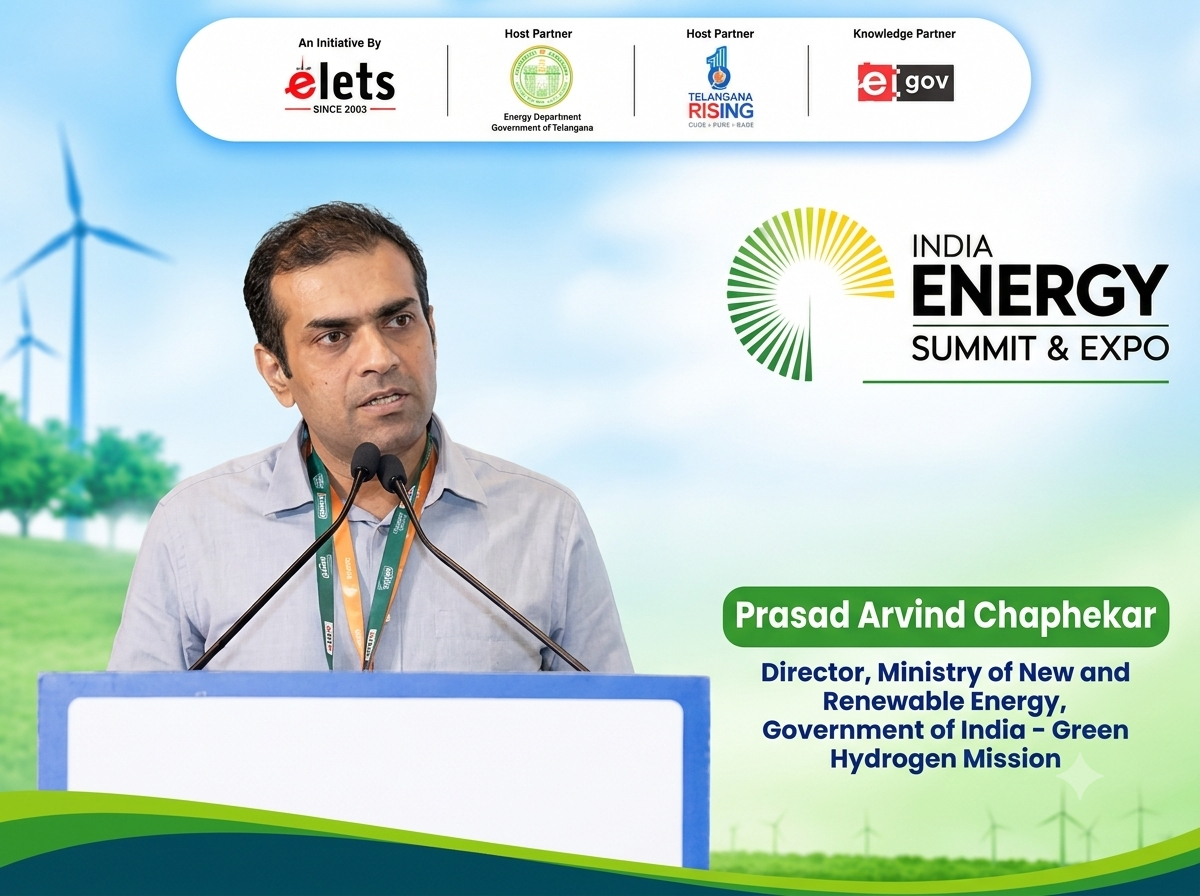
Insights shared by Prasad Arvind Chaphekar, Director, Ministry of New and Renewable Energy, Government of India – Green Hydrogen Mission. at the India Energy Summit and Expo 2026, held on 18-19 August 2026, Hyderabad

Be a part of Elets Collaborative Initiatives. Join Us for Upcoming Events and explore business opportunities. Like us on Facebook , connect with us on LinkedIn and follow us on Twitter, Instagram.
"Exciting news! Elets technomedia is now on WhatsApp Channels Subscribe today by clicking the link and stay updated with the latest insights!" Click here!