 News





Article
Modernising India’s Power Grid: Building a Reliable, Intelligent and Future-Ready Energy Network
Modernising India’s Power Grid: Building a Reliable, Intelligent and Future-Ready Energy Network
![]() By
Samuel Raj 27-November-2026


India’s power sector is entering a decisive phase. Electricity demand is rising rapidly, driven by industrial growth, urbanisation, modernisation of the railway network, expansion of data centres, electric mobility and increasing cooling requirements. As our economy grows and new industries emerge, the pressure on the electricity system will continue to intensify.
In this changing environment, I believe the central question is no longer simply how much power we can generate. We must ask whether we can deliver reliable, affordable and high-quality electricity wherever and whenever it is needed. Generating electricity is only one part of the energy value chain. Ensuring that it reaches consumers efficiently, safely and consistently requires a modern transmission and distribution network supported by digital intelligence, automation, storage, resilient infrastructure and skilled professionals.

For India, strengthening this infrastructure is essential to sustaining economic growth and meeting the changing expectations of consumers. We must move beyond measuring progress only through installed generation capacity and focus increasingly on usable, dispatchable and reliable energy.
The changing demands on India’s electricity grid
India’s electricity grid is becoming more complex. The rapid expansion of solar and wind generation, often located far from major consumption centres, is changing the way power flows across the country. Unlike conventional generation, renewable energy is variable and dependent on weather conditions. This creates new requirements for grid planning, balancing and transmission capacity.

At the same time, the growth of rooftop solar, battery storage systems and electric vehicles is adding new dimensions to electricity management. Industrial and urban demand is increasing, while consumers expect uninterrupted power supply and consistently high service quality. These expectations are becoming central to the competitiveness of businesses and the overall quality of life.
We must also account for emerging risks. Extreme weather events can disrupt infrastructure and affect electricity supply. Cyber threats are becoming more significant as power networks become increasingly connected and digitally managed. Equipment failures can have wider consequences when systems are operating under greater demand and complexity.
These developments make it clear that our existing infrastructure and operating practices must evolve. We need networks that can accommodate renewable energy, respond to changing demand, withstand disruptions and deliver dependable power to consumers.
Strengthening transmission infrastructure for renewable integration
Transmission is the backbone of India’s energy transition. Renewable energy cannot contribute fully to energy security unless the transmission system is planned and strengthened ahead of generation capacity.
Solar- and wind-rich regions are not always located close to major demand centres. We therefore need efficient transmission corridors to move electricity from generation locations to the places where it is consumed. Strengthening both inter-state and intra-state transmission networks must remain a priority.
The development of green energy corridors will be particularly important in connecting renewable-rich regions with industrial and urban centres. Depending on technical and economic requirements, high-capacity alternating current (AC) and high-voltage direct current (HVDC) systems can play an important role in expanding the capacity and efficiency of the transmission network.
However, strengthening the grid does not always mean building entirely new infrastructure. We must also examine how effectively we are using our existing assets. Land and right-of-way constraints are significant challenges for transmission expansion. In many locations, creating additional infrastructure is difficult, making it necessary to improve the carrying capacity of existing networks.
One approach is reconductoring, where existing conductors are replaced with high-temperature, low-sag conductors that can carry greater amounts of electricity. This allows us to increase transmission capacity while making better use of existing corridors.
We should also consider upgrading voltage levels where technically and economically feasible, rather than relying only on adding more transmission assets. Dynamic line rating is another important tool. By monitoring operating conditions, it can help improve the utilisation of existing transmission infrastructure.
These interventions can help us address capacity constraints more efficiently while ensuring that the grid is prepared for increasing renewable energy generation and electricity demand.
Integrating storage and flexible resources
As renewable energy becomes a larger part of India’s electricity mix, flexibility will become increasingly important. Solar and wind generation do not always match the timing of electricity demand. We therefore need systems that can balance fluctuations and ensure power availability when consumers require it.
Battery energy storage systems and other flexible resources must become an integral part of grid planning and operation. Storage can help manage variations in renewable generation, support peak demand and improve the reliability of electricity supply.
The focus should not be limited to installing storage capacity. We must ensure that these resources are effectively integrated into transmission and distribution networks and can respond to the operational requirements of the power system.
A modern grid will need coordination between renewable generators, transmission utilities, distribution companies and system operators. Digital platforms can support this coordination by enabling better information sharing, forecasting and operational decisions.
The objective is to create a power network in which generation, transmission, storage and consumption operate as interconnected parts of one system.
Moving from reactive maintenance to predictive reliability
Another important transformation must take place in the way we maintain power infrastructure. Traditionally, maintenance has often depended on scheduled inspections or action taken after a fault has occurred. As electricity networks become more complex and the cost of disruption increases, this approach needs to evolve.
I believe reliability must move from a reactive model to a predictive one.
The use of sensors across transmission substations and the application of machine learning tools for transmission-line maintenance represent important steps in this direction. By collecting and analysing operational data, utilities can identify potential problems earlier and take corrective action before equipment failure affects the network.
Predictive maintenance can help improve asset availability, reduce unplanned outages and support more efficient maintenance planning. It also allows utilities to make better use of their resources by identifying which equipment requires attention and when.
We are also seeing the emergence of physical intelligence alongside digital coordination. Digital systems can help different stakeholders exchange information, while physical intelligence and advanced monitoring technologies can support the actual operation and maintenance of infrastructure.
At Mega Engineering and Infrastructure Limited, we have recently brought in a technology partner as part of our effort to strengthen these capabilities. Our focus is on combining technological solutions with engineering expertise to support the modernisation of power infrastructure.
The larger objective is to improve coordination between generators, transmission utilities, distribution companies and system operators. In today’s electricity ecosystem, these stakeholders cannot work in isolation. Their decisions must be connected if we are to deliver reliable power consistently.
The role of engineering companies in the grid transformation
As an engineering and infrastructure company, I believe our responsibility extends well beyond constructing transmission lines, substations and other physical assets. We must support the complete lifecycle of infrastructure, beginning with planning and design and continuing through commissioning, operations, maintenance and eventual modernisation.
The quality of infrastructure is determined not only by how quickly it is built but also by how safely and efficiently it performs throughout its operating life.
At Mega Engineering and Infrastructure Limited, we place emphasis on several key areas.
First, we must deliver safe and high-quality transmission and distribution assets. Safety and quality cannot be treated as secondary considerations, particularly when infrastructure is expected to operate under increasing demand and changing conditions.
Second, we must use digital engineering and Building Information Modelling (BIM) to improve planning, design coordination and project execution. These technologies can help create better visibility across different stages of infrastructure development and support more informed engineering decisions.
Third, we need to improve construction productivity and maintain discipline in project schedules. Delays in infrastructure development can affect the wider power ecosystem. Better planning, coordination and execution are therefore essential.
Fourth, maintainability and lifecycle costs must be considered at the design stage itself. Infrastructure should not simply be designed to meet immediate construction requirements. It must also be practical to operate and maintain over the long term.
Finally, our support to utilities must continue beyond project completion. Training, spare parts availability and long-term service capabilities are important for ensuring that assets deliver consistent performance throughout their operational life.
This is how engineering companies can contribute to a more reliable electricity system—not only by creating infrastructure but by supporting its performance over time.
From isolated digital interventions to an integrated power network
The power sector has already begun adopting digital technologies, but the next stage must focus on integration. Individual digital interventions can deliver value, but their impact will be greater when they are connected through a coordinated and outcome-driven approach.
We need an intelligent network in which infrastructure monitoring, asset management, maintenance planning and system operations work together. Data generated at substations, transmission lines and other network assets should support practical decisions that improve reliability and efficiency.
This requires collaboration among utilities, technology providers, engineering companies and system operators. It also requires skilled people who understand both the physical infrastructure and the digital systems being deployed.
Technology alone cannot modernise the power sector. We need engineers, technicians, project managers and operations professionals who can implement these solutions and ensure that they deliver measurable improvements.
Training and capability development must therefore remain an important part of infrastructure modernisation. As automation, sensors, machine learning and digital engineering become more common, the skills required across the sector will also evolve.
Our approach must combine technology, engineering discipline and human expertise to create infrastructure that is not only modern but also dependable and sustainable.
Building a reliable power future through collaboration
India’s electricity requirements will continue to grow as industries expand, cities develop and new technologies reshape consumption patterns. Meeting this demand will require more than additional generation capacity. We must build a power network capable of delivering electricity reliably, efficiently and safely.
This means strengthening inter-state and intra-state transmission corridors, developing green energy corridors, improving the capacity of existing assets, integrating storage and flexible resources, and adopting predictive maintenance practices. It also means using digital engineering, improving construction productivity and ensuring that infrastructure is designed with its entire lifecycle in mind.
No single stakeholder can accomplish this transformation independently. Governments must create enabling policies and infrastructure plans. Utilities must modernise their networks and operating practices. Technology companies must bring innovation, while engineering companies must deliver high-quality assets and support their long-term performance. Skilled professionals must bring these different capabilities together.
At Mega Engineering and Infrastructure Limited, we see an important opportunity to contribute to this transformation through our engineering, infrastructure and technology capabilities. Our role is to support utilities not only in constructing assets but also in improving their reliability, maintainability and long-term performance.
I believe the future of India’s power sector will depend on how effectively we move from isolated infrastructure projects and digital interventions towards an intelligent, integrated and outcome-driven electricity network.
Ultimately, the objective is straightforward: every consumer should receive reliable, affordable and high-quality electricity whenever it is needed. Achieving this will require us to rethink how we plan, build, operate and maintain our power infrastructure.
That is how we can strengthen India’s energy backbone and build a reliable power future for the country.
——————————–
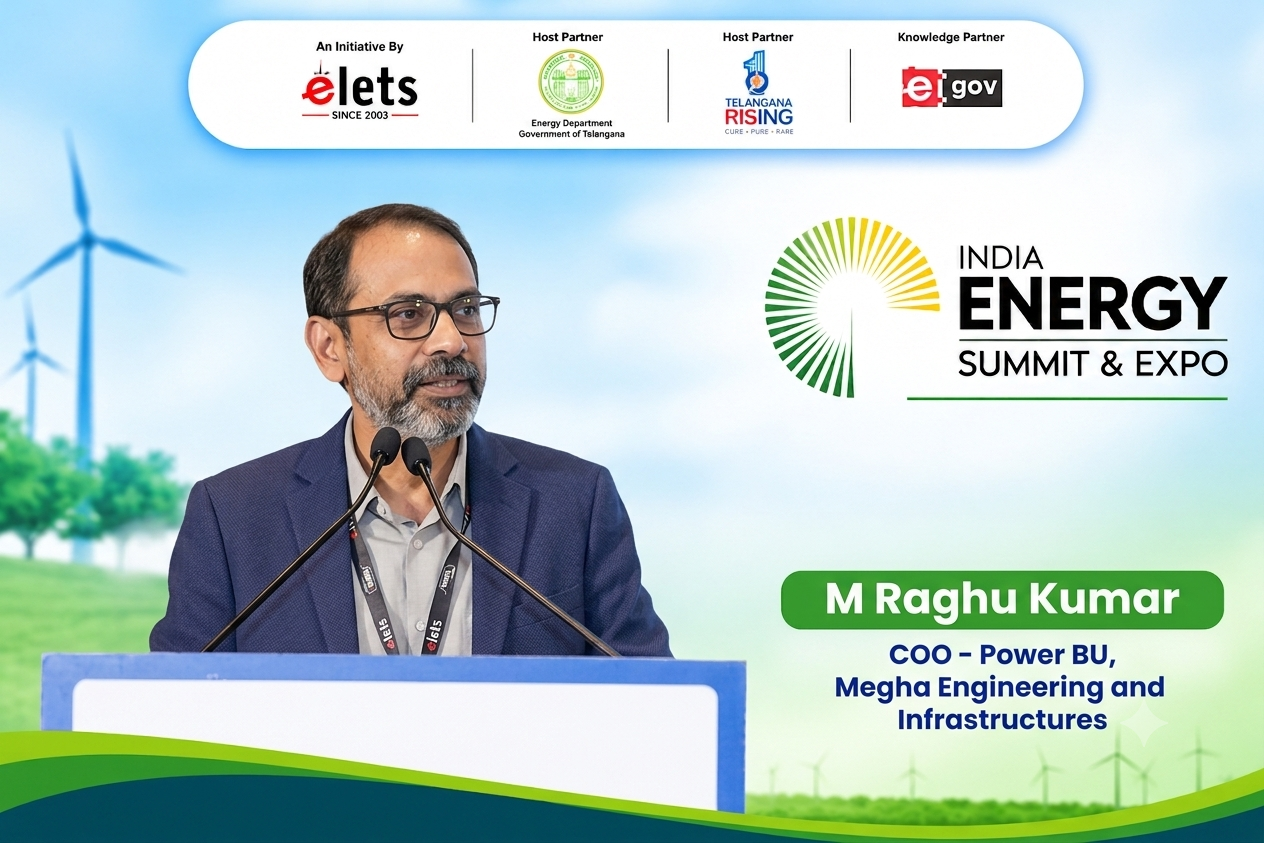
Insights shared by M Raghu Kumar, COO – Power BU, Megha Engineering and Infrastructures, at the India Energy Summit and Expo 2026, held on 18-19 August 2026, Hyderabad

Be a part of Elets Collaborative Initiatives. Join Us for Upcoming Events and explore business opportunities. Like us on Facebook , connect with us on LinkedIn and follow us on Twitter, Instagram.
"Exciting news! Elets technomedia is now on WhatsApp Channels Subscribe today by clicking the link and stay updated with the latest insights!" Click here!