 News
News





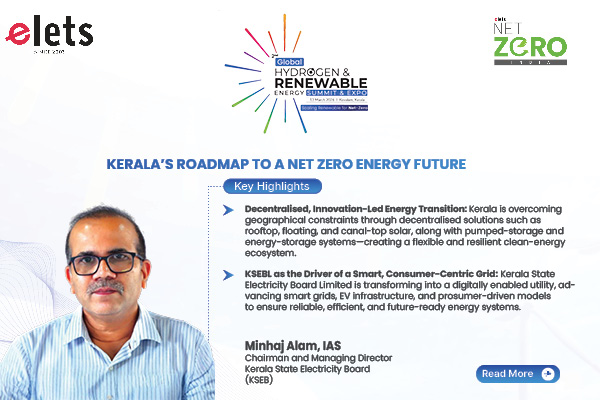
Kerala has long been recognised for its commitment to sustainable development and environmental stewardship. Minhaj Alam, IAS, Chairman and Managing Director, Kerala State Electricity Board (KSEB), shares insights on the state’s clean energy roadmap in an exclusive interaction with Krishna Mishra of Elets News Network. He outlines Kerala’s strategy to achieve 100% renewable energy by 2040 and Net Zero emissions by 2050, highlighting initiatives such as distributed solar, pumped hydro storage, smart grids, electric mobility and green hydrogen.
Kerala has always been a pioneer in sustainable development. How do you envision the state’s energy transition journey toward Net Zero in the coming decade?
Kerala’s energy transition will be driven by a balanced approach that integrates renewable energy expansion, energy efficiency, electrification of transport and grid modernisation. As a state with limited land availability but strong environmental consciousness, our strategy focuses on maximising distributed renewable energy, optimising hydropower resources and enhancing demand-side management.
Over the coming decade, Kerala aims to significantly increase the share of clean and renewable energy in its energy mix through initiatives such as rooftop solar, floating solar, pumped hydro storage and emerging technologies like green hydrogen. KSEBL will continue to act as the backbone of this transition, ensuring that the state’s key sustainability goals – 100% renewable energy by 2040 and Net Zero by 2050 – are achieved without compromising the reliability and affordability of power for consumers.

As CMD of KSEBL, what strategic reforms are being implemented to transform the utility into a future-ready green power utility?
KSEBL is undergoing a comprehensive transformation to become a digitally enabled, consumer-centric and environmentally responsible utility. Key reforms include grid modernisation, digitalisation of distribution networks, advanced metering infrastructure and improved integration of renewable energy sources into the grid.
We are strengthening planning and forecasting capabilities, investing in smart grid technologies and building institutional capacity to manage a more dynamic and decentralised energy ecosystem. At the same time, KSEBL is aligning its strategies with national energy transition targets and global climate commitments, positioning the utility as a key driver of Kerala’s green energy future.
In parallel, KSEBL is playing a pivotal role in advancing electric mobility in the state. The utility has been actively establishing and operating a network of electric vehicle (EV) charging stations across Kerala to support the transition to clean transportation. Through initiatives such as the deployment of public charging infrastructure, integration of EV load into grid planning and participation in national programmes such as the PM E-DRIVE scheme, KSEBL is enabling the growth of a reliable EV ecosystem.
These efforts not only promote the adoption of electric vehicles but also contribute to reducing carbon emissions and strengthening Kerala’s pathway towards sustainable mobility and clean energy transition.
Kerala has geographical constraints for large renewable projects. What innovative renewable energy models is KSEBL exploring to overcome these challenges?
Kerala’s unique geography requires innovative renewable energy models rather than large land-based projects. KSEBL is therefore focusing on distributed and hybrid renewable energy solutions.
Key initiatives include floating solar projects on reservoirs, canal- top solar installations, expansion of rooftop solar through consumer participation, and the development of pumped storage hydropower projects using existing reservoirs. We are also exploring agrivoltaics, community solar models and the integration of solar with EV charging infrastructure.
A major milestone in this direction has been the success of KSEBL’s rooftop solar programme, Soura. Through this initiative, thousands of domestic consumers, institutions and commercial establishments across Kerala have installed grid-connected rooftop solar systems with the support of KSEBL. The programme has significantly accelerated decentralised solar generation in the state, enabling consumers to become prosumers while reducing dependence on conventional power sources.
KSEBL has also introduced an innovative initiative to deploy an extensive network of pole-mounted EV charging stations for light electric vehicles across the state. This approach supports the growth of electric mobility while ensuring productive utilisation of excess solar power during peak generation periods, thereby improving grid efficiency and promoting a clean, integrated energy ecosystem.
These models allow us to utilise existing assets and spaces efficiently while significantly expanding renewable energy capacity.
As renewable penetration increases, grid stability becomes critical. What steps is KSEBL taking toward smart grids, storage solutions and grid flexibility? How important are battery storage and pumped hydro storage for Kerala’s power security?
Grid stability is a key priority as renewable penetration increases. KSEBL is investing in smart grid infrastructure, advanced forecasting systems and digital monitoring tools to enhance grid flexibility and reliability.
Energy storage will play a crucial role in Kerala’s future power system. Battery Energy Storage Systems (BESS) will help manage short-term fluctuations and improve grid responsiveness, while pumped hydro storage offers a reliable long-duration storage solution suited to Kerala’s hydrological landscape.
In this direction, KSEBL has initiated three grid-level BESS projects with a combined storage capacity of 1500 MWh. These projects are currently under implementation and are expected to be commissioned by October 2026. The deployment of such large-scale storage infrastructure will significantly enhance grid flexibility and help manage the variability associated with renewable energy generation.
Together, these technologies will enable better integration of renewable energy while ensuring round-the-clock power security for the state.
What opportunities exist for private sector participation and technology providers in Kerala’s renewable and hydrogen ecosystem?
The energy transition requires strong partnerships between public utilities, private investors and technology providers. Kerala offers significant opportunities in areas such as renewable energy development, energy storage, EV charging infrastructure, green hydrogen and smart grid technologies.
KSEBL is increasingly adopting collaborative models including public-private partnerships, competitive procurement and innovation partnerships. We welcome investors and technology providers who can bring advanced solutions, innovative financing models and global expertise to support Kerala’s clean energy ambitions.
How is KSEBL encouraging consumer participation in the energy transition?
Consumer participation is central to Kerala’s energy transition. KSEBL has been actively promoting rooftop solar installations, net metering mechanisms, EV charging infrastructure and energy efficiency programmes.
We envision consumers evolving into “prosumers” — both producers and consumers of energy. Local communities can play a significant role by adopting rooftop solar, participating in energy efficiency initiatives and supporting the transition toward electric mobility.
Such decentralised participation not only strengthens the energy ecosystem but also helps build a community-driven model of sustainability.
How important is collaboration between government, utilities, industry and research institutions in achieving energy transition targets?
Energy transition is a complex challenge that cannot be achieved by any single stakeholder. It requires strong collaboration between government agencies, utilities, industry partners, research institutions and startups.
Academic and research organisations can support innovation, policy development and technology adaptation, while industry partners can accelerate deployment through investment and expertise.
Collaborative platforms ensure that policy, technology and market mechanisms evolve together, enabling a smoother and faster transition to a sustainable energy system.
What are your expectations from the Global Hydrogen and Renewable Energy Summit in Kovalam?
Achieving 100% renewable energy by 2040 and Net Zero emissions by 2050 are among the most ambitious and time- bound energy transition goals being pursued globally today. Platforms such as the Global Hydrogen and Renewable Energy Summit play a critical role in bringing together governments, utilities, industry stakeholders and investors to collectively work towards these targets.
The summit provides an important platform for policymakers, industry leaders, researchers and investors to exchange ideas, build partnerships and identify practical pathways for deploying emerging technologies such as green hydrogen, large-scale renewable integration and advanced energy storage solutions.
Discussions on green hydrogen are particularly significant as hydrogen is emerging as a key energy vector that can complement renewable energy by enabling long-duration storage, supporting grid stability and decarbonising hard-to- abate sectors such as heavy industry and transport.
My message to participants is that the energy transition is both a responsibility and a tremendous opportunity. States like Kerala are committed to building a sustainable, resilient and inclusive energy future, and we welcome collaboration from innovators, technology providers and investors willing to partner with us in accelerating the transition toward a clean and sustainable energy ecosystem.

Be a part of Elets Collaborative Initiatives. Join Us for Upcoming Events and explore business opportunities. Like us on Facebook , connect with us on LinkedIn and follow us on Twitter, Instagram.
"Exciting news! Elets technomedia is now on WhatsApp Channels Subscribe today by clicking the link and stay updated with the latest insights!" Click here!