 News
News





Article
When Arjuna Asked About Net Zero
When Arjuna Asked About Net Zero
A dialogue on buildings, cities, and the systems that shape them
![]() By
Abhineet Kumar 08-May-2026
By
Abhineet Kumar 08-May-2026


On the battlefield of Kurukshetra, as told in the Bhagavad Gita, Arjuna once again stood in confusion. But this time, it was not about war. It was about the consequences of the future we are building. He wondered why our best efforts fail to produce better outcomes.
“Krishna,” Arjuna began, “we are designing greener buildings, adopting better materials, and improving ratings and certifications. Yet cities continue to heat up. Emissions continue to rise. If buildings are improving, why are outcomes not improving with them?”

Krishna did not answer immediately. Instead, he asked a quieter question.
“Tell me, Arjuna,” he asked, “what is it that you are truly designing: a building or an outcome?”

“You are solving for the visible unit, while the invisible system shapes the outcome.”
Arjuna paused.
“But let us go step by step. Does a building exist alone?”
“No,” Arjuna replied.
Krishna looked at Arjuna and said, “First, let us understand what Net Zero truly means and why buildings matter so much.”
Arjuna remained silent. Krishna continued:
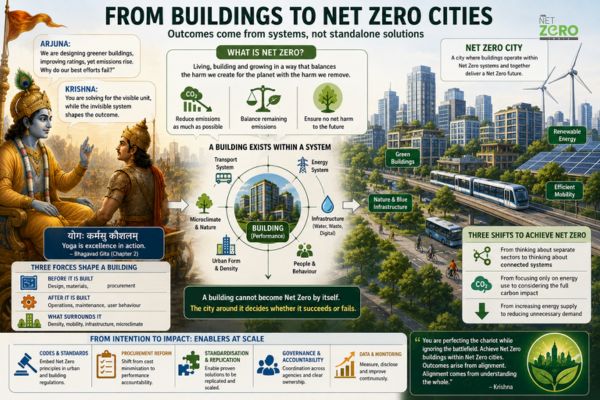
“Net Zero means living, building, and growing in a way that balances the harm we create for the planet with the harm we remove. It is about reducing emissions as much as possible and ensuring that what remains does not continue damaging the future.”
He paused.
“And why do buildings matter so much?”
Because cities are built through buildings, and buildings consume energy, use materials, generate heat, and shape how people live and travel. If buildings change, cities change. And if cities change, the future changes.
“Then what shapes a building’s performance?” Arjuna asked.
Krishna smiled.
“A building alone does not determine Net Zero. The city does. The building exists within a built environment, and that environment determines its performance. The roads around it matter. The transport system matters. The heat outside matters. The energy system matters. The crises you are witnessing are crises of interconnectedness.”
But in reality,” Krishna continued, “a building is shaped by three forces: what happens before it is built, such as design, materials, and procurement; what happens after it is built, such as operations, maintenance, and user behaviour; and what surrounds it, such as density, mobility, infrastructure, and microclimate. You still treat buildings as standalone products designed, constructed, and handed over. What matters is not what a building claims. What matters is how it works.”
“Tell me, Arjuna, can something be Net Zero in isolation?”
Arjuna shook his head.
“Then understand this,” Krishna said, “a building cannot become Net Zero by itself, Arjuna. The city around it decides whether it succeeds or fails. You seek control over outcomes, but outcomes arise from alignment. And alignment comes from understanding the whole.”
He continued, “If the neighbourhood traps heat, if mobility increases emissions, and if infrastructure is inefficient, can a building remain Net Zero?”
Krishna smiled gently and reminded Arjuna:
“योगः कर्मसु कौशलम्” — Yoga is excellence in action.
(Bhagavad Gita, Chapter 2)
“Net Zero,” Krishna said, “is not achieved through intention alone, but through disciplined and aligned action.”
Krishna now reframed Arjuna’s question into a larger realization.
“A high-performance building in a poorly planned city will always underperform. If the city is inefficient, energy demand rises, transport emissions increase, and heat stress intensifies. No building can compensate for a failing system. You are perfecting the chariot while ignoring the battlefield. You are trying to achieve Net Zero buildings within non-Net Zero cities, and then you question why the outcome is incomplete.”
“Then how does a Net Zero city happen?” Arjuna asked.
“A Net Zero city is not designed directly. It emerges,” Krishna replied.
“Emerges from what?” Arjuna asked.
“From Net Zero buildings operating within Net Zero systems,” Krishna said. “You must choose three clear shifts to achieve Net Zero:
- from thinking about separate sectors to thinking about connected systems,
- from focusing only on energy use to considering the full carbon impact, and
- from increasing energy supply to reducing unnecessary demand.”
“In truth,” Krishna said, “urban form influences building performance as much as design.”
“At a building scale, sustainability depends on good design. But at the city scale, sustainability is no longer just a design challenge. It becomes a question of governance, coordination, and accountability — and this is where most efforts fail.”
“Net Zero must be embedded into the DNA of urban growth. Decisions on procurement, materials, design standards, and operations determine whether buildings perform individually or collectively.”
“What happens when these decisions are repeated at scale?” Arjuna asked.
“That is where real transformation begins,” Krishna said.
Krishna turned pragmatic.
“Net Zero sustainability should be incorporated into codes and standards. Procurement must shift from cost minimisation to performance accountability, and standardisation should enable replication at scale.”
“These are not efficiency tools alone,” Krishna said. “They are instruments of decarbonisation. What can be standardised can be optimised. What can be optimised can be decarbonised.”
“You are still thinking of Net Zero as a carbon problem,” he said. “But the city is already telling you otherwise. Climate stress is no longer a distant possibility. It is becoming the defining test of our built environment, whether through extreme heat, floods, water stress, cyclones, or earthquakes.”
He continued, “In cities, workers are losing productivity, vulnerable populations are exposed, buildings are trapping heat instead of releasing it, and infrastructure is amplifying thermal stress. What you design as efficient may still be unlivable.”
Arjuna looked troubled.
“Then buildings must do more than save energy,” he said.
“Yes,” Krishna replied. “Buildings are not just structures that reduce carbon. They are places where people survive climate stress, live safely, and build their future. A building that saves energy but cannot protect people during extreme heat has failed its purpose.”
“For buildings, carbon is also no longer just measured at the end,” Krishna said. “It is locked in at the beginning. The materials you choose, how you construct, how far materials travel, and how buildings are assembled all shape emissions long before the building is occupied.”
“So, what must change?” Arjuna asked.
“Stop chasing the lowest short-term cost, the fastest approvals, and isolated improvements. Start focusing on long-term performance, better systems, and outcomes that last.”
“If you optimise the wrong outcome,” Krishna said, “decline is inevitable, even if everything else improves. If you want Net Zero cities, you must change how decisions are made.”
“You celebrate ratings,” Krishna observed, “but reality unfolds after occupancy. Static certification offers comfort, but measured performance reveals the ultimate truth. Real-time monitoring and post-occupancy evaluation are becoming the new benchmarks of credibility.”
“Buildings are not just carbon assets. They are thermal survival systems.”
“The future is not just about faster construction,” Krishna said. “It is about predictable and scalable outcomes. Off-site construction, modular systems, and digital coordination reduce waste and improve consistency across entire cities.”
“The future will belong to cities that choose performance over promises, coordination over silos, and long-term thinking over short-term gain. These are levers for carbon reduction at scale.”
“Responsibility must not end at the handover of a building. It must extend into actual performance. Carbon and performance must live in procurement, contracts, and finance — not just in sustainability reports. A building does not perform alone. It performs within a city. Move from predicted outcomes to measured ones, and act on the data.”
Krishna reflected, “You are trying to build high-performance buildings within low-performance systems. And then you wonder why outcomes fall short.”
He looked at Arjuna once more.
“Do not try to build one perfect building. Build systems that make many good buildings possible.”
“You are designing buildings to reduce emissions,” Krishna said. “But are you designing them to survive heat? Net Zero without thermal resilience is incomplete.”
“A truly sustainable building must also withstand the shocks and stresses of a changing climate. A building that saves energy but cannot protect its occupants has failed its purpose.”
Arjuna lowered his gaze and bowed his head.
“The challenge,” he said, “was never the bow, nor the arrow, but the steadiness of the hand.”
Krishna paused and added, “What you choose to preserve determines what you will produce. If you optimise buildings, you will get better buildings. If you optimise systems, you will get better cities.”
“When action is aligned, outcomes follow. When systems are aligned, cities transform. Then Net Zero will not be pursued; it will emerge.”
Krishna looked toward the battlefield and reminded him:
“यद्यदाचरति श्रेष्ठस्तत्तदेवेतरो जनः” — Whatever leaders choose, society follows.
(Bhagavad Gita, Chapter 3)
“If cities choose long-term thinking over short-term gain,” Krishna said, “future generations will build differently.”
Views expressed are Personal: Hitesh Vaidya, Urban Practitioner and Former Director, National Institute of Urban Affairs, Government of India; and Dr Shailesh Kumar Agrawal, Former Executive Director, BMTPC, under the Ministry of Housing and Urban Affairs, Government of India

Be a part of Elets Collaborative Initiatives. Join Us for Upcoming Events and explore business opportunities. Like us on Facebook , connect with us on LinkedIn and follow us on Twitter, Instagram.
"Exciting news! Elets technomedia is now on WhatsApp Channels Subscribe today by clicking the link and stay updated with the latest insights!" Click here!