 News
News




News
‘No AI Without Power’: Adani Calls for India to Own Its Energy and Intelligence Future, Unveils $200 Billion Commitment
‘No AI Without Power’: Adani Calls for India to Own Its Energy and Intelligence Future, Unveils $200 Billion Commitment
![]() By
eletsnetzerofinal2025 12-May-2026
By
eletsnetzerofinal2025 12-May-2026


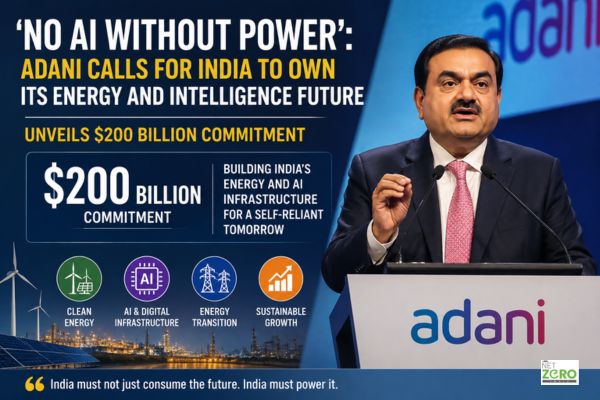
New Delhi: Adani Group Chairman Gautam Adani on Monday delivered what is being widely described as one of the most significant speeches at the Confederation of Indian Industry’s (CII) Annual Business Summit 2026 — a sweeping address that framed energy sovereignty and artificial intelligence as the defining contests of the 21st century, and called on India to build, power, and own the infrastructure of its intelligence future.
Addressing a gathering of India’s top industry leaders, policymakers and global executives in New Delhi, Adani said the world had fundamentally changed — and that India’s strategic response to that change would determine its trajectory for decades. The era of globalisation built on open supply chains, borderless technology and neutral platforms, he argued, is over.

“The world that is emerging is not flat. It is fractured and contested. Semiconductors have become instruments of statecraft. Data is being treated as a national resource. Clouds are being weaponised. And Artificial Intelligence is being built behind the protective walls of data centres.”
— Gautam Adani, Chairman, Adani Group | CII Annual Business Summit 2026

In a keynote that blended geopolitics, industrial strategy and personal conviction, Adani outlined what he called the “new geometry of power” — one where a nation’s economic and strategic standing will be determined not by military strength or trade volume alone, but by its control over two resources: energy and compute.
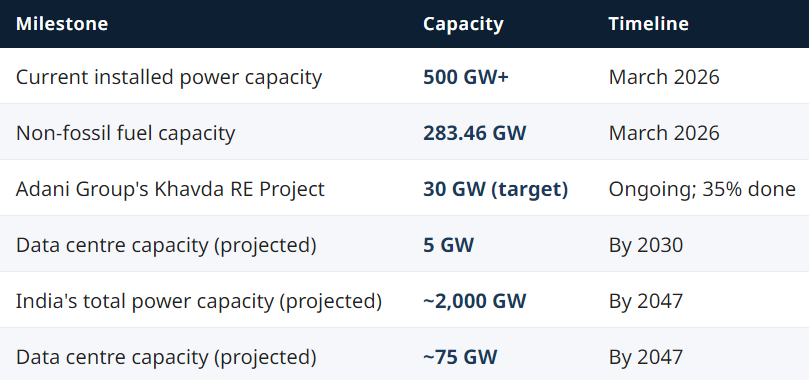
India’s Power Trajectory: 500 GW Today, 2,000 GW by 2047
Adani grounded his address in numbers. He noted that India has already crossed 500 GW of installed power capacity as of March 2026 — a milestone that itself reflects a remarkable acceleration, given that nearly 53 per cent of this capacity was added in just the last decade. But he argued this is only the foundation.
India, he said, must expand its total power capacity nearly four-fold — to close to 2,000 GW by 2047 — to power the factories, electric vehicles, smart cities, data centres and AI infrastructure that a rising, 1.5-billion-strong economy will demand. Meeting that target, he made clear, is not optional. It is a strategic imperative.
India’s Power Capacity — Present and Projected
The AI Stack: Energy at the Bottom of Everything
At the core of Adani’s address was a pointed observation that has become increasingly urgent in global policy circles: artificial intelligence is not simply a software challenge. It is, fundamentally, an infrastructure and energy challenge.
“There can be no AI without compute, no compute without data centres, and no data centres without power. AI is not just software. AI is infrastructure. AI is energy. AI is cooling. AI is chips. AI is networks. AI is data. AI is talent. AI is governance.”
— Gautam Adani, Chairman, Adani Group
Adani described what he called the three-layer AI stack — energy, compute, and applications — arguing that India must own all three layers domestically to be a true player in the intelligence economy, rather than a service provider for other nations’ platforms.
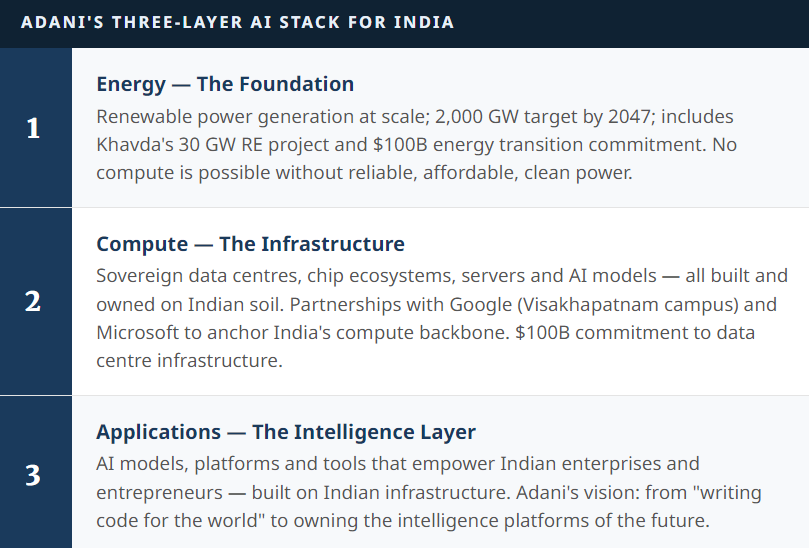
$200 Billion Commitment: Energy and Digital Infrastructure
Adani used the summit to reiterate — and reinforce — a scale of investment commitment that few private sector leaders anywhere in the world have articulated. The Adani Group has committed $100 billion towards energy transition and digital infrastructure, anchored by the 30 GW renewable energy project at Khavda in Gujarat — which, when fully commissioned, will be the world’s largest single-site renewable energy plant. As of the CII Summit, 35 per cent of the Khavda project has already been commissioned.
In addition, Adani announced that a separate $100 billion commitment has been earmarked for the group’s data centre business — a signal of the scale at which the group intends to build India’s AI-ready compute infrastructure. He announced a partnership with Google to develop a gigawatt-scale data centre campus in Visakhapatnam, and said collaborations with Microsoft and other global firms are also underway as part of India’s emerging sovereign compute ecosystem.
‘Don’t Rent the Infrastructure of India’s Intelligence Future’
Some of the most pointed moments of the address came when Adani turned his focus to the risk of digital dependence. Drawing a sharp contrast with India’s traditional IT outsourcing model — which he described as “writing code for other people’s platforms” — he argued that the AI age rewards those who own the data, the compute infrastructure, and the foundational platforms themselves.
“If our data is processed on distant shores, it means our future is being written on foreign shores. India must not rent the infrastructure of its intelligence future. India must build it, power it and own it on its own soil.”
— Gautam Adani, Chairman, Adani Group
He also rejected the prevailing Western narrative that AI would primarily destroy jobs, arguing that India should approach artificial intelligence as a productivity and empowerment tool — drawing parallels with the UPI revolution, which he said “moved trust into the hands of ordinary Indians” and birthed an entirely new generation of homegrown enterprises. “Rejecting AI because of fears of job loss would be like rejecting electricity because of fears of the dark,” he said.
Geopolitics: The ‘Fractured World’ and India’s Strategic Window
Adani opened his address by rejecting the “flat world” theory that defined global economic thinking for the past three decades, arguing it has been replaced by a “fractured world” where supply chains, semiconductors and cloud infrastructure are being redesigned around national interests. He pointed to the United States — which achieved energy abundance through the shale revolution and is now pushing for compute dominance — and China — which built energy scale through renewables and is racing ahead in AI — as examples of powers that had already understood this convergence.
For India, Adani argued, the window is open — but it will not remain so indefinitely. He called on the country to treat the next ten years as the critical build-out phase, using its scale of domestic demand, its renewable energy advantage, and its deep pool of technical talent to construct an integrated growth model that no other nation can easily replicate.
“The country that controls its energy will power its industrial future. The country that controls its compute will power its intelligence future. And the country that controls both will shape the century ahead.”
— Gautam Adani, Chairman, Adani Group
He concluded with a reflection on his own decades of building infrastructure in places others had considered impossible — “from ports where there were only marshlands to power projects in regions that knew only darkness” — before turning to a challenge for India as a whole.
“The future does not arrive,” he said. “It is built.” The next freedom struggle, he added, “will be fought in our grids, our data centres, our factories, our classrooms, our laboratories and our minds.”

Be a part of Elets Collaborative Initiatives. Join Us for Upcoming Events and explore business opportunities. Like us on Facebook , connect with us on LinkedIn and follow us on Twitter, Instagram.
"Exciting news! Elets technomedia is now on WhatsApp Channels Subscribe today by clicking the link and stay updated with the latest insights!" Click here!