 News
News




Article
A vision for a Carbon-neutral & Energy-independent Kerala
A vision for a Carbon-neutral & Energy-independent Kerala
![]() By
eletsnetzerofinal2025 07-May-2026
By
eletsnetzerofinal2025 07-May-2026


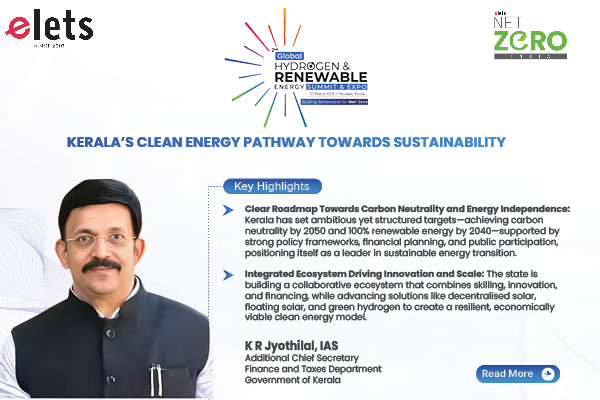
Kerala has set an ambitious yet carefully structured pathway for its energy future. We have committed ourselves to becoming carbon-neutral by 2050 and achieving 100 per cent renewable energy by 2040.
These are not aspirational slogans; they are measurable goals backed by policy, institutional mechanisms, technological integration, and public participation. I believe that the transition to clean energy is not optional. It is an economic, environmental, and moral necessity.
Climate change is a global challenge and therefore demands a global response. We cannot approach it through isolated interventions or competitive positioning. Instead, we must collaborate, share research, pool resources, and scale innovations together. In Kerala, our strategy revolves around building strong linkages between government departments, universities, R&D institutions, start-ups, established industries, and financial institutions. This integrated approach ensures that innovation does not remain confined to laboratories but is translated into viable projects on the ground.
INVESTING IN PEOPLE, INNOVATION AND ECONOMIC VIABILITY

The clean energy transition will succeed only when it rests on three strong pillars.
First, we must invest in people. Skilling and reskilling our workforce is fundamental. Kerala has historically supplied millions of skilled workers to energy-intensive sectors across the world. Today, our focus is to prepare that workforce for the green economy. We aim to become a global hub for clean energy skills, equipping engineers, technicians, researchers, and entrepreneurs to contribute to global decarbonisation.
Second, innovation must drive cost reduction. Research and development play a decisive role in making renewable technologies affordable. Universities, private research centres, and industry partners must work together in a structured manner. Through initiatives such as our Hydrogen Valley innovation cluster, we are integrating academia, industry, and policy frameworks to accelerate the development of scalable hydrogen solutions.
Third, clean energy must be economically sustainable. Technologies will only achieve mass adoption when supported by workable business models. Financial innovation is as important as technological innovation. We are exploring mechanisms such as Infrastructure Investment Trusts and global collaborations with institutions like REC, KfW, and multilateral agencies to mobilise large-scale investments. Estimates suggest that we may require investments of nearly 66,000 crore to achieve our clean energy targets. Structured financial models will help unlock this capital.
EXPANDING RENEWABLE ENERGY THROUGH POLICY INNOVATION
Kerala has taken consistent steps to diversify its renewable portfolio. We were among the first states in India to operationalise floating solar projects. Recognising land constraints, we introduced a dedicated floating solar policy, targeting thousands of megawatts across reservoirs. Floating solar not only optimises water bodies but also improves efficiency by reducing panel temperature.
Rooftop solar adoption has witnessed exponential growth. Under national schemes, significant capacity has been added in recent years. However, I strongly advocate moving beyond mere installation numbers toward deeper citizen participation. I call this approach “production by the masses and storage by the masses.” If households invest in rooftop solar coupled with battery storage, we create decentralised energy nodes. This reduces grid stress, improves resilience, and encourages individuals to become stakeholders in the energy economy.
Consider the potential: if ten lakh households invest even modestly in decentralised systems, the cumulative capital infusion could reach tens of thousands of crores. More importantly, citizens generate revenue while contributing to sustainability. This democratisation of energy is transformative.
Beyond solar, we are leveraging Kerala’s natural advantages:
• Pumped hydro storage projects using our abundant water resources and elevation gradients
• Small hydro initiatives
• Wind energy expansion along viable corridors
• Biomass utilisation for decentralised energy production
• Battery energy storage systems to strengthen grid stability
Our success with the fully solar-powered Cochin International Airport demonstrates that large-scale renewable integration is not theoretical. It is practical, bankable, and globally replicable.
GREEN HYDROGEN AS A STRATEGIC STORAGE MEDIUM
Hydrogen is emerging as a critical component of the future energy architecture. I view hydrogen primarily as a storage medium that complements renewable generation. However, two fundamental challenges must be addressed: reducing production costs and ensuring technological scalability.
The cost of hydrogen must become competitive with conventional fuels. Historically, energy transitions have occurred only a few times in human civilisation, and they have unfolded gradually. Today, the pace is far more rapid. Research advancements in electrolysis technologies, fuel cells, and safe storage mechanisms are already driving cost reductions. Some industry players are approaching globally competitive price benchmarks, which would have seemed unrealistic a few years ago.
Storage innovations are equally important. Emerging technologies such as metal hydride absorption systems offer safer and more practical storage alternatives compared to high- pressure compression. With such breakthroughs, hydrogen can become easier to transport and deploy across sectors.
Once hydrogen becomes economically viable, adoption across transportation, heavy industry, maritime operations and power backup systems will accelerate naturally. The key lies in integrating R&D, policy support, industrial participation, and financial models in a coordinated manner.
MOVING TOWARD ENERGY INDEPENDENCE
Energy independence is at the core of our long-term vision. Kerala, though geographically small, is resource-rich. We possess water bodies suitable for hydro and pumped storage, favourable wind zones, biomass resources, and strong human capital. By harnessing these natural and intellectual assets, we can reduce dependence on imported fossil fuels.
Energy independence is not merely about self-sufficiency in supply. It is about resilience, stability, and economic empowerment. It is about enabling communities to generate value from local resources. It is about aligning sustainability with prosperity.
We must move from reliance to self-reliance, from consumption to creation. Technology, appropriate business models, transparent policies, and active public participation will collectively determine our success. I am convinced that if we sustain this integrated and inclusive approach, Kerala can emerge as a global model for clean energy transformation.
Our journey is ambitious, but it is achievable. With collaboration, innovation, and commitment, we can build a cleaner, greener, and energy-secure future—not only for Kerala, but as an example for the world.
Insights shared by: K R Jyothilal, IAS, who was then Additional Chief Secretary, Power Department, Government of Kerala, at the Global Hydrogen & Renewable Energy Summit 2025, held on 12 March, in Kochi, Kerala.

Be a part of Elets Collaborative Initiatives. Join Us for Upcoming Events and explore business opportunities. Like us on Facebook , connect with us on LinkedIn and follow us on Twitter, Instagram.
"Exciting news! Elets technomedia is now on WhatsApp Channels Subscribe today by clicking the link and stay updated with the latest insights!" Click here!