 News




Article
Powering Viksit Bharat: Why India’s Energy Transition Must Balance Security, Affordability and Sustainability
Powering Viksit Bharat: Why India’s Energy Transition Must Balance Security, Affordability and Sustainability
![]() By
Samuel Raj 28-November-2026


When we talk about building a developed India, or Viksit Bharat, our conversations usually revolve around economic growth, manufacturing, infrastructure, employment generation and improving the quality of life. These are all essential aspirations. However, there is one foundation that cuts across every one of them: energy.
We cannot build a modern economy, expand manufacturing, create jobs or improve living standards without reliable access to electricity and other forms of energy. As India’s economy continues to grow, the question of how we power Viksit Bharat will become one of the most important challenges of the coming decade.

The challenge is not simply to generate more energy. We must provide it in a manner that is secure, affordable and sustainable. We must ensure that electricity is available when consumers need it, that industries remain competitive, that farmers receive reliable power and that the cost of the transition does not become a burden on society.
India has made a strong beginning. Over the last decade, we have witnessed an extraordinary expansion of renewable energy, particularly solar and wind. I remember a time when annual renewable capacity additions were in the range of 12–15 GW, while the ambition of reaching 500 GW of non-fossil energy capacity seemed daunting. We had to rethink our approach, strengthen implementation and create the conditions for investments to come into the sector.

Today, the scale of progress is very different. On July 31, India crossed the milestone of 300 GW of non-fossil energy capacity. We had crossed 200 GW around May 2024, which means that we added approximately 100 GW in just over two years. This pace of expansion reflects how much the sector has evolved.
The PM Surya Ghar: Muft Bijli Yojana has also contributed significantly to this growth. Around 15 GW of capacity has come through the scheme, and more than 50 lakh households have been covered against the original target of one crore. These achievements demonstrate what can happen when national programmes, state governments, industry and public institutions work together.
I am confident that India can move towards its 500 GW ambition earlier than initially anticipated. However, as our renewable capacity expands, the nature of the challenge is changing. The next phase will not be defined only by how much renewable energy we add. It will be determined by how effectively we integrate, transmit, store and deliver that energy.
From renewable capacity to reliable power
The first challenge before us is the integration of renewable energy into the electricity system.
Solar and wind generation are dependent on weather conditions and the availability of natural resources. Electricity demand, meanwhile, does not always coincide with the hours when renewable power is generated. Solar energy may be available in abundance during the day, while DISCOMs and consumers need substantial power during evening and peak-demand periods.
Therefore, the question we must ask is not merely how much electricity we can generate, but whether we can deliver it at the time and place it is required.
This also brings flexibility into the discussion. Electricity markets and power exchanges must evolve to recognise and appropriately value flexibility. We need to understand how the market will price power that can be supplied when demand is high, and whether those prices will allow industries to remain competitive.
Our objective must be to satisfy the requirements of all sections of society. Consumers need reliable and affordable electricity, farmers need dependable power for irrigation, and industries need competitive energy prices. The energy system must balance these requirements rather than address them in isolation.
Energy security is another important part of this challenge. Recent geopolitical developments have demonstrated how international events can directly affect trade, fuel availability and everyday consumption. India has no option but to reduce its dependence on imported fossil fuels.
We have already made considerable progress through domestic renewable energy resources and the growth of manufacturing. Solar manufacturing is expanding, while India also has an established wind manufacturing base. We must bring these capabilities together to reduce our exposure to imported fuels.
However, energy security is not only about reducing imports. It is equally about ensuring that electricity remains available reliably. The era of looking at solar and wind generation in isolation is behind us. We need firm and flexible power.
That means combining renewable energy with battery storage, pumped storage hydropower, nuclear energy and other sources of flexible generation. India has also been exploring the ambition of reaching 100 GW of nuclear capacity by 2050. The larger objective is to create an energy mix that can support demand across different hours and operating conditions.
Installed capacity is important, but reliable and deliverable power is what ultimately matters.
The electricity grid must be built ahead of demand
The second major priority is strengthening our electricity grid.
Renewable energy projects cannot deliver their full potential if transmission infrastructure is not available when generation capacity comes online. Transmission planning and execution must therefore move ahead of generation wherever possible.
We are witnessing situations where projects face delays because the necessary transmission infrastructure has not been completed. Curtailment of renewable energy is becoming a significant national concern, resulting in the loss of electricity that could otherwise have been supplied to consumers.
Grid management is also becoming more complex. During solar-generation hours, electricity prices on power exchanges can fall to very low levels, sometimes approaching zero. During peak-demand hours, however, prices can rise sharply. This creates challenges for both producers and buyers.
We need a grid that can move electricity efficiently across regions, accommodate changing generation patterns and support the growing requirement for flexibility.
I believe we must begin looking at electricity networks as basic economic infrastructure, much like roads and ports. A modern economy cannot function without a reliable transport network, and it cannot function without a strong electricity grid either.
Both the Centre and state governments must give greater attention to transmission infrastructure. We need to plan it well in advance, close existing gaps and complete projects within their scheduled timelines. If we want renewable energy to support economic growth, transmission cannot remain an afterthought.
Storage must become an integral part of new projects
Storage is closely connected to the challenge of grid integration. As renewable capacity increases, the ability to store electricity and supply it when required will become increasingly important.
Estimates indicate that India will need more than 300 GWh of energy storage by 2030. Some projections also point to the need for significant storage deployment as early as 2027 to manage emerging grid challenges. The concern is not necessarily a shortage of electricity generation capacity; it is whether the system can manage fluctuations and deliver power reliably.
We must therefore accelerate the implementation of storage projects. Battery energy storage systems and pumped storage projects will both have important roles to play.
There are encouraging developments on the cost front. A recent SECI round-the-clock power tender discovered a tariff of approximately Rs 5.25 per unit for a supply arrangement involving six hours of flexibility. The participation of around 15–16 companies indicates that the price discovery was not simply an isolated outcome. It reflects the growing competitiveness of storage-linked power solutions.
In my view, we should now begin introducing mandatory storage requirements in every new renewable energy project and tender. We may start with modest requirements and increase them progressively over the coming months and years.
Existing projects will have to be addressed differently, but new projects should be designed with storage as an integral component.
At the same time, we must ensure that storage services receive appropriate compensation. Regulators and electricity markets need to recognise the value that storage provides to the grid. The tariffs and payment structures must be commercially viable. If investors cannot earn reasonable returns, the sector will not attract the investment required to expand at scale.
The objective is to create a sustainable storage market in which investment can continue and capacity can grow.
Decarbonising industry without compromising competitiveness
Another priority that deserves greater attention is industrial decarbonisation.
When we discuss the energy transition, we often focus on electricity generation. We talk about adding solar and wind capacity and making the power supply progressively greener. But India’s development ambitions also require us to expand steel, cement, chemicals, fertilisers and other manufacturing industries.
These sectors are difficult to electrify, and reducing their emissions is not as simple as asking them to adopt clean energy.
We must find ways to help industries decarbonise while remaining competitive. If companies are required to make substantial additional capital investments without an economically viable pathway, their production costs may rise and their ability to compete in domestic and international markets may be affected.
Our approach must therefore be collaborative. We need to support industries through renewable power, energy efficiency, green hydrogen and other clean technologies. The transition should create opportunities for businesses rather than place them at a disadvantage.
India’s domestic market can play an important role here. We often begin conversations about new industries by looking at export opportunities. However, the demand within India itself is large enough to provide the scale needed for new technologies and manufacturing ecosystems to develop.
Green hydrogen is a good example. We need to strengthen the domestic market so that the sector can mature, attract investment and develop commercially viable applications. The same opportunity exists in battery manufacturing, electrolysers, power electronics, grid equipment, wind components and other technologies required for the energy transition.
Solar manufacturing has already demonstrated how domestic capabilities can expand over time. India is now moving further upstream and integrating more parts of the manufacturing value chain. We should aim to create similar ecosystems across other clean-energy technologies.
This will require research and development, innovation and international partnerships. The energy transition is not only an environmental responsibility; it is also an industrial development opportunity.
Policy certainty and energy efficiency will shape investment
For these industries and infrastructure projects to grow, policy consistency is essential.
Investments in energy infrastructure do not operate on three- or five-year timelines. When banks and financial institutions evaluate projects, they often look at a horizon of 15–20 years. Investors need confidence that the policy environment will remain predictable over that period.
It is important that policies remain consistent irrespective of changes in government, both at the Centre and in the states. Investors must be able to understand the incentives, regulations and operating conditions that will apply throughout the life of a project.
Without this certainty, financing becomes more difficult and the pace of investment can suffer. If we want capital to flow into renewable energy, storage, manufacturing and transmission, policy stability must remain a priority.
We must also pay attention to the demand side of the energy equation. We cannot continue to focus only on producing more electricity without asking how efficiently we are using it.
Energy efficiency is relevant across buildings, cooling systems, factories, appliances, agriculture and transport. Every unit of electricity saved is a unit that does not need to be generated, stored or transmitted. This reduces pressure across the entire energy system.
We should make energy efficiency an integral part of development planning. Improving the efficiency of buildings, industrial processes and cooling systems can help moderate demand while reducing the investment required in additional infrastructure.
Making the transition affordable and inclusive
Finally, we must ensure that the energy transition remains affordable and inclusive.
Consumers want reliable electricity at a reasonable price. Businesses need energy that allows them to remain competitive. Farmers require dependable power for irrigation. These are not separate considerations; they are fundamental requirements of a successful energy system.
We cannot measure the success of the transition only through the amount of renewable capacity installed or the number of projects commissioned. We must also examine whether people and businesses can experience its benefits.
Affordability and inclusivity must be considered while designing generation, transmission, storage and distribution projects. If the benefits are visible to consumers, farmers and industries, it becomes easier to build wider support for the transition and ensure that projects remain viable over the long term.
Development and sustainability must move together
When I look at India’s ambition of becoming a developed economy, I see energy as an economic development agenda rather than a standalone sector.
We have several advantages: a large domestic market, abundant renewable resources, a strong manufacturing base and a private sector that is increasingly innovative and adaptive. We have also demonstrated our ability to implement large programmes at scale, within defined timelines and budgets.
Our challenge now is to bring all these strengths together.
We need generation and transmission to develop in coordination. We need renewables and storage to work together. We need investment supported by policy certainty. And we need clean energy to strengthen, rather than weaken, industrial competitiveness.
Most importantly, we do not have to choose between development and sustainability. Both are possible, provided we integrate these objectives into the way we plan our economy and energy infrastructure.
I believe the energy system we build must be secure enough to support India’s ambitions, affordable enough to sustain our competitiveness and sustainable enough to protect the interests of future generations.
If we can bring these priorities together, we will not simply be powering India’s growth. We will be building Viksit Bharat through the energy transition itself.
——————————–
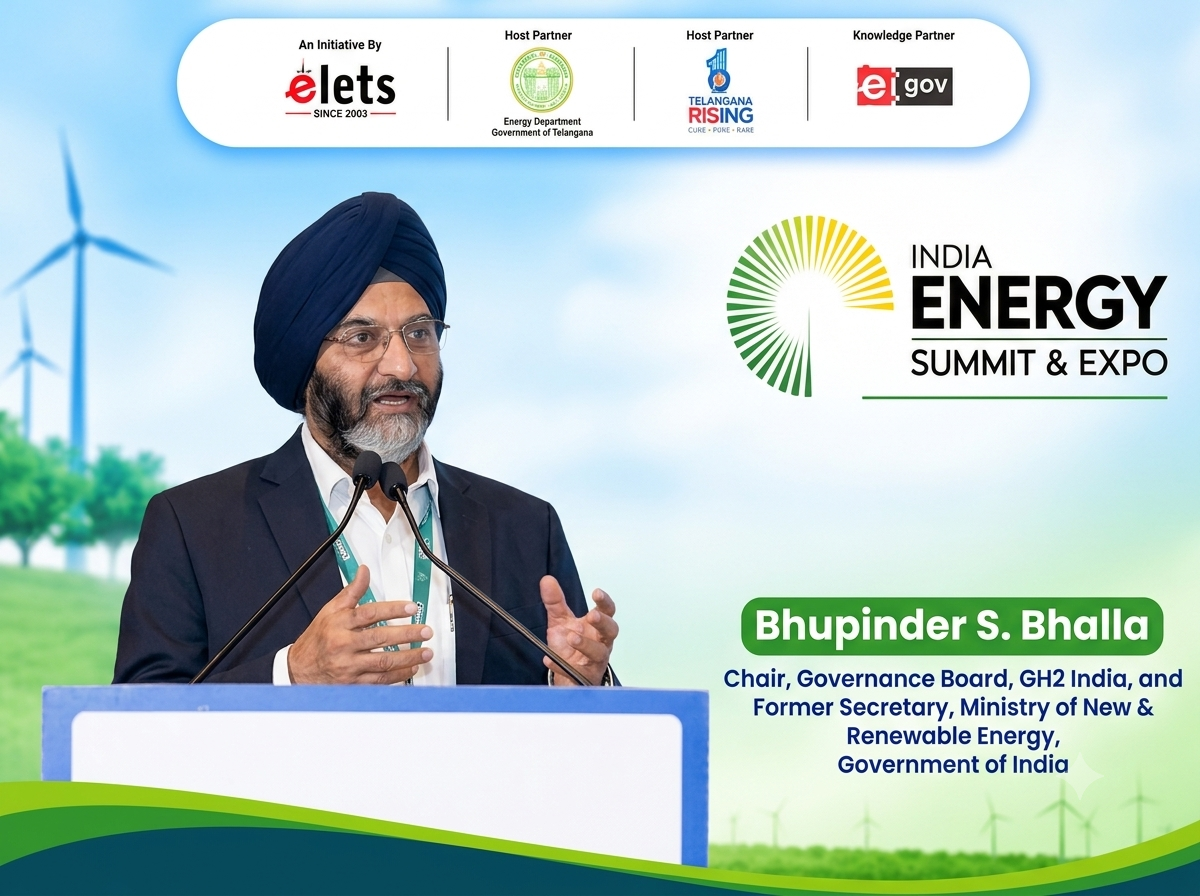
Insights shared by Bhupinder S. Bhalla, former secretary, Ministry of New & Renewable Energy, Government of India, Chair, Governance Board, GH2 India, at the India Energy Summit and Expo 2026, held on 18-19 August 2026, Hyderabad

Be a part of Elets Collaborative Initiatives. Join Us for Upcoming Events and explore business opportunities. Like us on Facebook , connect with us on LinkedIn and follow us on Twitter, Instagram.
"Exciting news! Elets technomedia is now on WhatsApp Channels Subscribe today by clicking the link and stay updated with the latest insights!" Click here!