 News
News




Article
“France Sees India as a Key Partner in Shaping the IMEC”
“France Sees India as a Key Partner in Shaping the IMEC”
![]() By
eletsnetzerofinal2025 14-August-2026
By
eletsnetzerofinal2025 14-August-2026


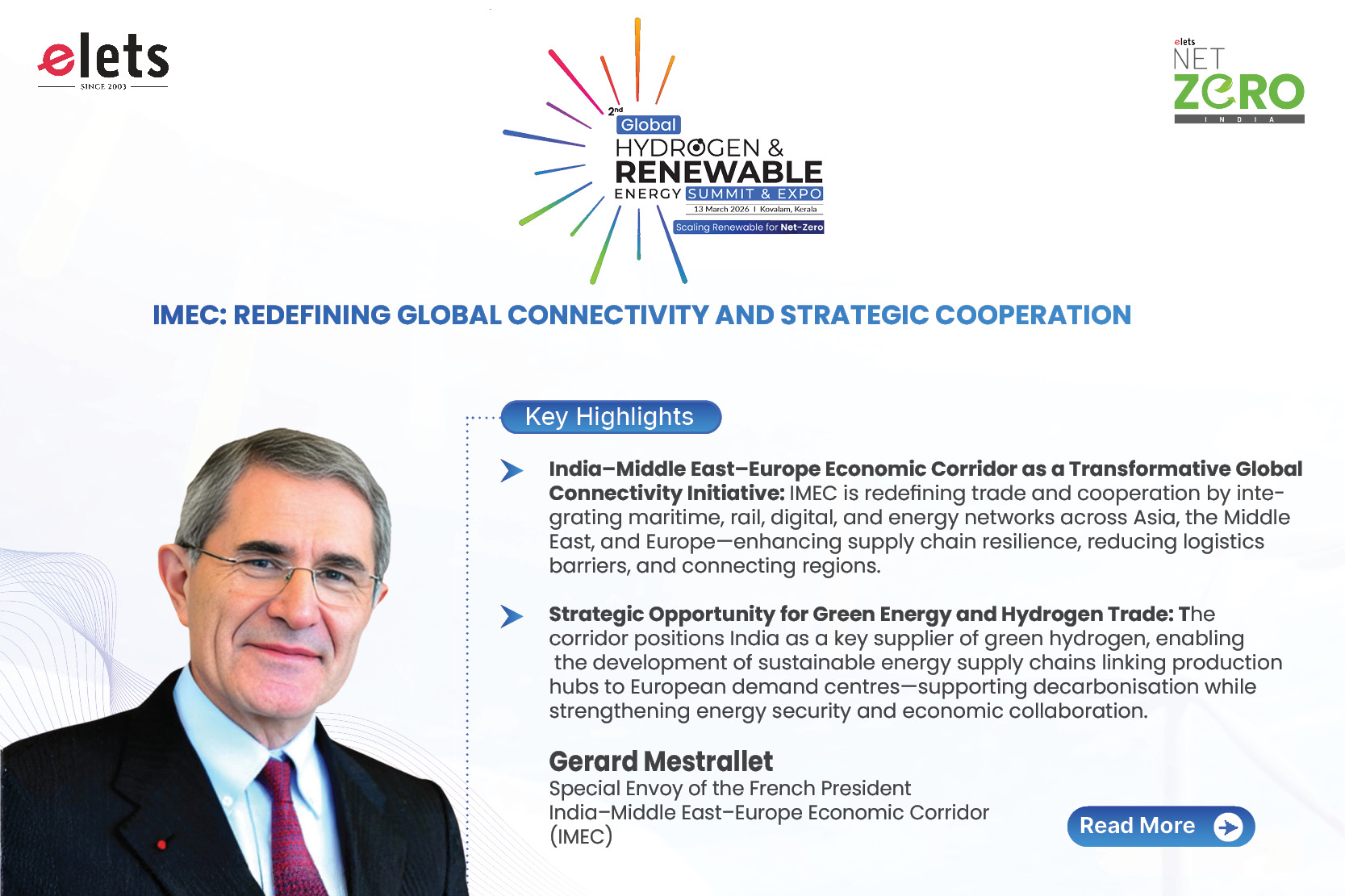
The India–Middle East–Europe Economic Corridor (IMEC) represents far more than an infrastructure project. In my view, it is a strategic initiative that aims to reshape global connectivity by linking Asia, the Middle East, and Europe through a modern, integrated corridor. By strengthening trade routes, digital networks, and energy partnerships, IMEC has the potential to redefine economic cooperation across regions that collectively account for nearly half of the world’s GDP and over 40 per cent of the global population.
The initiative was formally announced during the G20 Summit in New Delhi, where eight key partners—India, Saudi Arabia, the United Arab Emirates, France, Germany, Italy, the European Union, and the United States—came together to launch this ambitious vision. The corridor is designed as a multi-modal network consisting of maritime routes, rail links, and advanced infrastructure systems.
The structure of the corridor includes three main segments. The first connects India to the Arabian Peninsula through maritime routes. The second is a land-based network that runs through the Middle East, linking key economic hubs in the region. The final segment connects the Middle East to Europe through maritime channels across the Mediterranean. Together, these elements form a seamless logistical network that will significantly enhance trade efficiency, supply chain resilience, and economic integration.
France and India occupy particularly strategic positions at the two ends of this corridor. This geographical positioning naturally makes our two nations pivotal stakeholders in the success of IMEC. From the European side, the port of Marseille is expected to play a central role. Marseille already serves as a major gateway for global connectivity and has developed into the world’s seventh-largest digital hub, hosting fifteen international submarine cable connections.

This unique digital and maritime infrastructure gives Marseille a strong advantage as a strategic entry point for the Mediterranean leg of the corridor. Its location and connectivity will enable efficient integration with European transport networks and digital ecosystems, strengthening Europe’s linkages with Asia and the Middle East.
France has demonstrated a strong commitment to advancing the IMEC initiative. President Emmanuel Macron has taken the unique step of appointing a dedicated Special Envoy for the corridor, an indication of the importance France attaches to this project. My role is to work closely with partners across all participating countries to help shape the corridor’s development and ensure its successful implementation.
Our approach is rooted in collaboration. France intends to work closely with India not only bilaterally but also within the broader framework of the European Union. This partnership will be essential in translating the vision of IMEC into concrete infrastructure and economic outcomes.
The scale of the project is substantial. Estimates suggest that the full development of IMEC could require investments of nearly €500 billion. The corridor will combine several critical infrastructure components, including railway networks, shipping routes, digital communication systems, high-voltage power transmission lines, and pipelines designed to transport energy resources.
One of the most exciting aspects of IMEC is its alignment with global sustainability goals. The corridor is being envisioned as a platform that supports the energy transition and promotes the development of clean energy value chains. Among its key features will be pipelines and infrastructure dedicated to transporting green hydrogen and other renewable energy resources.
In this context, India holds a particularly important position. India’s rapidly expanding renewable energy sector and its capacity to produce green hydrogen at competitive costs make it a central player in the energy dimension of the corridor. The development of hydrogen supply chains linking production centers in India, Saudi Arabia, the UAE, and Egypt with consumption markets in Europe represents a powerful opportunity for sustainable cooperation.
Also Read | Energy Security the Foundation of a Developed India
From our perspective, IMEC is therefore not simply a logistics initiative. It is a strategic partnership designed to support decarbonization, enhance energy security, and diversify global value chains. India has already demonstrated significant readiness to engage with the objectives of the corridor. Ports such as Mundra and their adjoining economic zones illustrate how India is building the infrastructure necessary to support large-scale international trade and energy connectivity. These facilities could become key nodes in the emerging IMEC network.
French companies are also keen to contribute to the development of the corridor. Many of France’s leading enterprises possess deep expertise in sectors that will be critical for the project’s success—energy systems, digital infrastructure, logistics, transport engineering, and advanced construction.
Companies such as TotalEnergies, CMA CGM, ENGIE, EDF, Orange Marine, and Alstom are already exploring potential opportunities related to the corridor. Their capabilities in renewable energy, maritime logistics, rail systems, telecommunications infrastructure, and engineering solutions position them well to support the development of this ambitious initiative.
However, turning this vision into reality requires careful planning and strong coordination among all partners. The next phase of IMEC will focus on establishing an effective governance structure that brings together all signatory countries. This framework will guide decision-making, ensure alignment among stakeholders, and provide clarity for investors.
At the same time, comprehensive feasibility studies will be conducted to evaluate infrastructure needs, identify investment requirements, and assess long-term economic viability. These studies will help define the precise roadmap for the development of the corridor and determine how its various components will be implemented.
Looking ahead, I firmly believe that the success of the IMEC initiative will depend on the strength of partnerships between participating nations—particularly between France and India. Our countries share a long-standing strategic relationship built on trust, innovation, and a shared commitment to shaping a more sustainable global future.
Recent high-level engagements between our leaders, including Prime Minister Narendra Modi’s visit to Marseille, have further strengthened this partnership. These interactions highlight the growing alignment between France and India on issues related to connectivity, energy transition, and global economic cooperation.
The IMEC corridor represents a unique opportunity to build a new bridge between continents—one that integrates trade, technology, energy, and sustainability. By working together, our nations can help create a connectivity framework that will shape the global economy for decades to come.
Insights shared by: Gerard Mestrallet, Special Envoy of the French President for the IMEC, at the Global Hydrogen & Renewable Energy Summit on 12 March 2025 in Kochi, Kerala.

Be a part of Elets Collaborative Initiatives. Join Us for Upcoming Events and explore business opportunities. Like us on Facebook , connect with us on LinkedIn and follow us on Twitter, Instagram.
"Exciting news! Elets technomedia is now on WhatsApp Channels Subscribe today by clicking the link and stay updated with the latest insights!" Click here!