 News





News
India’s Strategic Approach to Critical Minerals: Harmonising National Goals with Global Dynamics
India’s Strategic Approach to Critical Minerals: Harmonising National Goals with Global Dynamics
![]() By
Samuel Raj 29-October-2026


- India is developing a robust industrial policy for critical minerals, incorporating over a dozen regulatory, financial, and trade mechanisms valued at nearly $40 billion, all part of a comprehensive industrialisation strategy.
- What sets India’s approach to critical minerals apart from other lower- and middle-income nations are three key aspects. Firstly, the government is backing various stages of the value chain, extending beyond just mining. Secondly, supportive policies like manufacturing incentives and consumer subsidies are designed to boost domestic demand for critical minerals. Lastly, India is actively seeking to secure mineral supplies from international sources due to its significant reliance on imports.
- However, the effectiveness of India’s industrial policy will hinge on overcoming transnational coordination hurdles, particularly with mineral-rich developing nations aiming to enhance their productive capacities and with advanced economies focused on mineral security and manufacturing objectives.
- India has the opportunity to tackle these global challenges by establishing itself as a unique alternative within the international critical minerals landscape, setting itself apart from China’s state-driven, capital-heavy approach and the West’s security-focused strategies. Leveraging its vast market potential, manufacturing strength, and engineering know-how, India can serve as a vital link that enhances value creation in developing nations while also diversifying the supply of critical minerals for more advanced economies.
Introduction
India is actively shaping a more unified industrial strategy for essential minerals. In 2023, the Ministry of Mines recognised 30 minerals as vital to the Indian economy, considering their economic significance and potential supply challenges. The subsequent year saw the Union Budget introduce a Critical Minerals Mission, highlighting its importance within the broader manufacturing and services agenda for “Viksit Bharat”, which reflects India’s aspiration to evolve into a developed economy by 2047. In January 2025, the National Critical Mineral Mission (NCMM) was launched, laying down the government’s primary framework for securing critical mineral resources and enhancing domestic capabilities throughout the value chain, with the clear aim of creating a “globally competitive and resilient critical mineral ecosystem.”

India’s approach to critical minerals stands out distinctly from the initiatives of other low- and middle-income nations. To begin with, the government is taking a comprehensive approach by engaging at various points along the value chain, rather than merely focusing on the extraction of minerals. Additionally, these efforts are bolstered by supportive policies beyond the mining sector, which aim to boost domestic demand for technologies that rely heavily on minerals. This includes incentives for manufacturing batteries, rare-earth magnets, solar panels, and semiconductors, along with consumer subsidies for electric vehicles and rooftop solar installations. Lastly, India is actively working to secure mineral resources from international sources as well.
Successfully implementing such an ambitious industrial policy is fraught with various fiscal, institutional, and technological challenges. But the need to secure imported inputs to feed a robust critical minerals industry—India depends on mineral resources, technologies, and finance from abroad—places a significant constraint on what domestic policy alone can accomplish.

Thus, the success of India’s critical minerals industrial policy largely hinges on its ability to navigate two complex transnational coordination issues. The first involves resource-rich producer nations that are increasingly eager to enhance their own processing, refining, and manufacturing capabilities instead of merely supplying raw materials. The second pertains to India’s interactions with affluent partners, whose goals of diversifying critical mineral supply chains resonate with India’s, yet whose mineral security strategies are leaning towards stricter trade and investment frameworks that prioritise keeping manufacturing within their own borders.
This analysis delves into India’s strategies for expanding its critical minerals sector while also considering the international challenges that must be navigated to achieve its objectives. The authors suggest that India has the opportunity to define itself as a unique player—a “third way” in the global critical minerals landscape—avoiding the pitfalls of China’s state-driven, capital-heavy approach and not merely aligning with Western security-focused supply chains. In this capacity, India could serve as a vital connector—leveraging joint ventures, long-term agreements, technology and skills collaborations, and selective co-investment—to create synergistic value chains that benefit both low- and middle-income producing nations and advanced economies.
Unique Aspects of India’s Critical Minerals Industrial Policy
The National Critical Minerals Mission (NCMM) serves as the foundational framework for India’s approach to critical minerals, yet the strategy encompasses much more than just this mission. Financially, the NCMM allocates $1.7 billion (₹16,300 crore) in direct funding and expects an additional $1.88 billion (₹18,000 crore) in investments from public-sector undertakings (PSUs) through the fiscal year 2030–31. When factoring in supportive policies from various ministries and departments, the total financial commitments approach nearly $40 billion (refer to the appendix for detailed policy breakdowns). An analysis of government documents and announcements regarding these initiatives highlights three key characteristics of India’s strategic approach.
An Integrated Strategy for Developing Mineral Value Chains
India is taking a comprehensive approach to the critical minerals value chain, moving beyond mere extraction. The National Critical Minerals Mission (NCMM) aims to enhance mineral exploration, mining, beneficiation, and recycling, while also fostering technology development, skill enhancement, and financial support.
To boost domestic exploration, regulatory reforms have been introduced, allowing private and foreign investments in previously restricted commodities, auctioning exploration licenses, and permitting 100% foreign direct investment (FDI) in exploration and mining activities. These reforms are complemented by fiscal initiatives aimed at developing midstream capabilities, which include backing collaborative research and development (R&D) efforts both domestically and internationally, establishing critical mineral processing parks, and creating a National Critical Minerals Stockpile for at least five commodities by 2031.
The Science and Technology Programme for Promoting Research and Innovation in Startups and MSMEs (S&T PRISM) predates the NCMM and provides funding for startups focused on commercialising technologies in mineral processing, metallurgy, and recycling. Additionally, a new set of regulations is in place to facilitate the recovery of critical minerals from solar photovoltaic modules, batteries, and other electronic devices. Collectively, these initiatives are designed to build robust capabilities across all segments of the mining value chain, from upstream to downstream.
Supporting Strategies to Enhance Local Demand
India’s approach to critical minerals encompasses a range of industrial policy measures designed to stimulate domestic demand in sectors reliant on these essential materials.
Through the Production Linked Incentive Scheme, the government offers financial rewards linked to specific performance indicators such as sales figures, production outputs, and domestic value addition (DVA) targets for companies. Among the initiatives detailed in the appendix, three are tailored specifically for critical minerals—namely advanced chemistry cells (ACC), sintered rare earth permanent magnets, and critical mineral recycling. The remaining initiatives focus on the end-users of these resources, including solar photovoltaic (PV) systems and semiconductors. For instance, the ACC initiative allocates $1.9 billion (₹18,100 crore) in incentives to foster large-scale domestic battery cell production, mandating that recipients achieve a minimum of 25% domestic value addition, which is set to increase to 60% over a five-year period.
Incentives aimed at consumer demand play a crucial role in making mineral-heavy products more accessible. Initiatives like PM E-DRIVE, PM KUSUM, and PM Surya Ghar are designed to enhance the appeal of electric vehicles and solar photovoltaic systems, thereby driving up the need for essential minerals such as lithium, cobalt, nickel, indium, and tellurium. The total investment in these manufacturing and consumer demand programmes, nearing $40 billion, significantly surpasses the NCMM budget of approximately $4 billion. Consequently, policies implemented across various sectors, including electronics and renewable energy, can substantially elevate the domestic markets for India’s mineral processing and manufacturing industries.
Ensuring Reliable Access to Critical Minerals from International Sources
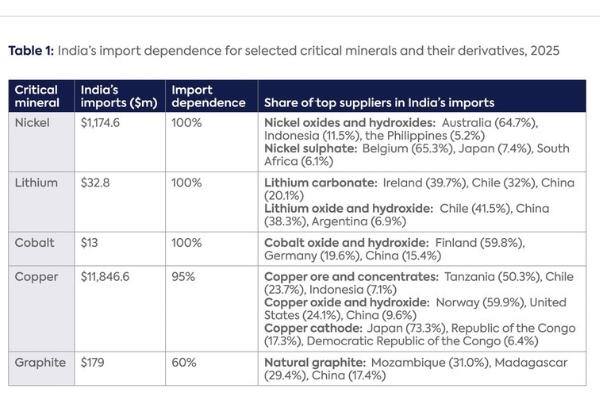
One significant aspect of India’s strategy to enhance its capabilities in the critical minerals sector involves initiatives aimed at minimising the costs and risks associated with mineral imports. Although India benefits from a variety of suppliers, the associated vulnerabilities remain considerable (refer to Table 1). For instance, India relies entirely on imports for 10 essential minerals, such as lithium, cobalt, nickel, vanadium, and niobium. While India has developed a robust infrastructure for copper smelting and refining, it was reported in 2025 that over 90% of the necessary inputs for these operations were imported.
Consequently, India has aligned its domestic industrial strategies and demand frameworks with tools related to trade and international investments. On the trade front, the government has systematically eliminated the Basic Customs Duty (BCD) on essential mineral inputs. Gradual exemptions were introduced in the fiscal budgets for 2025 and 2026, and during the NCMM launch in January 2025, these exemptions collectively encompass the majority of the 30 critical minerals identified. The latest budget also extended BCD exemptions for the capital goods necessary for processing critical minerals.
Additionally, the government is actively seeking to acquire critical mineral assets abroad. The Khanij Bidesh India Limited (KABIL), a public sector undertaking joint venture, is tasked with identifying, exploring, acquiring, and developing strategic mineral assets internationally. The NCMM anticipates that public sector undertakings will invest approximately $1.9 billion by 2031 to secure 50 overseas mining assets, which will satisfy about 5% of India’s annual demand for critical minerals.
In contrast to domestic tools, external strategies cannot be solely executed by the Indian government. Their success hinges on discussions with producer nations, international corporations, and global partners whose strategic goals may not align with those of India. This situation raises important transnational coordination challenges for India’s approach to critical minerals.
Addressing Two Global Challenges as an Innovative Approach in the Critical Minerals Sector
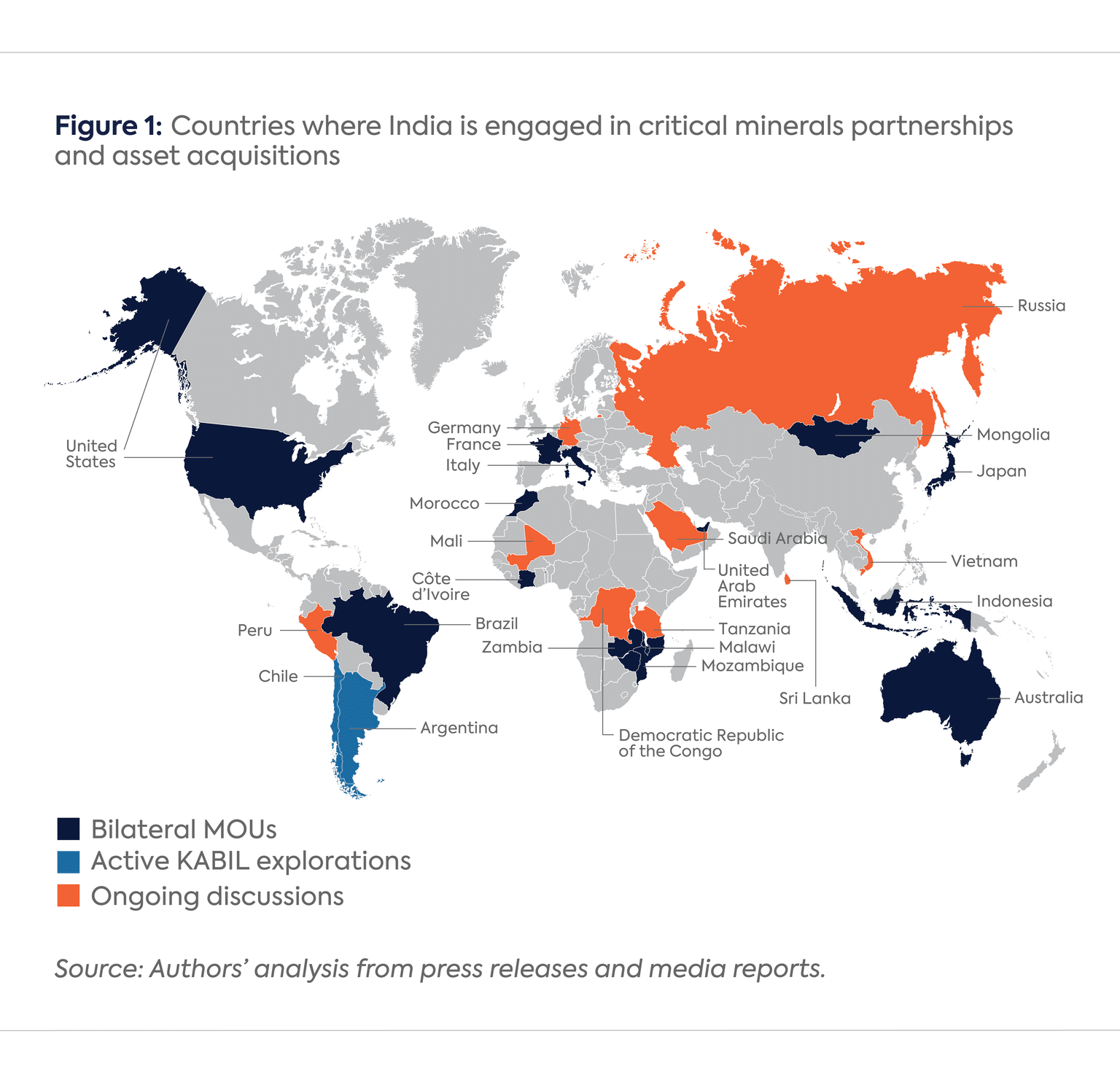
India’s reliance on imported critical minerals presents two significant global coordination hurdles. The countries that supply these minerals are increasingly pursuing their own industrial goals, while the advanced economies that collaborate with India to secure these resources are simultaneously focused on safeguarding their domestic manufacturing sectors. As depicted in Figure 1, India’s international engagements in critical minerals already encompass numerous bilateral partnerships, overseas asset acquisitions, plurilateral initiatives, and ongoing negotiations.
India’s unique positioning can be characterised as a “third way”, defined by a dual identity. Its vast market and robust industrial foundation align it more closely with China than with other low- and middle-income nations. However, its ongoing gap from the technological frontier—referring to its ability to innovate rather than merely replicate technologies—sets it apart from its advanced-economy counterparts. This perspective aligns well with the Indian government’s “multi-alignment” foreign policy and is supported by recent insights from Indian think tanks.
As the most populous nation on the planet, India boasts a vast and expanding domestic market, impressive economic growth rates, and significant industrial capabilities, particularly in metals refining and smelting. This positions India uniquely, with the potential to rival China’s scale, setting it apart from other lower-middle-income countries (LMICs). However, India still faces challenges as a lower-middle-income nation, grappling with considerable needs in development, infrastructure, and technology, which differentiates it from its advanced-economy counterparts in East Asia, North America, and Western Europe. By clearly defining its role within the global critical minerals landscape, India could more effectively obtain the minerals, technology, and financial resources necessary to fulfil its industrial aspirations while also supporting the value-addition objectives of LMICs and addressing the security and manufacturing concerns of advanced economies.
Collaborating with LMICs Abundant in Resources to Enhance Value Creation
The initial challenge in transnational coordination arises from the conflicting industrial policies of various mineral-producing nations. Countries in regions such as Africa, Latin America, and Southeast Asia are eager to secure a larger portion of the mineral processing, refining, and manufacturing sectors within their borders. To achieve this, many have implemented export restrictions on raw ores and oxides, alongside other initiatives aimed at boosting domestic value addition. For instance, Indonesia has placed limits on nickel ore exports while encouraging investments to foster local smelting and the growth of battery-related industries. Similarly, Chile’s National Lithium Strategy aims to enhance its economic development by integrating lithium extraction with elements like capital, technology, sustainability, and value addition. These strategies illustrate a broader trend among resource-rich nations, which can sometimes clash with the interests of India and others in the realm of domestic processing.
In the context of a unique critical minerals industrial ecosystem, India has the potential to present resource-rich partners with an appealing value proposition that aligns with their industrialization goals. This includes fostering value chain development, facilitating knowledge and skills transfer, and providing access to export markets in India and other advanced economies. Unlike China, which leverages its surplus capital to invest in emerging markets and large infrastructure projects, India boasts a distinct advantage through its extensive experience in developing and managing refineries, smelters, petrochemical plants, and various industrial facilities in lower-income environments.
Despite facing capital constraints, India is home to some of the largest petroleum refineries globally and ranks as the second-largest refiner of aluminum and lead, as well as the third-largest refiner of zinc. Consequently, India might explore the possibility of establishing mineral refineries and metal smelters in low- and middle-income countries through collaborative ventures with local enterprises. These facilities could effectively support downstream manufacturers of solar cells, modules, batteries, and semiconductors within India.
Lohum, recognised as India’s foremost producer and processor of critical minerals, is embracing this innovative strategy. The company has obtained rights to ten lithium mining blocks in Zimbabwe, with intentions to locally process the ore into lithium sulphate before transporting it to India for refinement into more valuable products. Additionally, Lohum is eyeing opportunities to acquire nickel mines in both Indonesia and the Philippines.
The Dangote Group’s refinery in Nigeria serves as an exemplary case study. Engineers India Limited (EIL), a state-owned entity, played a pivotal role by providing project management and engineering expertise to Africa’s largest refinery and petrochemicals complex. In January 2026, they secured a substantial $350 million contract to facilitate its expansion. Such collaborations can be enhanced through knowledge and skills-sharing initiatives that connect Indian firms with their counterparts in host nations. Notably, the Dangote Group facilitated the training of hundreds of Nigerian graduates at Bharat Petroleum Corporation Limited in Mumbai from 2016 to 2018, preparing them for refinery operations prior to the facility’s commissioning.
These strategies can be tailored to the critical mineral sectors in other resource-abundant nations. India may need to develop a clear strategy for KABIL, its state-owned joint venture, to effectively navigate competition with the industrial aspirations of producer countries, moving beyond a mere project-by-project asset acquisition strategy. A valuable reference is Japan’s established resource diplomacy framework, managed by the Japan Organization for Metals and Energy Security (JOGMEC), which combines equity investments and offtake agreements with technology transfer, joint processing ventures, and infrastructure co-financing in producer nations. Similarly, South Korea’s POSCO, one of the leading steel manufacturers globally, has adopted a parallel strategy in its lithium investments in Argentina, integrating capital with midstream processing technology.
Considering India’s financial limitations, these collaborations will probably have to leverage private investment instead of primarily depending on government funding.
Aligning with Developed Nations on Supply-Chain Resilience
A notable challenge emerges from India’s interactions with affluent nations. India is actively involved in the Minerals Security Partnership and the Quad Critical Minerals Initiative alongside developed economies aiming to broaden their supply chains. In May 2026, India, Australia, Japan, and the United States established the Quad framework for critical minerals, which aims to mobilise up to $20 billion in both public and private funding for mining, processing, and recycling, while clearly acknowledging each partner’s domestic policies and priorities. Additionally, India and the United States have entered into a Strategic Critical Minerals Cooperation Framework to foster resilient and diversified mineral supply chains. These collaborations present India with avenues to secure investment, technology, and expertise in project development.
Nonetheless, shared goals regarding supply chain security do not inherently suggest aligned industrial ambitions. India is focused on enhancing its domestic manufacturing capabilities, while advanced economies are similarly employing industrial policies to safeguard their strategic production capacities within their own territories. For instance, Australia plans to introduce a refundable 10% tax offset on qualifying company expenditures for critical minerals that are processed and refined domestically, starting in July 2027. Furthermore, US bilateral trade agreements concerning critical minerals intertwine economic partnerships with preferential sourcing, investment scrutiny, market access stipulations, and limitations on third-party participants.
In the context of the global critical minerals landscape, India has the potential to present a unique value proposition to its advanced economy partners, focusing on mineral security. This involves diversifying supply sources, enhancing productive capacity in the medium term, and ultimately establishing supply chains that are less reliant on China. In the immediate future, India can position itself as a viable alternative to China for specific refined metals and mineral derivatives, leveraging its domestic facilities and possibly collaborating with smelters and refineries in low- and middle-income countries (LMICs). Looking ahead, India could evolve into both a destination and a source of foreign direct investment (FDI) in sectors like clean energy, storage solutions, and digital technology manufacturing.
This reciprocal relationship is already taking shape. For instance, Apple is transitioning parts of its iPhone production from China to India through partnerships with Tata Electronics and Foxconn, with the goal of manufacturing the majority of iPhones destined for the United States in India by the end of 2026. Additionally, Tata Steel’s acquisition of the Anglo-Dutch steelmaker Corus for $12.4 billion in 2007, along with Hindalco’s purchase of US-based Novelis in the same year, has enabled these Indian companies to establish a significant presence in the global downstream aluminium and recycling markets.
Strategic alliances, while beneficial, do not ensure seamless entry into advanced economy markets. The ongoing discussions and adjustments regarding US policies on stockpiling, price controls, and trade limitations may lead to India’s exclusion from specific products or areas within the mining value chain. For instance, Indian exports currently encounter an 18% reciprocal tariff in the United States.
India’s most viable approach with advanced economies, therefore, may be to present its “third way” as a non-adversarial ecosystem that complements but remains distinct from US and others’ supply chain strategies—maintaining strategic linkages without pursuing full integration.
Conclusion
India’s approach to critical minerals is fundamentally shaped by its robust manufacturing sector, expansive domestic market, and significant reliance on mineral imports. These factors present ample opportunities for developing connections from mining and processing to sectors like batteries, electronics, renewable energy technologies, defense, and various manufacturing industries. However, some of the most impactful aspects of this strategy extend beyond the confines of national industrial policy. The success of India’s critical minerals initiative will hinge on its ability to navigate the complexities of value distribution across international borders. To achieve this, India must establish partnerships that align with the industrial aspirations of resource-rich developing nations while also addressing the security concerns and manufacturing objectives of advanced economies.

Be a part of Elets Collaborative Initiatives. Join Us for Upcoming Events and explore business opportunities. Like us on Facebook , connect with us on LinkedIn and follow us on Twitter, Instagram.
"Exciting news! Elets technomedia is now on WhatsApp Channels Subscribe today by clicking the link and stay updated with the latest insights!" Click here!