 News
News




Article
Battery Energy Storage Systems (BESS): A Key Enabler of India’s Renewable Energy Transition
Battery Energy Storage Systems (BESS): A Key Enabler of India’s Renewable Energy Transition
![]() By
Abhineet Kumar 30-September-2026
By
Abhineet Kumar 30-September-2026


India’s energy transition is driven by the imperatives of energy security, sustainably meeting rising electricity demand, reducing greenhouse gas emissions, and fulfilling its international climate commitments. Under its Nationally Determined Contributions (NDCs), India has committed to sourcing 50% of its cumulative installed electric power capacity from non-fossil fuel sources by 2030, in pursuit of the broader national targets of 500 GW of non-fossil fuel-based capacity by 2030 and net-zero emissions by 2070.
Meeting these targets requires a power system capable of reliably absorbing a much larger share of variable renewable energy (VRE), particularly solar and wind. Unlike conventional generation, VRE output is weather-dependent and varies across both time and location. As its share of the electricity mix grows, maintaining a real-time balance between generation and demand becomes increasingly difficult. Higher VRE penetration brings greater ramping and reserve requirements, a challenge compounded in India by the temporal mismatch between peak solar generation during the day and peak electricity demand in the evening.

Battery Energy Storage Systems (BESS) address this mismatch directly. By storing surplus renewable electricity when generation is high and discharging it when demand peaks or renewable output falls, BESS enables higher VRE penetration while preserving grid reliability and security.
Role and Benefits of BESS
BESS supports secure and efficient power system operation in three principal ways:

- Energy shifting and asset utilisation: By storing surplus generation and releasing it during peak demand, BESS reduces renewable energy curtailment and improves the utilisation of renewable assets.
- Grid services: BESS provides a range of ancillary services, including frequency regulation, voltage support, spinning reserve, black-start capability and congestion management. These services enhance system stability and power quality while reducing reliance on conventional thermal generators for balancing.
- Distributed energy resource (DER) integration: BESS facilitates the integration of rooftop solar, AgriPV systems, EV charging infrastructure and microgrids. Strategically deployed at the transmission and distribution levels, it can defer network reinforcement, relieve local congestion, improve asset utilisation and enhance overall grid resilience.
As power systems become increasingly decentralised and renewable-intensive, BESS is emerging as a critical source of operational flexibility.
Global and Indian BESS Scenario
BESS has become one of the fastest-growing clean energy technologies globally, with rapid technological advancement, declining lithium-ion costs, and supportive government policies accelerating utility-scale, commercial and residential deployment across many countries.
India is following a similar trajectory. Installed BESS capacity grew rapidly from approximately 0.78 GWh in December 2025 to 8.70 GWh in the first half of 2026 and is expected to exceed 10 GWh by the end of 2026. Looking ahead, the National Electricity Plan (NEP) 2023 estimates that India will require approximately 47 GW (236 GWh) of battery storage by 2031–32 to support reliable system operation. To accelerate this deployment across transmission and distribution networks, the Government of India has introduced measures including viability gap funding (VGF), competitive bidding and supportive policy frameworks.
Critical Minerals and Geopolitics
The rapid expansion of BESS has heightened the strategic importance of critical minerals, including lithium, cobalt, nickel, graphite and manganese, which are essential to battery manufacturing. Global reserves and refining capacity for these minerals remain heavily concentrated, with China dominating midstream processing. This leaves India’s battery supply chain exposed to geopolitical tensions, trade restrictions and price volatility.
This exposure is material: India’s battery demand is projected to grow from around 28 GWh in 2025 to 272 GWh by FY2030. Without a domestic mineral and cell-manufacturing base, the country risks substituting oil import dependence with battery import dependence.
India has moved from policy intent to concrete action on this front. The National Critical Mineral Mission, approved by the Union Cabinet in January 2025 with an outlay of ₹34,300 crore over seven years, aims to build a full domestic value chain across a criticality list of 30 minerals and has already brought lithium and rare earths under central auction.
On the resource side, the 2023 discovery of an estimated 5.9 million tonnes of inferred lithium resources in Reasi, Jammu & Kashmir, offers a potential domestic source. Meanwhile, Khanij Bidesh India Limited (KABIL) has secured lithium exploration rights over roughly 15,700 hectares in Argentina’s Catamarca province, with further assets under evaluation in Australia and Chile.
On the manufacturing side, the ₹18,100 crore Advanced Chemistry Cell (ACC) PLI scheme targets 50 GWh of domestic cell capacity. Battery recycling is being brought into this loop through the Battery Waste Management Rules, 2022, which place Extended Producer Responsibility (EPR) obligations on manufacturers to recover materials from end-of-life batteries.
Also Read: Telangana Powering India’s Clean Energy Future
Emerging Battery Technologies
Although lithium-ion batteries currently dominate the market, several next-generation battery technologies are being developed to improve performance, safety, cost and sustainability.
- Sodium-ion batteries offer a cost-effective alternative by using abundant sodium instead of lithium and cobalt, while leveraging existing lithium-ion manufacturing infrastructure.
- Flow batteries provide long operational lifetimes and are particularly suitable for utility-scale applications requiring scalable, long-duration storage.
- Iron-air and other metal-air batteries show promise for low-cost, long-duration energy storage, particularly for bulk energy shifting.
- Solid-state batteries offer higher energy density, improved safety and the potential for significantly lower lifecycle costs as manufacturing technologies mature.
Continued technological innovation is expected to diversify storage options and further accelerate BESS deployment across the power sector.
Relevance for Telangana
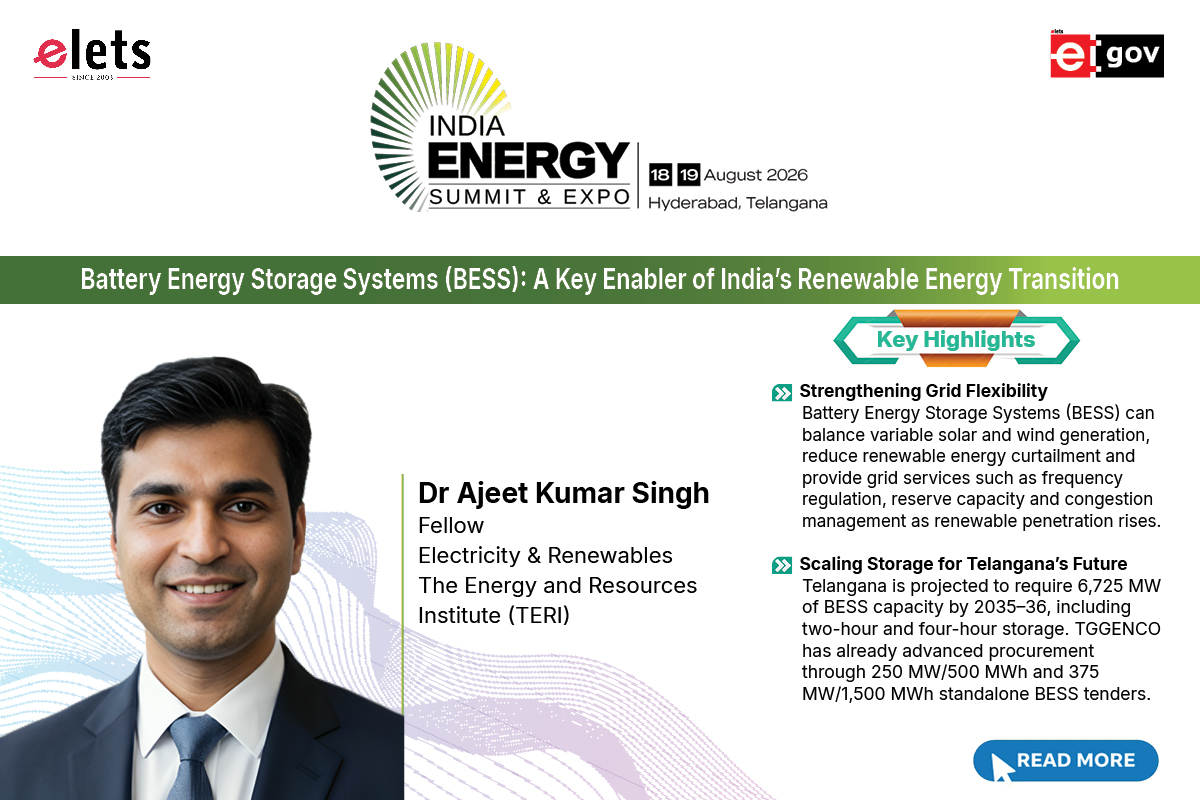
Telangana is rapidly expanding its renewable energy capacity, particularly through utility-scale solar. CEA’s resource adequacy studies indicate that the state will optimally require 6,725 MW of BESS capacity by 2035–36, comprising 3,225 MW of two-hour storage and 3,500 MW of four-hour storage.
This requirement is already translating into procurement. TGGENCO issued a 250 MW/500 MWh standalone BESS tender in January 2025 under the central VGF scheme, followed by a larger 375 MW/1,500 MWh standalone BESS tender in November 2025. The Telangana Clean and Green Energy Policy 2025 identifies energy storage as a key pillar of the state’s clean energy strategy.
As renewable deployment continues to grow, BESS is set to play an increasingly important role in ensuring a reliable, resilient and sustainable electricity system for the state.
TERI’s Role in Supporting India’s Transition to BESS
The Energy and Resources Institute (TERI) has been an active contributor to the development of India’s BESS ecosystem through research, techno-economic assessments, feasibility studies, Detailed Project Report (DPR) preparation, transaction advisory, pilot demonstrations, and policy and regulatory support.
The institute has undertaken BESS studies for several Indian states and Union Territories, including West Bengal, Gujarat, Delhi, Andhra Pradesh and Odisha, in collaboration with more than 10 utilities, to evaluate the technical and economic viability of energy storage for renewable energy integration.
TERI also supported BRPL in the implementation of India’s first regulatory-approved 20 MW/40 MWh BESS project at Kilokari, Delhi. In addition, TERI conducts long-term Integrated Resource Planning (IRP) studies at the national and sub-national levels to determine the optimal deployment of BESS alongside other generation and storage technologies.
Beyond technical studies, TERI further contributes to the sector by convening industry and policy dialogues and delivering capacity-building programmes for utilities, regulators, financial institutions, developers and academic institutions. These efforts support the wider adoption of energy storage in India.
———————————————————————————————————-
Views expressed by: Dr. Ajeet Kumar Singh, Fellow, Electricity & Renewables, The Energy and Resources Institute (TERI)

Be a part of Elets Collaborative Initiatives. Join Us for Upcoming Events and explore business opportunities. Like us on Facebook , connect with us on LinkedIn and follow us on Twitter, Instagram.
"Exciting news! Elets technomedia is now on WhatsApp Channels Subscribe today by clicking the link and stay updated with the latest insights!" Click here!