 News
News





Article
India’s First Hydrogen Train Hits the Tracks: A Milestone in Sustainable Railway Mobility and the Green Hydrogen Mission
India’s First Hydrogen Train Hits the Tracks: A Milestone in Sustainable Railway Mobility and the Green Hydrogen Mission
From steam engines to electrified corridors, Indian Railways has continuously evolved to meet the country's growing transportation needs. The launch of India's first hydrogen-powered passenger train marks another important chapter in this journey, introducing a new clean-energy technology that could complement the nation's expanding rail network while supporting its long-term climate and energy goals.
![]() By
Abhineet Kumar 17-July-2026
By
Abhineet Kumar 17-July-2026


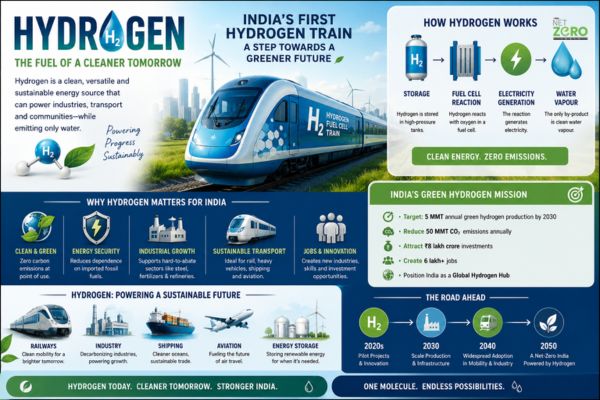
On 17 July 2026, Prime Minister Narendra Modi flagged off India’s first hydrogen fuel cell-powered passenger train between Jind and Sonipat in Haryana. The launch is more than the introduction of another train service. It represents India’s entry into an exclusive group of nations experimenting with hydrogen-powered railway operations, including Germany, France and China, while demonstrating the country’s growing capabilities in indigenous railway engineering and clean mobility.
Unlike conventional diesel locomotives, the hydrogen train generates electricity onboard using hydrogen fuel cells, emitting only water vapour during operation. Developed entirely using indigenous technology, the project aligns with India’s broader vision of achieving sustainable transportation, strengthening energy security, and reducing dependence on imported fossil fuels.

A New Milestone in India’s Railway Evolution
Indian Railways has witnessed multiple technological transitions over the past century. From coal-powered steam locomotives to diesel engines and large-scale electrification, every phase has focused on improving efficiency and reducing operational costs.

Today, more than 99 per cent of India’s Broad Gauge railway network has been electrified, making it one of the world’s largest electrified railway systems. Yet, electrification alone does not solve every operational challenge. Heritage routes, remote branch lines, difficult terrain and sections where overhead infrastructure may not be economically viable continue to require alternative propulsion technologies. Hydrogen-powered trains offer one such solution rather than replacing electrification altogether.
The hydrogen train should therefore be viewed as the next layer of India’s clean mobility strategy instead of an alternative to electric railways.
How the Hydrogen Train Works
The train uses hydrogen fuel cell technology to generate electricity onboard instead of drawing power from overhead electric lines.
Hydrogen stored in high-pressure cylinders reacts with oxygen from the atmosphere inside fuel cells through an electrochemical process. This reaction produces electricity, which powers the train’s traction motors. The only direct by-product is water vapour, eliminating smoke and direct carbon emissions at the point of use.
Each driving power car is also equipped with Lithium Iron Phosphate (LFP) batteries, which support energy management during acceleration, braking and varying operating conditions, ensuring smooth performance throughout the journey.
Built in India, Powered by Indigenous Technology
One of the most significant aspects of the project is that it has been designed, engineered and integrated in India.
The train consists of:
- Two Hydrogen Driving Power Cars
- Eight passenger coaches
- Combined propulsion output of 2,400 kW
- Capacity for approximately 2,600 passengers
- Design speed of 110 kmph
- Operational speed of 75 kmph
With ten coaches, it is among the world’s largest hydrogen-powered passenger trainsets currently in operation.
The pilot service will operate on the 89-km Jind-Sonipat route, supported by India’s first integrated hydrogen production, storage, compression and refuelling facility established at Jind. The project has also undergone multiple safety evaluations, incorporating systems capable of detecting hydrogen leaks, flames, heat and smoke.
Why Hydrogen Matters for Indian Railways
Hydrogen trains are often compared with battery-electric or conventional electric trains. However, each technology serves different operational requirements.
Battery trains are suitable for relatively short distances, while fully electrified railways remain the preferred option for high-density passenger and freight corridors. Hydrogen-powered trains become particularly valuable where installing overhead electrification is technically challenging, economically expensive or operationally impractical.
For India, hydrogen technology could eventually find applications on:
- Remote branch lines
- Heritage railway routes
- Low-density passenger corridors
- Difficult terrain
- Future regional rail services
By diversifying propulsion technologies, Indian Railways reduces dependence on a single energy source while improving operational flexibility.
Supporting India’s Green Hydrogen Mission
The railway project is closely aligned with the National Green Hydrogen Mission, launched to position India as a global hub for the production, utilisation and export of green hydrogen.
Hydrogen is expected to play an important role in sectors that are difficult to decarbonise through direct electrification, including steel, fertilisers, shipping, aviation and heavy transport. Railways now become another important application area.
The hydrogen train therefore serves not only as a transportation project but also as a demonstration platform for India’s emerging hydrogen economy. Every successful pilot strengthens domestic expertise in hydrogen storage, refuelling infrastructure, fuel cells and safety systems, creating opportunities for wider industrial adoption.
Beyond Sustainability: Building an Industrial Ecosystem
The significance of the hydrogen train extends beyond environmental benefits.
Developing indigenous hydrogen technology requires expertise across multiple industries including: Fuel cell manufacturing
- Hydrogen storage systems
- Power electronics
- Railway engineering
- Advanced batteries
- Hydrogen infrastructure
- Safety technologies
As domestic manufacturing expands, India could emerge as a supplier of hydrogen railway technologies for countries exploring similar clean mobility solutions.
The project also supports the government’s Atmanirbhar Bharat initiative by encouraging indigenous design, manufacturing and research instead of depending entirely on imported technologies.
The Environmental Advantage
Transportation remains a significant contributor to greenhouse gas emissions globally.
Although Indian Railways is already one of the most energy-efficient modes of mass transport, hydrogen technology offers additional environmental benefits on routes where diesel traction would otherwise continue.
Compared to diesel locomotives, hydrogen trains offer:
- Near-zero tailpipe emissions
- Elimination of smoke and particulate matter
- Lower local air pollution
- Reduced dependence on imported fossil fuels
- Quieter operation
However, environmental benefits depend on how hydrogen itself is produced.
Hydrogen generated using renewable electricity, commonly known as green hydrogen, delivers the greatest climate benefits. If hydrogen is produced using fossil fuels without carbon capture, the overall emissions reduction becomes significantly lower.
This highlights the importance of simultaneously expanding renewable energy generation and green hydrogen production across India.
Challenges That Cannot Be Ignored
Despite its promise, hydrogen rail technology is still evolving globally.
Several practical challenges remain:
- Green hydrogen production remains relatively expensive.
- Storage and transportation require specialised high-pressure infrastructure.
- Refuelling networks are still limited.
- Fuel cells require further cost reductions for large-scale deployment.
- Operational economics need validation under Indian conditions.
These realities explain why Indian Railways has chosen a pilot route rather than immediate nationwide deployment. The Jind-Sonipat project will provide valuable operational data before future expansion decisions are taken.
Prime Minister’s Vision for Green Rail Mobility
Flagging off the train, Prime Minister Narendra Modi described the project as an important step towards adopting clean and sustainable mobility in the railway sector.
According to the Prime Minister’s Office, the train has been designed, engineered and integrated in India using indigenous technology, reflecting the country’s growing capabilities in advanced railway engineering. The PMO also noted that with this launch, India joins the select group of countries operating hydrogen-powered trains.
The project reflects the government’s broader emphasis on combining infrastructure development with clean energy adoption under India’s long-term sustainability agenda.
Also Read: Storage & Batteries: The Missing Link in India’s Renewable Energy Push
The Road Ahead
India’s first hydrogen-powered train should not be viewed merely as a technological demonstration or a symbolic achievement. Its true significance lies in the ecosystem it is expected to create. The development of hydrogen production facilities, refuelling infrastructure, fuel cell manufacturing, safety standards, engineering capabilities, and operational expertise through this project will lay the foundation for broader applications across the transport and industrial sectors.
The widespread adoption of hydrogen-powered trains in India will depend on continued technological advancements, lower green hydrogen production costs, the expansion of renewable energy capacity, and the successful outcomes of pilot operations. As with any transformative technology, scaling up will require sustained policy support, infrastructure development, and industry collaboration.
Just as the Vande Bharat Express showcased India’s capabilities in indigenous railway engineering, the hydrogen-powered train has the potential to usher in a new era of sustainable rail mobility. For a country operating one of the world’s largest railway networks, this launch represents more than an advancement in propulsion technology. It reflects India’s commitment to developing home-grown clean mobility solutions while strengthening energy security and advancing its long-term sustainability goals.
The launch also demonstrates how clean energy technologies are beginning to reshape India’s transport sector. Although hydrogen rail technology is still at an early stage, it has the potential to complement railway electrification, strengthen the domestic hydrogen ecosystem, and support India’s journey towards achieving its net-zero ambitions.
As India accelerates investments in green hydrogen, renewable energy, energy storage, and clean mobility, collaboration among policymakers, industry, technology providers, researchers, and academia will be critical to scaling these innovations. These priorities will take centre stage at the India Energy Summit & Expo 2026, scheduled for 18-19 August in Hyderabad, where government leaders, public sector organisations, utilities, technology innovators, and industry experts will come together to explore the policies, partnerships, and technologies shaping India’s clean energy transition and sustainable energy future.clean energy transition and the technologies driving a sustainable energy economy.

Be a part of Elets Collaborative Initiatives. Join Us for Upcoming Events and explore business opportunities. Like us on Facebook , connect with us on LinkedIn and follow us on Twitter, Instagram.
"Exciting news! Elets technomedia is now on WhatsApp Channels Subscribe today by clicking the link and stay updated with the latest insights!" Click here!