 News
News




Article
Storage & Batteries: The Missing Link in India’s Renewable Energy Push
Storage & Batteries: The Missing Link in India’s Renewable Energy Push
![]() By
eletsnetzerofinal2025 18-June-2026
By
eletsnetzerofinal2025 18-June-2026



When solar generation peaks in the afternoon, electricity demand is often still hours away from its evening high. Similarly, wind generation can fluctuate significantly depending on weather conditions. As renewable energy occupies a larger share of India’s power mix, managing these variations is becoming one of the biggest challenges for grid operators.
This is where energy storage is emerging as a key part of the solution.

For years, India’s clean energy conversation centred on adding solar and wind capacity. Today, the focus is gradually shifting towards a different question: how to store that energy and make it available when consumers need it.
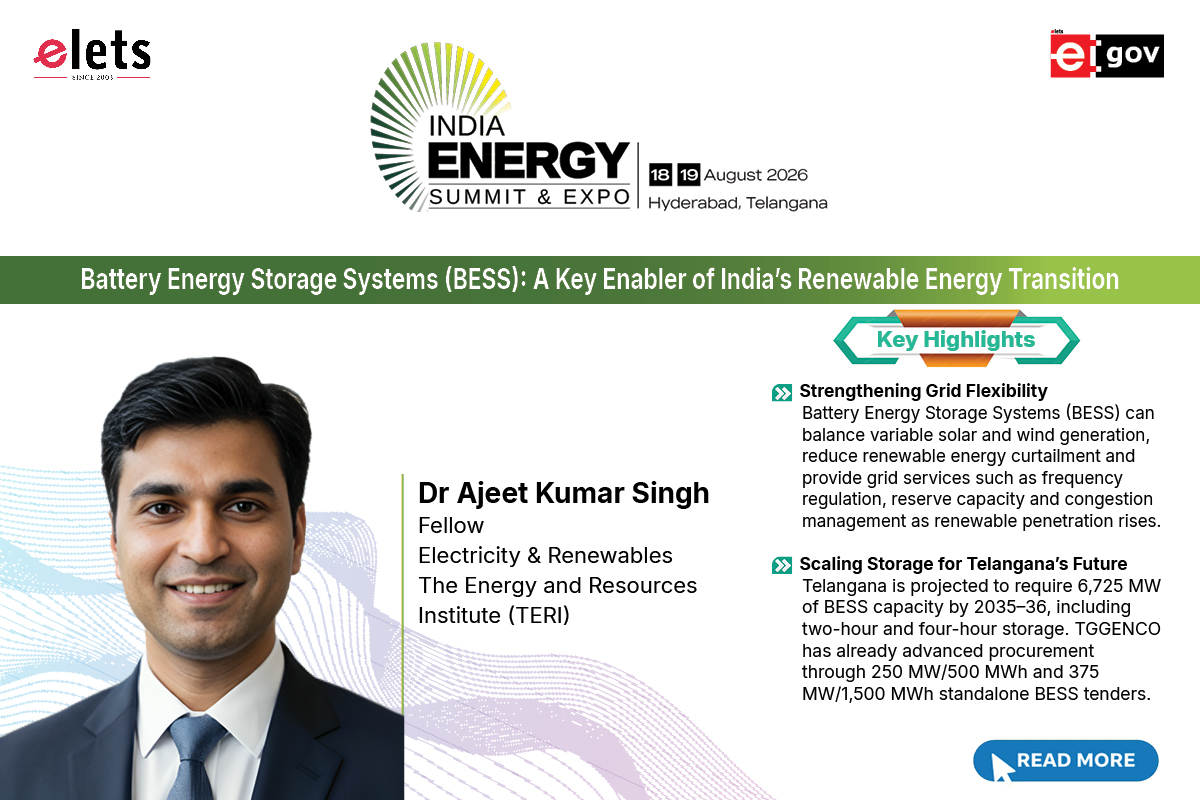
The numbers underline the scale of the challenge. India has set a target of achieving 500 GW of non-fossil fuel capacity by 2030. According to estimates by the Central Electricity Authority (CEA), meeting that objective will require 60.63 GW of energy storage capacity, including 41.65 GW from Battery Energy Storage Systems (BESS).

Without adequate storage, a large share of renewable power generated during periods of low demand could go unused. Storage technologies help bridge this gap by absorbing surplus electricity and supplying it back to the grid during peak demand periods.
As a result, batteries are no longer being viewed solely as a supporting technology. They are increasingly becoming part of the country’s core power infrastructure.
Storage Capacity Begins to Scale Up
The sector is still at a relatively early stage, but deployment is gathering pace.
According to industry estimates, India’s installed battery energy storage capacity grew by 26 per cent in 2025, with 547 MWh added during the year. Total installed battery storage capacity has now crossed 1,082 MWh.
While these numbers remain modest compared to large international markets such as China and the United States, they indicate that storage is beginning to move beyond pilot projects and demonstration initiatives.
A large portion of recent deployments has come from solar-plus-storage projects. These projects allow solar power generated during the day to be stored and supplied later, improving utilisation and reducing dependence on conventional power sources during evening demand peaks.
Several central and state agencies have also started issuing dedicated battery storage tenders, signalling growing confidence in the technology.
Policy Support Moves Beyond Renewable Generation
One reason for the sector’s momentum is the increasing policy focus on storage.
Over the past decade, government support was largely directed towards expanding renewable generation capacity. While that remains a priority, policymakers are now recognising that renewable growth alone cannot address grid balancing requirements.
The introduction of the ₹18,100 crore Production Linked Incentive (PLI) Scheme for Advanced Chemistry Cells marked a significant step in that direction.
The scheme aims to establish 50 GWh of domestic battery manufacturing capacity and reduce India’s dependence on imported battery cells. So far, 40 GWh of manufacturing capacity has already been allocated to selected companies.
Alongside manufacturing incentives, the government has introduced viability gap funding support for battery storage projects and has begun creating regulatory frameworks that recognise storage as a distinct component of the power sector.
These measures are helping improve project viability and providing greater certainty to investors.
From Imports to Manufacturing
Until recently, India relied heavily on imported battery cells, particularly from East Asian markets.
That dependence is now prompting efforts to build a domestic manufacturing ecosystem.
The emergence of large-scale battery manufacturing facilities, commonly referred to as gigafactories, is expected to play a major role in this transition.
Several companies are investing in facilities capable of producing advanced chemistry cells for applications ranging from electric vehicles to grid-scale storage systems. These investments are expected to strengthen domestic supply chains and support local value addition.
For policymakers, the issue extends beyond industrial growth. Batteries are increasingly being viewed through the lens of energy security.
As electricity demand rises and renewable deployment accelerates, dependence on imported storage technologies could become a strategic vulnerability. Domestic manufacturing is therefore being seen as a way to improve long-term resilience.
Why Utilities Are Looking at Batteries
For utilities and grid operators, the appeal of battery storage lies in flexibility.
Unlike conventional power plants, batteries can respond within seconds to fluctuations in supply and demand. They can absorb excess power, stabilise frequency, support voltage management, and help meet peak demand.
This capability becomes increasingly valuable as renewable penetration rises.
Storage can also reduce renewable energy curtailment, a situation in which clean power is available but cannot be used because demand is insufficient or transmission constraints exist.
By storing surplus electricity and supplying it later, batteries improve the utilisation of renewable assets and enhance the economics of clean energy projects.
A Growing Market Opportunity
Beyond technical benefits, storage is emerging as a major business opportunity.
Developers, manufacturers, utilities, technology providers, EPC contractors, software companies, and investors are all seeking a foothold in the sector.
The combination of policy support, growing demand, declining technology costs, and increasing renewable deployment is creating one of the fastest-growing segments within India’s energy sector.
Industry experts expect battery storage to follow a trajectory similar to solar power, where costs declined rapidly as deployment increased and manufacturing scaled up.
While challenges related to financing, supply chains, and raw material availability remain, the long-term outlook continues to attract significant interest from both domestic and international investors.
The Road Ahead
As India scales up battery manufacturing, utility-scale storage deployments, gigafactory investments, and grid modernisation efforts, the sector is creating new opportunities for technology providers, battery manufacturers, EPC companies, utilities, renewable energy developers, investors, and solution providers.
These developments will be a major focus at the India Energy Summit & Expo 2026, which will bring together senior government officials, policymakers, regulators, DISCOMs, power utilities, industry leaders, and investors from across the energy value chain.
The summit offers a unique platform to showcase innovations, engage with key decision-makers, explore emerging business opportunities, and contribute to the discussions shaping India’s energy storage future. Organisations looking to strengthen their presence in this rapidly growing market can leverage the summit to build partnerships, demonstrate capabilities, and connect with stakeholders driving the next phase of India’s clean energy transition.

Be a part of Elets Collaborative Initiatives. Join Us for Upcoming Events and explore business opportunities. Like us on Facebook , connect with us on LinkedIn and follow us on Twitter, Instagram.
"Exciting news! Elets technomedia is now on WhatsApp Channels Subscribe today by clicking the link and stay updated with the latest insights!" Click here!