 News
News




Article
Ahead Of The Curve: How ASAP Kerala is shaping the skills of tomorrow
Ahead Of The Curve: How ASAP Kerala is shaping the skills of tomorrow
![]() By
eletsnetzerofinal2025 12-May-2026
By
eletsnetzerofinal2025 12-May-2026


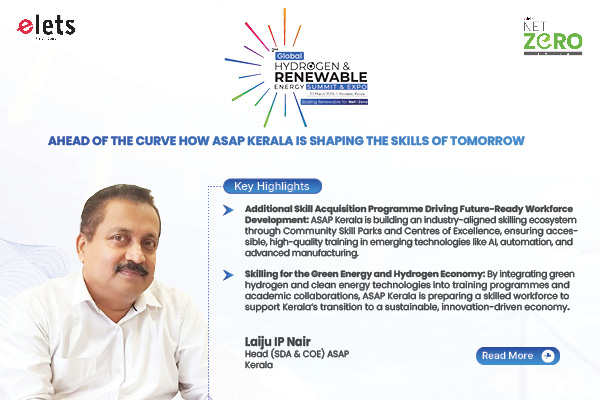
The future of work is being rewritten at an unprecedented pace. Artificial intelligence, automation, advanced manufacturing, and new energy technologies are rapidly transforming industries and redefining the skills that economies need to remain competitive. In this evolving landscape, the real challenge is not simply creating jobs but preparing people for jobs that are only beginning to emerge.
Kerala’s Additional Skill Acquisition Programme (ASAP Kerala) is positioning itself at the forefront of this transition. By identifying emerging technologies, aligning them with industry demand, and translating them into structured skilling pathways, the initiative is building a comprehensive ecosystem designed to prepare the workforce for the industries of tomorrow.

A key pillar of this ecosystem is the establishment of Community Skill Parks (CSPs) across Kerala. These parks function as modern skill hubs that provide industry-grade infrastructure and hands-on learning environments. With 16 Community Skill Parks being developed across the state, the initiative is creating a distributed network of advanced training centres accessible to learners from different regions.
Equipped with smart classrooms, machine rooms for practical training, computer laboratories, and high-speed connectivity, CSPs create an environment where training providers and industry partners can deliver programmes aligned with real workforce needs. By bringing advanced training infrastructure closer to communities, the CSP model ensures that skill development opportunities are inclusive, accessible, and responsive to emerging economic sectors.

Beyond infrastructure, ASAP Kerala focuses strongly on industry-aligned skilling and curriculum innovation. Training programmes are curated in collaboration with sector skill councils and industry stakeholders to ensure that courses reflect evolving technological and market requirements. Learning resources such as digital modules, facilitator guides, and structured course materials support a dynamic skill ecosystem that connects education with employability.
To prepare learners for emerging industries, ASAP Kerala has established Centres of Excellence (CoEs) across several high- growth technology domains. These centres serve as specialised hubs for advanced technical training, research collaboration, and industry engagement. By combining modern infrastructure with industry partnerships, the CoE model enables learners to gain exposure to cutting-edge technologies while building practical, job-ready skills.
At the same time, the global transition towards sustainable energy is opening new opportunities for innovation and employment. Kerala has outlined an ambitious roadmap for renewable energy, aiming to achieve 100 per cent renewable energy by 2040 and carbon neutrality by 2050.
Initiatives such as the Hydrogen Valley Innovation Cluster (HVIC Kerala) are being developed to accelerate the adoption of hydrogen technologies and support emerging clean energy industries.
ASAP Kerala is playing a strategic role in preparing the workforce for this transition by developing training programmes across the hydrogen value chain, from production and storage to transportation and fuel cell technologies. As a skilling organisation functioning under the Higher Education Department, ASAP Kerala is also working to connect the state’s higher education institutions with emerging technology domains such as green hydrogen, enabling both students and faculty members to gain exposure through specialised training programmes and industry-linked learning opportunities.
To strengthen the knowledge ecosystem in the state supporting these initiatives, ASAP Kerala has initiated collaborations with leading academic institutions. A partnership with the College of Engineering Muttathara under CAPE (Co-operative Academy of Professional Education) focuses on developing advanced training programmes linked to hydrogen technologies, research, and industry applications. An MoU has been signed with the College of Engineering Muttathara to facilitate this collaboration.
Similarly, ASAP Kerala is in the final stages of collaboration with the University of Kerala to integrate hydrogen energy into academic programmes, internships, research initiatives, and professional training.
In the green hydrogen domain, industry engagement is also expanding through a proposed Centre of Excellence-based Skill Development Institute (SDI) in partnership with Bharat Petroleum Corporation Limited (BPCL), Kochi, with the support of a Spanish company and its training partner. The institute will initially focus on advanced domains such as robotics, advanced welding, precision manufacturing, and industrial automation. In the next phase, the facility is planned to expand into specialised training and research infrastructure in green hydrogen technologies.
Through these initiatives, ASAP Kerala is building a comprehensive ecosystem that connects infrastructure, academia, industry, and emerging technologies. By anticipating the industries of tomorrow and preparing the workforce today, the organisation is helping position Kerala as a leader in future- ready skill development and innovation-driven growth.

Be a part of Elets Collaborative Initiatives. Join Us for Upcoming Events and explore business opportunities. Like us on Facebook , connect with us on LinkedIn and follow us on Twitter, Instagram.
"Exciting news! Elets technomedia is now on WhatsApp Channels Subscribe today by clicking the link and stay updated with the latest insights!" Click here!