 News
News




News
India Overtakes Brazil to Become World’s Third-Largest Renewable Energy Nation, IRENA Report Confirms
India Overtakes Brazil to Become World’s Third-Largest Renewable Energy Nation, IRENA Report Confirms
![]() By
eletsnetzerofinal2025 11-May-2026
By
eletsnetzerofinal2025 11-May-2026


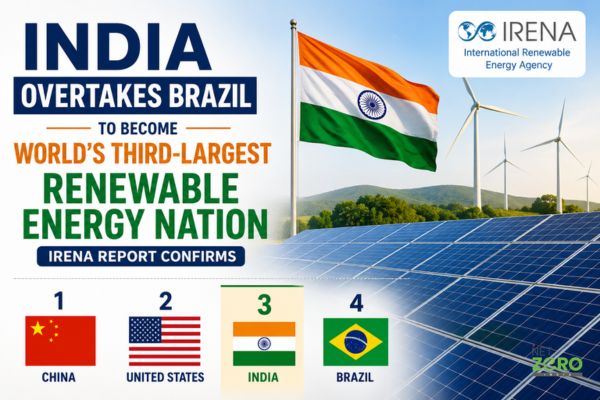
New Delhi: India has officially emerged as the world’s third-largest nation in renewable energy installed capacity, overtaking Brazil, according to the Renewable Energy Statistics 2026 released by the International Renewable Energy Agency (IRENA). The country now ranks behind only China and the United States — a feat described by the government as a landmark in India’s clean energy journey.
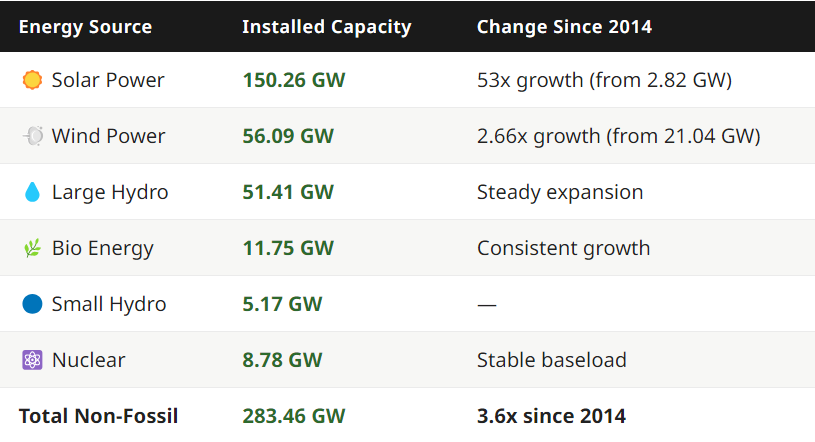
As of March 31, 2026, India’s total non-fossil fuel installed capacity reached 283.46 GW, comprising 274.68 GW from renewable sources and 8.78 GW from nuclear power. During the financial year 2025–26, the country added a record 55.3 GW of non-fossil capacity — the highest single-year addition ever recorded in India’s history, and nearly double the 29.5 GW added in FY 2024–25.

“In July 2025, renewable energy sources met 51.5 per cent of India’s total electricity demand of 203 GW — the highest-ever share of renewables in electricity generation that this country has ever achieved.”
— Pralhad Joshi, Union Minister for New and Renewable Energy

Addressing the media in New Delhi, Union Minister Pralhad Joshi said the IRENA data, based on statistics as of December 2025, validates India’s sustained push across solar, wind, hydro, and bioenergy. He noted that the country’s renewable energy capacity has grown 3.6 times since 2014 — from 76.38 GW to 274.68 GW today.
Solar Leads the Charge
Solar power has been the dominant driver of India’s clean energy expansion. The country’s cumulative solar capacity crossed 150 GW for the first time, reaching 150.26 GW by March 2026 — a 53-fold increase from the 2.82 GW it had in 2014. In FY 2025–26, India installed a record 44.61 GW of solar capacity, almost double the 23.83 GW added in the previous fiscal year and well above its target of 34 GW for the year.
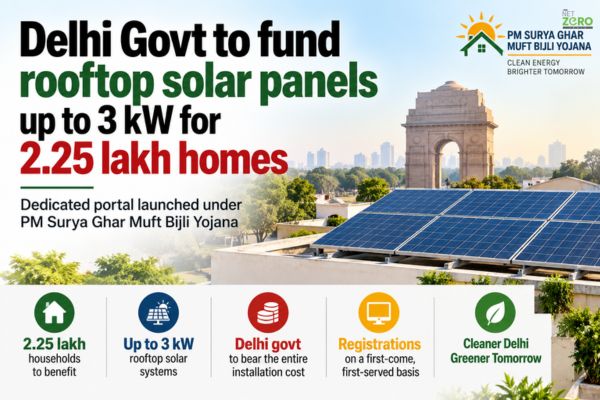
Utility-scale projects accounted for 110.43 GW of total solar capacity, while rooftop solar contributed 25.73 GW. Distributed solar emerged as a particularly significant growth driver, contributing 16.31 GW — or 36 per cent of all solar additions during the year — through the PM Surya Ghar and PM-KUSUM schemes. Over 42 lakh households have now benefited from rooftop solar installations across the country, with 22.7 lakh of them added in FY 2025–26 alone.
India’s Renewable Energy Mix — As of March 31, 2026
Wind Energy Records Its Best Year
Wind energy, too, had a landmark year. India added 6.05 GW of wind capacity during 2025–26, the highest annual addition in the segment’s history in the country. This was supported by smoother regulatory clearances, a government task force constituted in January 2026 to resolve land and grid bottlenecks, and the identification of approximately 66 GW of wind sites across high-potential states in coordination with the Ministry of Defence and the Ministry of Home Affairs.
Made in India: Manufacturing Surges
India’s clean energy progress is no longer just a story of capacity addition. The country has simultaneously built a significant domestic manufacturing base. Solar module manufacturing capacity has risen sharply from 2.3 GW in 2014 to approximately 172 GW in 2026, while wind turbine manufacturing capacity has grown from 10 GW to 24 GW in the same period. As a result, solar module imports fell from USD 2.15 billion in FY 2024–25 to USD 758 million in FY 2025–26.
Key policy interventions underpinning this shift include a reduction in the GST rate on renewable energy equipment from 12 per cent to 5 per cent in September 2025, extension of customs duty exemptions on capital goods for lithium-ion cell manufacturing until March 2028, and the launch of the Renewable Energy Equipment Import Monitoring System (REEIMS) portal in October 2025 to ensure supply chain transparency.
Paris Targets Met — Five Years Early
In a development that drew praise from international climate bodies, India achieved 50 per cent of its cumulative installed power capacity from non-fossil fuel sources in June 2025 — five years ahead of its Nationally Determined Contribution (NDC) commitment made under the Paris Agreement. The country had pledged to reach this milestone by 2030 at COP26.
“Countries that invested in the energy transition are weathering today’s geopolitical energy crises with less economic damage. India’s trajectory is a strong case for renewable energy resilience.”
— Francesco La Camera, Director-General, IRENA
India’s next target is 500 GW of non-fossil fuel capacity by 2030, a goal that will require an estimated USD 100 billion in investment. Proposed targets for 2031–35 include reducing emissions intensity by 47 per cent, sourcing 60 per cent of power capacity from non-fossil sources, and creating a carbon sink of 3.5–4 billion tonnes.
Challenges Remain
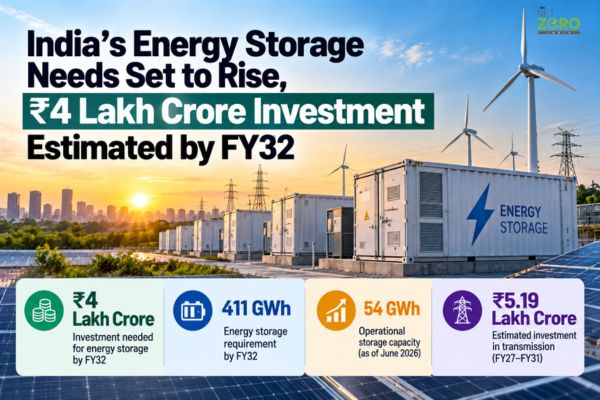
Despite the record additions, experts caution that sustaining this pace will require addressing structural challenges. Grid integration remains a key concern, with Crisil Ratings estimating that over 35 GW of renewable capacity could face curtailment risks in FY 2026–27 as transmission infrastructure struggles to keep up with rapid generation additions. Energy storage deployment — currently well under 5 GW — needs to scale significantly to handle the variability of solar and wind power.
Supply chain dependencies, particularly on China for battery materials, and the need for deeper financing at competitive rates for large-scale projects, are other areas the government and industry will need to address ahead of the 500 GW target.
Global Context
Globally, 2025 was another record year for renewable energy, with total installed capacity reaching 5,149 GW after an addition of 692 GW — a 15.5 per cent annual increase, according to IRENA. Solar accounted for 511 GW, or 74 per cent, of all additions. China led global expansion by a wide margin at 2,258 GW of installed capacity, followed by the United States at 467 GW. With 250.52 GW of renewable capacity as of December 2025 — the base period for IRENA’s ranking — India comfortably surpassed Brazil’s 228.20 GW to take third place.
The achievement comes as geopolitical tensions and fossil fuel price volatility are once again spotlighting energy security across the world, reinforcing the case for nations to accelerate their clean energy transitions.

Be a part of Elets Collaborative Initiatives. Join Us for Upcoming Events and explore business opportunities. Like us on Facebook , connect with us on LinkedIn and follow us on Twitter, Instagram.
"Exciting news! Elets technomedia is now on WhatsApp Channels Subscribe today by clicking the link and stay updated with the latest insights!" Click here!