 News
News





News
India’s Energy Storage Needs Set to Rise, ₹4 Lakh Crore Investment Estimated by FY32
India’s Energy Storage Needs Set to Rise, ₹4 Lakh Crore Investment Estimated by FY32
![]() By
Abhineet Kumar 30-September-2026
By
Abhineet Kumar 30-September-2026


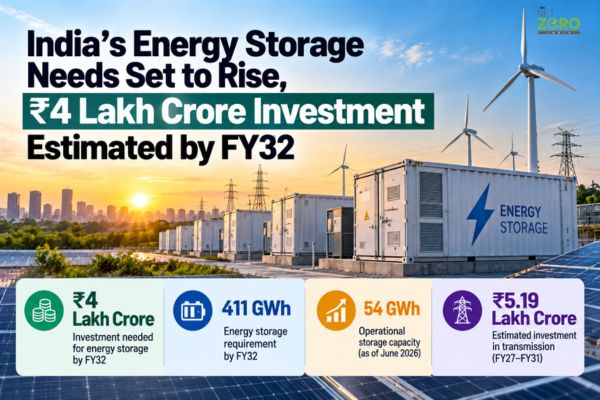
India may require more than ₹4 lakh crore in investment in energy storage infrastructure by FY32 as the country expands renewable power capacity and focuses increasingly on integrating variable renewable generation into the electricity grid, according to a report by CareEdge Ratings.
The report noted that India’s power sector is gradually shifting from the earlier focus of adding generation capacity to the challenge of integrating a growing share of renewable energy into the power system.

Non-fossil sources currently account for around 50 per cent of India’s installed power generation capacity, while their contribution to actual electricity generation is around 29 per cent. The gap highlights the increasing requirement for energy storage, transmission infrastructure and flexible generation as renewable capacity expands.
Energy Storage Requirement to Reach 411 GWh
According to CareEdge Ratings, India’s energy storage requirement is projected to reach around 411 GWh by FY32, compared with approximately 54 GWh of operational storage capacity as of June 2026.

The agency estimates that storage-related capital expenditure of more than ₹4 lakh crore will be required to meet the projected FY32 requirement. The investment will support the integration of renewable generation and help manage electricity generated from variable renewable sources.
The report also pointed to a sharp increase in standalone storage tenders, which rose to around 21 GW in FY26 from 7 GW in FY25, indicating increased activity in the energy storage segment.
BESS and Pumped Storage to Support Renewable Integration
CareEdge Ratings highlighted the complementary roles of Battery Energy Storage Systems (BESS) and Pumped Storage Plants (PSPs) in supporting India’s power transition.
Both technologies are expected to contribute to the management of renewable generation as the country adds more solar and wind capacity. Storage can help balance variable generation, while flexible generation and transmission infrastructure will remain important components of the wider power system.
The report also noted that coal-based thermal power is entering a period of improved credit stability and renewed investment relevance. Well-contracted coal-based thermal assets are expected to continue supporting rising electricity demand while providing flexibility for integrating increasing renewable generation.
This suggests that the expansion of renewable energy will be accompanied by investment across other parts of the electricity system, rather than an immediate replacement of conventional generation.
Also Read: India’s 500 GW Clean Energy Target Needs Grid Stability Roadmap: Report
₹5.19 Lakh Crore Transmission Investment
Transmission infrastructure is also expected to attract substantial investment. CareEdge Ratings estimates a capital expenditure outlay of around ₹5.19 lakh crore between FY27 and FY31.
However, the report identified right-of-way constraints, forest clearances and coordination requirements as key execution challenges for transmission projects.
Despite these challenges, the agency noted that the stable cash-flow profile and long concession periods of operational transmission assets continue to support the sector’s credit profile.
The findings underline the scale of investment required across storage, transmission and flexible generation as India works to accommodate a growing share of renewable electricity in its power system.

Be a part of Elets Collaborative Initiatives. Join Us for Upcoming Events and explore business opportunities. Like us on Facebook , connect with us on LinkedIn and follow us on Twitter, Instagram.
"Exciting news! Elets technomedia is now on WhatsApp Channels Subscribe today by clicking the link and stay updated with the latest insights!" Click here!