 News
News





Interviews
Beyond Runways: Building the World’s Greenest Airport Ecosystem
Beyond Runways: Building the World’s Greenest Airport Ecosystem
![]() By
eletsnetzerofinal2025 29-July-2026
By
eletsnetzerofinal2025 29-July-2026


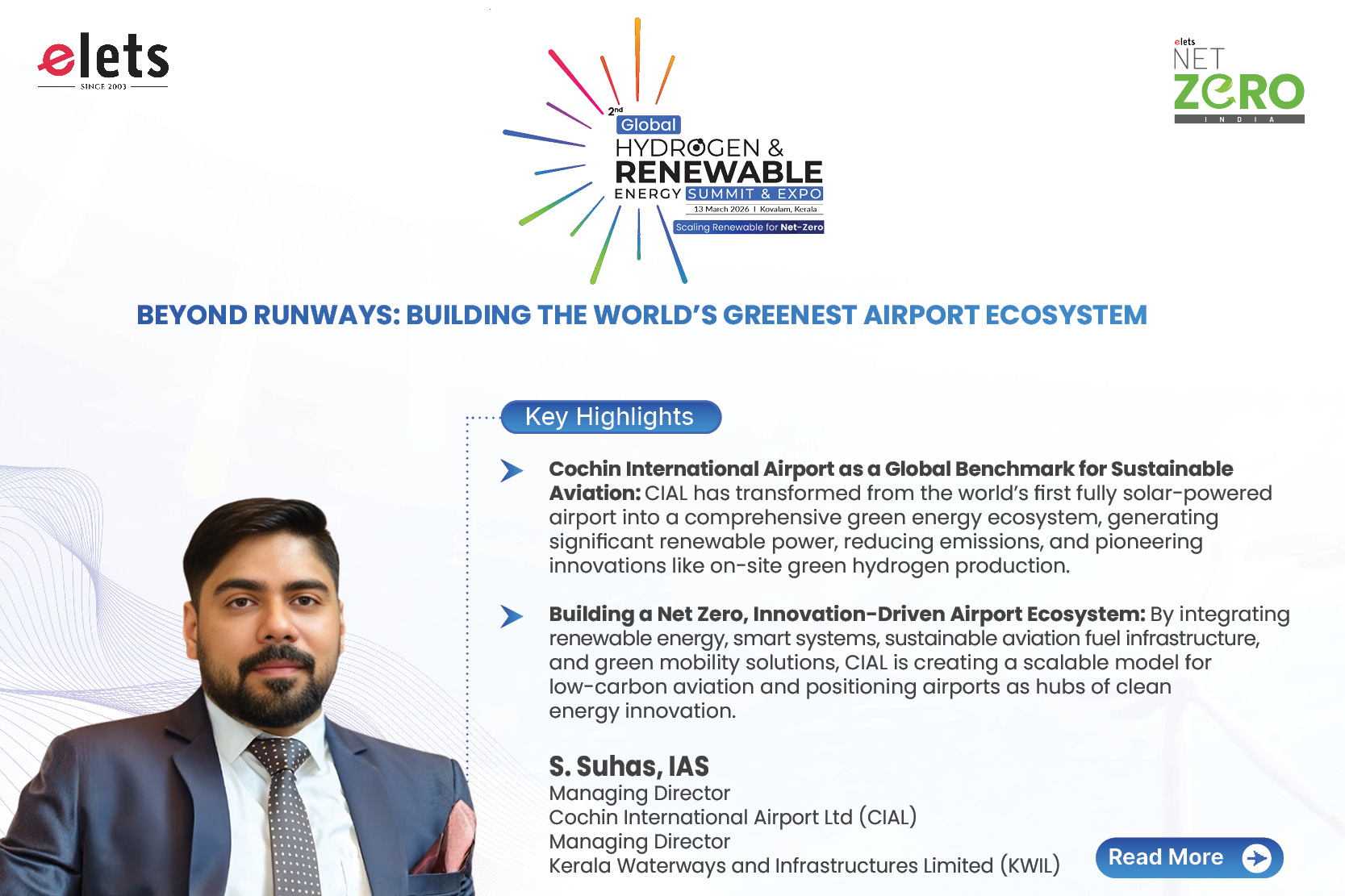
As aviation faces increasing pressure to decarbonise, airports are emerging as critical enablers of sustainable infrastructure, clean energy adoption, and low-carbon mobility. S. Suhas, IAS, Managing Director, Cochin International Airport Ltd (CIAL) and Managing Director of Kerala Waterways and Infrastructures Limited (KWIL), in an exclusive interview with Krishna Mishra of Elets News Network, discusses how the airport’s pioneering solar initiative, green hydrogen plans, and collaborative sustainability model are shaping the future of climate-resilient aviation and infrastructure. Edited excerpts:
Cochin International Airport Limited (CIAL) is the world’s first fully solar-powered airport. How has this milestone shaped CIAL’s long-term sustainability vision? What inspired CIAL to take such an early and bold step toward renewable energy adoption in aviation infrastructure?

Cochin International Airport achieved a historic milestone in 2015 by becoming the world’s first fully solar-powered airport. What began as an ambitious initiative has evolved into a powerful demonstration of how renewable energy can transform critical infrastructure. Today, CIAL’s solar installations generate around 73 million units of green electricity annually with a capacity of about 50 MW, reducing nearly 66,000 tonnes of carbon emissions each year.
This milestone has shaped CIAL’s long-term vision by embedding sustainability as a core operational philosophy rather than treating it as a peripheral initiative. The decision to adopt solar power early was driven by the understanding that infrastructure development must align with environmental responsibility and energy independence. It demonstrated that large-scale transport infrastructure can successfully transition to renewable energy while maintaining operational efficiency.

How do you see airports evolving as energy producers and sustainability hubs rather than just transportation infrastructure? What opportunities do you see for public-private partnerships and international collaboration in advancing sustainable aviation?
Airports are uniquely positioned to evolve into integrated energy and sustainability hubs due to the scale of their infrastructure, land availability, and continuous energy demand. Increasingly, airports are not just consumers of energy but are becoming producers of renewable power and facilitators of clean energy solutions within the broader mobility ecosystem. At CIAL, this transition is reflected in initiatives such as large-scale solar power generation and the development of a green hydrogen production and dispensing facility aimed at supporting clean mobility.
Public–private partnerships play a critical role in enabling such innovations. The collaboration between CIAL and Bharat Petroleum Corporation Limited (BPCL) on the green hydrogen project demonstrates how infrastructure operators and energy companies can work together to develop and deploy emerging clean energy technologies. Such partnerships combine operational infrastructure, technological expertise, and investment capabilities.
International collaboration is equally important in advancing sustainable aviation. As the sector moves toward decarbonisation, sharing knowledge, technology, and best practices among airports, energy providers, research institutions, and policymakers will be essential to accelerate the adoption of renewable energy, sustainable fuels, and green mobility solutions across the global aviation ecosystem.
What are the next steps for CIAL in its journey toward Net Zero operations? Are there any innovative green mobility solutions being planned within the airport ecosystem?
CIAL continues to expand its sustainability roadmap beyond solar energy. A significant step in this direction is the establishment of a 1000 kW green hydrogen production and dispensing facility at the airport in partnership with Bharat Petroleum Corporation Limited (BPCL). With this initiative, CIAL is set to become the world’s first airport to have a green hydrogen plant within its premises, further strengthening its leadership in sustainable airport infrastructure.
The facility will produce green hydrogen through alkaline water electrolysis using renewable energy, creating a clean fuel source for mobility applications. The hydrogen produced will be supplied through a dedicated refuelling station located near the airport road.
As part of the green mobility initiative, CIAL has signed a Memorandum of Understanding with ANERT (Agency for New and Renewable Energy Research and Technology) for the procurement of hydrogen fuel cell buses, which will be introduced for passenger transportation within the airport ecosystem.
Also Read | Kerala’s Roadmap to a Net Zero Energy Future
The project is being implemented as a pilot initiative to demonstrate the feasibility of hydrogen-based mobility within airport operations. In the long term, such initiatives are expected to support the development of a clean mobility ecosystem, contributing to the decarbonisation of airport ground transport and advancing the broader transition toward sustainable energy systems.
Aviation is often considered a hard-todecarbonise sector. What role can airports like CIAL play in supporting sustainable aviation fuel (SAF) adoption and low-carbon aviation initiatives? How important is collaboration with airlines, fuel providers, and technology partners in building a sustainable aviation ecosystem?
Aviation is widely considered a hard-to-decarbonise sector, and airports can play a key enabling role in supporting this transition. Airports can facilitate the adoption of Sustainable Aviation Fuel (SAF) by providing the necessary storage, blending, and distribution infrastructure, while working closely with fuel suppliers and airlines to integrate SAF into existing fuel supply chains.
Beyond fuel infrastructure, airports can also support lowcarbon aviation by deploying renewable energy, promoting green ground mobility, and serving as testing grounds for emerging clean technologies such as hydrogen-based energy systems.
Collaboration is therefore critical. Airlines, fuel providers, airport operators, and technology partners must work together to scale SAF supply, develop supporting infrastructure, and pilot new solutions. Such coordinated efforts are essential to build a practical and scalable ecosystem for low-carbon aviation.
How are digital technologies, smart systems, and data analytics helping CIAL optimise energy use and reduce emissions?
CIAL’s sustainability model integrates renewable energy generation with efficient infrastructure management. By aligning energy production with consumption patterns and operational planning, the airport maintains a balanced and sustainable energy ecosystem.
This approach has enabled key facilities at CIAL, including all three passenger terminals and cargo infrastructure, to achieve the Indian Green Building Council’s Net Zero Energy Rating, meaning they generate as much energy as they consume.
Digital monitoring systems, smart energy management tools, and data-driven operational strategies play an important role in optimising renewable energy utilisation and improving overall energy efficiency across the airport ecosystem.
CIAL’s solar model has inspired airports worldwide. What lessons from CIAL’s journey could be replicated by other airports and infrastructure projects? What advice would you give to authorities seeking to accelerate sustainable infrastructure development?
One of the most important lessons from CIAL’s journey is that sustainability must be integrated into infrastructure planning from the outset rather than treated as an afterthought.
CIAL has demonstrated that large-scale renewable energy projects are both technically feasible and economically viable for major infrastructure facilities. Key lessons include investing early in renewable energy, aligning sustainability goals with operational efficiency, building strong public– private partnerships, and encouraging innovation through pilot projects.
Authorities seeking to accelerate sustainable infrastructure development should focus on long-term planning, supportive policy frameworks, and collaboration with industry and research institutions to scale clean energy solutions.
Recently, the state government commissioned the first phase of the West Coast Canal project involving restoration of inland navigation infrastructure. As Director of Kerala Waterways and Infrastructures Limited (KWIL), how do you see the project contributing to sustainable tourism development?
The West Coast Canal project aims to revive Kerala’s historic inland waterway network stretching from Thiruvananthapuram to Kasaragod. The commissioning of the first phase, from Akkulam in Thiruvananthapuram to Chettuva in Thrissur, marks an important step in restoring inland navigation infrastructure in the state.
This phase was inaugurated along with the Chilakkor tourism project, which is designed to enhance tourism infrastructure along the canal corridor.
The revival of this waterway opens significant opportunities for sustainable tourism development. Inland waterways offer a low-carbon mode of transport compared to road-based travel and allow tourists to experience Kerala’s landscapes, backwaters, and cultural destinations in a more environmentally responsible manner.
The project is expected to facilitate the development of waterbased tourism circuits, including houseboat tourism, ecotourism initiatives, and local tourism hubs along the canal network. By improving navigation, creating tourism infrastructure, and connecting multiple districts through waterways, the project can promote slow and sustainable tourism while generating economic opportunities for local communities along the canal route.
In the long term, the West Coast Canal can emerge as a green mobility and tourism corridor, supporting Kerala’s efforts to promote environmentally responsible tourism while revitalising traditional inland water transport systems.
Looking ahead to 2030 and beyond, what does your vision of a Net Zero airport ecosystem look like? What message would you like to share with industry leaders and policymakers working toward a sustainable and climate-resilient aviation sector?
Looking ahead to 2030 and beyond, the vision is to develop CIAL as a fully integrated Net Zero airport ecosystem where infrastructure, energy systems, and mobility solutions operate with a minimal carbon footprint while supporting the continued growth of aviation.
The next phase will focus on deep decarbonisation of airport operations through greater energy efficiency, electrification of ground support equipment, expansion of clean mobility solutions, and integration of emerging fuels and technologies within the airport ecosystem. Airports must increasingly function as platforms that enable the transition to low-carbon aviation by supporting new fuel pathways, cleaner logistics, and sustainable infrastructure practices.
These efforts must also align with broader climate commitments. India has committed to achieving Net Zero emissions by 2070, while the Government of Kerala has set an even more ambitious target of Net Zero by 2050. Airports, as critical infrastructure, have an important role to play in supporting these national and state-level climate goals.
My message to industry leaders and policymakers is that achieving a climate-resilient aviation sector will require longterm policy support, sustained investment in clean technologies, and strong collaboration across the aviation value chain. If airports are viewed not only as transport facilities but also as innovation platforms for sustainable infrastructure, the aviation sector can successfully balance growth with environmental responsibility.

Be a part of Elets Collaborative Initiatives. Join Us for Upcoming Events and explore business opportunities. Like us on Facebook , connect with us on LinkedIn and follow us on Twitter, Instagram.
"Exciting news! Elets technomedia is now on WhatsApp Channels Subscribe today by clicking the link and stay updated with the latest insights!" Click here!