 News
News




News
India Becomes World’s Third-Largest Renewable Energy Capacity Holder, Manufacturing Push Gains Momentum
India Becomes World’s Third-Largest Renewable Energy Capacity Holder, Manufacturing Push Gains Momentum
![]() By
eletsnetzerofinal2025 16-May-2026
By
eletsnetzerofinal2025 16-May-2026


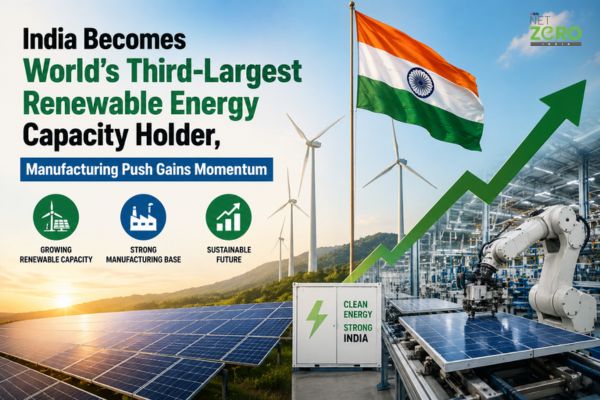
India has emerged as the world’s third-largest country in installed renewable energy capacity, reflecting the country’s rapid progress in clean energy adoption and its growing role in the global energy transition. According to a recent Morgan Stanley analysis and data from the Ministry of New and Renewable Energy (MNRE), solar and wind energy additions continue to drive this growth momentum.
The achievement highlights India’s ambitious push toward cleaner energy sources and reducing dependence on conventional fossil fuels, even as policymakers focus on strengthening domestic manufacturing capabilities.

Domestic Solar Manufacturing Sees Rapid Expansion
Recent ministry data shows a significant rise in India’s solar manufacturing capacity over the past year.

Domestic solar module capacity nearly doubled from 38 GW in March 2024 to 74 GW by March 2025. During the same period, solar cell manufacturing capacity increased from 9 GW to 25 GW.
Industry experts say the expansion has improved supply chain resilience and enabled larger deployment of renewable projects across various states.
The growth is also being linked to supportive government policies, increased private sector participation and rising market demand.
Import Dependence Remains a Key Challenge
Despite strong progress, analysts noted that India still relies heavily on imports for several upstream components used in solar manufacturing.
According to the report, India imported nearly 35 million solar modules worth around $1.6 billion during FY2025. An estimated 60–80 percent of these imports came from China.
The findings indicate that while module assembly capacity has expanded significantly, dependence on critical components such as wafers, polysilicon and solar cells remains a challenge.
The report suggested that accelerating localisation across these segments will be essential to reduce external dependence and improve long-term supply security.
Non-Fossil Capacity Crosses Major Milestone
India’s non-fossil fuel energy capacity has now crossed the 50 percent mark of total installed power capacity, reaching 262.7 GW.
Solar and wind projects continue to account for a major share of new additions and are gradually reshaping India’s power generation mix.
Government and industry stakeholders are now focusing on:
- Expanding manufacturing infrastructure
- Strengthening domestic supply chains
- Improving financing mechanisms
- Encouraging technology transfer
- Reducing logistics bottlenecks
Focus Shifts Towards Long-Term Energy Security
Industry observers believe India’s renewable energy journey is entering a new phase where manufacturing self-reliance will become as important as capacity addition.
Also Read | India Overtakes Brazil to Become World’s Third-Largest Renewable Energy Nation, IRENA Report Confirms
While India’s rise to the third global position reflects strong progress, experts say long-term success will depend on building an integrated domestic ecosystem that supports both energy generation and manufacturing.
As India accelerates its clean energy transition, policy support and investment in local manufacturing are expected to play a crucial role in sustaining future growth and reducing dependence on global supply chains.

Be a part of Elets Collaborative Initiatives. Join Us for Upcoming Events and explore business opportunities. Like us on Facebook , connect with us on LinkedIn and follow us on Twitter, Instagram.
"Exciting news! Elets technomedia is now on WhatsApp Channels Subscribe today by clicking the link and stay updated with the latest insights!" Click here!