 News
News






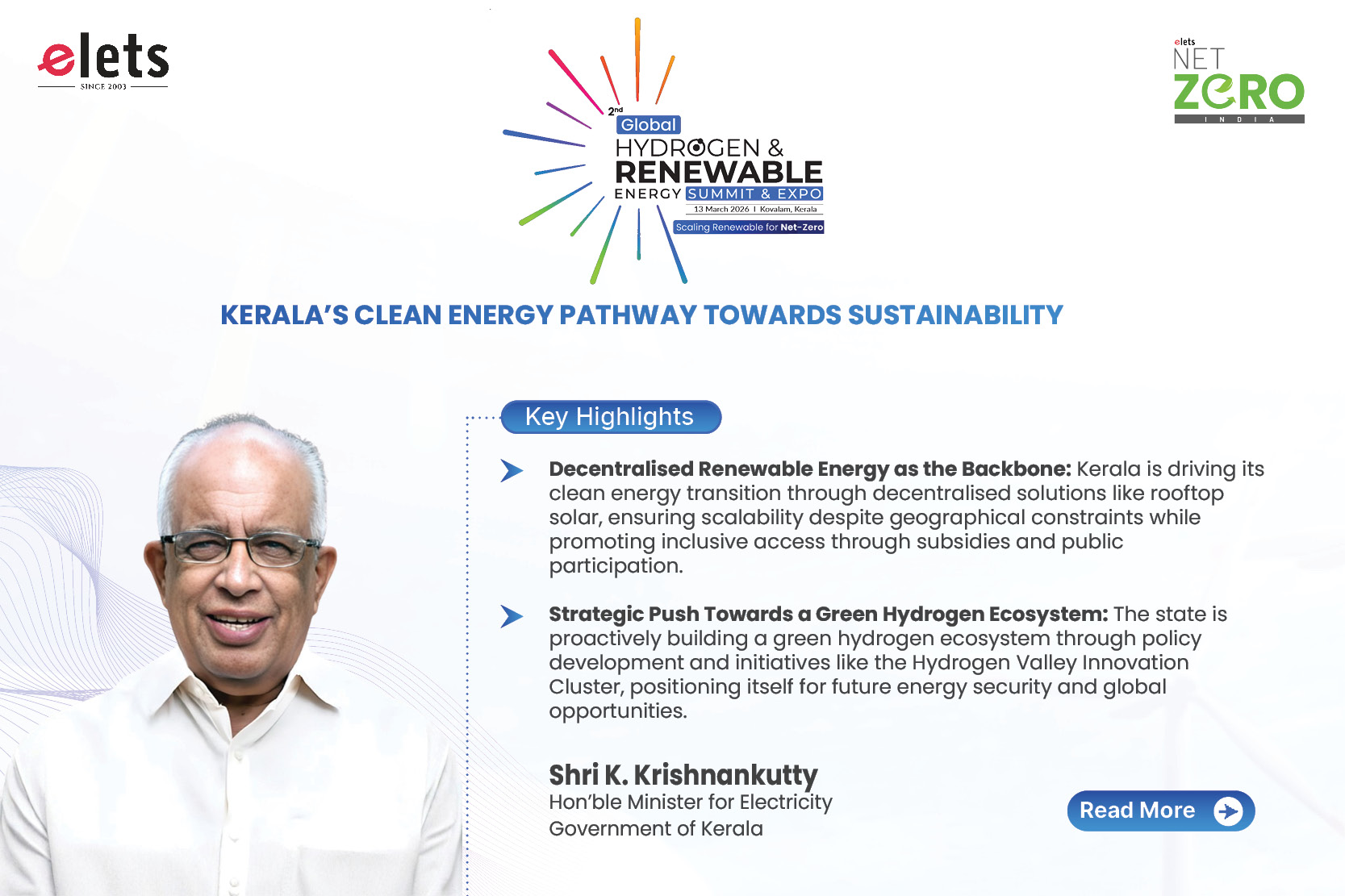
Kerala, like many regions across the world, is increasingly facing the consequences of climate change. Rising temperatures, erratic weather patterns and climate-related disruptions have reinforced the urgency of strengthening energy security while transitioning towards sustainable alternatives. At present, only about 20 to 25 per cent of the state’s total electricity requirement is met through domestic generation. At the same time, electricity demand has increased by nearly 12 per cent in the past year, a growth rate higher than the national average. This widening gap between demand and internal production presents a significant challenge for long- term energy stability.
To address this, Kerala is placing strong emphasis on expanding renewable energy and exploring green hydrogen as a future-ready solution. The state has consistently demonstrated leadership in designing and implementing innovative renewable energy programmes. While geographical constraints limit the feasibility of very large- scale projects, Kerala has made substantial progress in decentralised energy generation. Rooftop solar installations, in particular, have become a defining feature of the state’s renewable energy strategy. Public participation has been noteworthy, with households and institutions increasingly adopting solar solutions.

One of the key priorities of the Government of Kerala is ensuring that the benefits of renewable energy reach all sections of society. Fully subsidised solar power plants are being provided to marginalised communities, reinforcing the state’s commitment to inclusive development. In parallel, the solarisation of agricultural pumps is being implemented on a large scale with full government support in a decentralised manner. This initiative not only helps reduce the financial burden associated with electricity subsidies but also creates opportunities for farmers to generate additional income through surplus power.
Kerala has also achieved important milestones in institutional adoption of renewable energy. Cochin International Airport operates entirely on solar power, establishing a model for large-scale renewable integration. In Thiruvananthapuram, most government buildings now function using solar energy

These initiatives demonstrate that renewable adoption is being embedded within public infrastructure.
The state has recently issued guidelines for the implementation of floating solar projects on reservoirs. These guidelines are expected to facilitate the development of larger solar projects, particularly through public-private partnerships. Such collaborations are seen as critical for accelerating renewable capacity while ensuring financial sustainability.
Cochin International Airport operates entirely on solar power
In addition to solar, wind energy projects are under active consideration. The formulation of a Green Hydrogen Policy is in its final stages, reflecting the state’s forward-looking approach to emerging clean technologies. Pump storage projects are also being examined, with guidelines under preparation. Pump storage is expected to complement intermittent renewable sources by improving grid reliability and ensuring energy availability beyond peak generation hours.
Kerala is working towards a comprehensive energy policy that integrates solar power, small hydro projects, battery storage systems and other renewable sources into a cohesive framework. The emphasis is not merely on expanding capacity but on creating an integrated and resilient energy ecosystem capable of meeting future demand.
In alignment with the guidelines of the Ministry of Science and Technology, Government of India, approval has been granted to establish a Special Purpose Vehicle under Section 8 of the Companies Act, 2013, titled the Hydrogen Valley Innovation Cluster Kerala. This initiative, led by ANERT, is intended to advance the Hydrogen Valley project in the state and promote coordinated development across the hydrogen value chain.
Kerala’s unique strengths, including water availability, renewable energy potential and the presence of major ports, provide a strong foundation for promoting green hydrogen production, domestic utilisation and exports. Under the National Green Hydrogen Mission, pilot projects in the transport sector have already commenced. Approval is anticipated for the broader Hydrogen Valley initiative, which is expected to include pilot projects covering multiple components of hydrogen production, storage and application.
Through these coordinated efforts, Kerala is strengthening its transition towards clean energy while addressing the dual objectives of sustainability and energy security. The state’s approach reflects a balanced strategy that combines decentralised renewable expansion, technological innovation, inclusive policies and structured institutional frameworks to build a resilient and future-ready energy system.
Edited by: Abhineet Kumar | ENN
Insights shared by: K. Krishnankutty, Hon’ble Minister for Electricity, Government of Kerala, at the Global Hydrogen & Renewable Energy Summit 2025, held on 12 March, in Kochi, Kerala.

Be a part of Elets Collaborative Initiatives. Join Us for Upcoming Events and explore business opportunities. Like us on Facebook , connect with us on LinkedIn and follow us on Twitter, Instagram.
"Exciting news! Elets technomedia is now on WhatsApp Channels Subscribe today by clicking the link and stay updated with the latest insights!" Click here!