 News
News





Article
Financing Decarbonization: Unlocking Capital for Hard-to-Abate Sectors
Financing Decarbonization: Unlocking Capital for Hard-to-Abate Sectors
![]() By
eletsnetzerofinal2025 16-April-2026
By
eletsnetzerofinal2025 16-April-2026


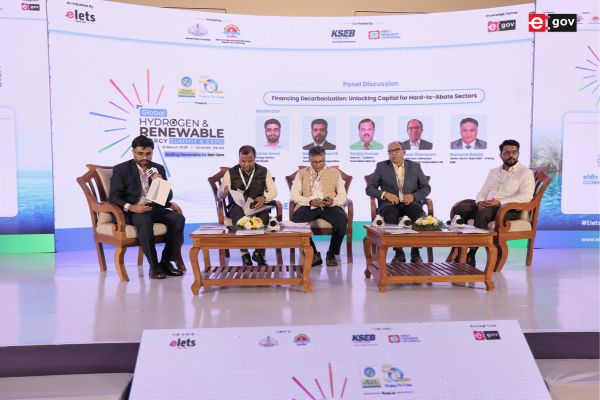
Financing Decarbonisation: Bridging Technology and Capital
The panel brought forward a critical dimension of the energy transition, financing decarbonisation in hard-to-abate sectors. While technological solutions such as green hydrogen and carbon capture, utilisation, and storage (CCUS) are gaining momentum, their large-scale deployment remains closely tied to the availability of innovative and accessible financing models. The discussion at the 2nd Global Hydrogen & Renewable Energy Summit in Kovalam on 13th March 2026 highlighted that decarbonisation is no longer just an engineering challenge; it is equally a financial one, requiring new approaches to risk-sharing, capital mobilisation, and long-term investment planning.

Blended finance, viability gap funding, and demand-assured contracts emerged as essential tools in addressing the financial barriers associated with these technologies. At the same time, the importance of inclusivity, particularly for MSMEs, was emphasised, alongside the need for policy reforms to ensure broader access to clean technology finance. The panel underscored that only through strategic partnerships and integrated ecosystem development can decarbonisation be achieved at scale and in a cost-effective manner.
Speaker Perspectives

Karan Arora, Energy Advisor, GiZ GmbH
Decarbonisation in hard-to-abate sectors presents a dual challenge that extends beyond technology into the realm of finance. High capital costs, long payback periods, and uncertain returns make it difficult for industries to commit to low-carbon investments without adequate financial support. This is particularly relevant in sectors such as steel, cement, and refining, where operational margins are often constrained.
Also Read | From Policy to Projects: Building India’s Green Hydrogen Economy
Access to affordable and scalable finance is, therefore, a critical enabler for accelerating adoption. Without mechanisms that can de-risk investments and improve project viability, even the most advanced technologies may struggle to achieve widespread deployment. Addressing this gap requires innovative financial structures that align long-term sustainability goals with immediate economic realities.
Ranjith Kumar E R, General Manager, Kerala Financial Corporation
The role of financial institutions in enabling inclusive and sustainable growth was highlighted through the work of Kerala Financial Corporation. By supporting over 75,000 enterprises, the institution has played a significant role in strengthening the MSME ecosystem and fostering entrepreneurship across sectors.
This support is increasingly being channelled toward clean and energy-efficient technologies, helping businesses transition toward more sustainable practices. For MSMEs, access to finance remains a key barrier, and targeted financial interventions can significantly accelerate their adoption of green solutions. Expanding access to capital for these enterprises is essential for ensuring that the benefits of decarbonisation are widely distributed across the economy.
Sanjay Kumar, Director – Systems, Kochi Metro Rail Ltd.
Sustainable mobility was highlighted as a critical pathway for reducing emissions, particularly in urban environments. Mass transit systems such as metro and water metro offer a highly efficient solution, with the potential to reduce emissions by nearly 70% per passenger. By shifting large volumes of people from individual vehicles to public transport, these systems help reduce congestion, lower fuel consumption, and improve air quality. Investments in integrated, accessible, and reliable public transport infrastructure not only enhance mobility but also contribute significantly to building low-carbon and livable cities. Such initiatives demonstrate how infrastructure development can align with climate goals to deliver long-term environmental and social benefits.
Prateek Shanware, CGM (Net Zero, Refineries), Bharat Petroleum Corporation Ltd.
The scale of transformation required in the industrial sector was underscored through the example of hydrogen demand in refining. While a 5 MW electrolyser produces less than 1 KTPA of hydrogen, the refining industry alone requires over 2,000 KTPA. This stark contrast highlights the magnitude of the challenge in transitioning to green hydrogen.
Meeting this demand will require a substantial expansion of electrolyser capacity, along with access to low-cost renewable energy and robust infrastructure. The transition must be carefully planned to ensure that supply can scale in line with industrial demand, while maintaining cost competitiveness. Addressing these challenges is essential for making green hydrogen a viable solution for large-scale industrial decarbonisation.
Ramana Reddy, Senior Sector Specialist – Energy, KfW
The bankability of green hydrogen projects is a key factor in attracting global investment. Demand assurance mechanisms, such as forward contracts and long-term offtake agreements, play a crucial role in this context by providing revenue visibility and reducing market uncertainty. These instruments enable better risk allocation and improve investor confidence, making it easier for developers to secure financing at competitive rates. By lowering the cost of capital and ensuring stable returns, such mechanisms can accelerate the scale-up of green hydrogen projects and support the broader energy transition. Strengthening these financial structures will be essential for unlocking large-scale investment in emerging low-carbon technologies.
Key Insights
The discussion highlighted that blended finance and viability support are essential for enabling early-stage technologies like green hydrogen and CCUS to reach commercial scale. Instruments such as grants, concessional funding, and risk-sharing frameworks help bridge the cost gap and attract private investment. At the same time, achieving financial closure for projects depends heavily on demand assurance and risk mitigation, with forward contracts and structured offtake agreements providing the revenue visibility needed to build investor confidence.
Also Read | Operating the High-RE Grid: Storage, Flexibility as a Grid Resource
Another critical area is the inclusion of MSMEs and supply chains in the decarbonisation journey. Existing financial and regulatory constraints often limit their access to capital, underscoring the need for policy reforms and dedicated green financing mechanisms. Ensuring broader participation will be key to achieving an inclusive transition. Furthermore, large-scale decarbonisation cannot be driven by isolated efforts; it requires strategic public-private partnerships, global collaboration, and integrated infrastructure ecosystems that enable cost-effective and scalable solutions across industries.
Conclusion
The panel clearly established that the transition to a low-carbon economy in hard-to-abate sectors will depend as much on financial innovation as on technological advancement. While solutions such as green hydrogen and CCUS hold immense potential, their success will be determined by the ability to create enabling financial ecosystems that reduce risk, ensure viability, and attract sustained investment. The emphasis on blended finance, demand assurance, and inclusive policy frameworks reflects a pragmatic approach to addressing these challenges. At the same time, the importance of collaboration—across governments, industry, financial institutions, and global stakeholders—emerges as a central theme in driving progress.
As the decarbonisation agenda continues to evolve, building a strong foundation of financial and institutional support will be essential for translating ambition into action. With the right mix of policy direction, financial innovation, and strategic partnerships, large-scale, cost-effective decarbonisation across industries can become an achievable reality.

Be a part of Elets Collaborative Initiatives. Join Us for Upcoming Events and explore business opportunities. Like us on Facebook , connect with us on LinkedIn and follow us on Twitter, Instagram.
"Exciting news! Elets technomedia is now on WhatsApp Channels Subscribe today by clicking the link and stay updated with the latest insights!" Click here!