 News
News






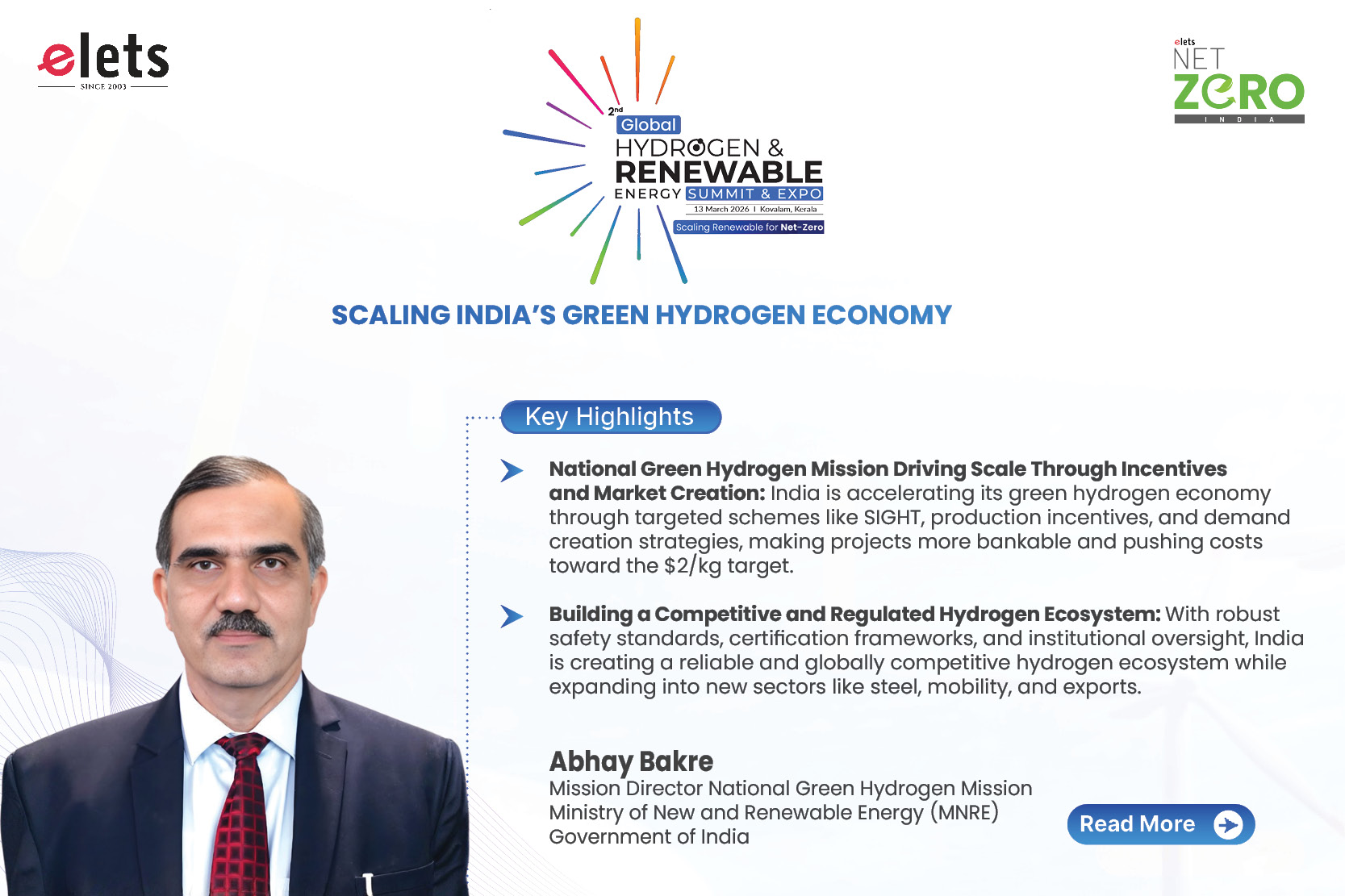
India is steadily building its green hydrogen ecosystem through policy support, financial incentives, and expanding industrial demand. Abhay Bakre, Mission Director, National Green Hydrogen Mission, Ministry of New and Renewable Energy (MNRE), Government of India, in an exclusive conversation with Nijhum Rudra of Elets News Network, shares insights on the mission’s incentives, regulatory framework, and strategies to scale green hydrogen production in India.
Edited excerpts:
The National Green Hydrogen Mission includes incentive mechanisms such as the Strategic Interventions for Green Hydrogen Transition (SIGHT) program and electrolyser manufacturing support. How do these frameworks help ensure project bankability and attract long-term investments?

Under the National Green Hydrogen Mission, our strategy has two key components. First, we provide financial incentives in the form of subsidies. Second, we encourage the development of new sectors through pilot projects.
One of the major requirements for scaling green hydrogen production is the development of large electrolyser manufacturing capacity. To support this, we have introduced incentive mechanisms similar to a Production Linked Incentive framework, where production is incentivised annually. These incentives are designed to gradually taper over time as technology matures and costs decline.

On the hydrogen production side, the mission provides tapered financial incentives of 50, 40, and 30 per kilogram during the initial years following project commissioning. This support helps bridge the cost gap between conventional hydrogen and green hydrogen.
The objective is to partially de-risk early projects and reduce the financial uncertainty for developers. As producers gain experience and sectors begin to absorb green hydrogen at scale, projects will gradually become commercially viable and bankable.
The government aims to reduce the cost of green hydrogen to around two dollars per kilogram by 2032. What steps are being taken to achieve this target across sectors such as steel and mobility?
Our primary focus is on expanding demand across multiple sectors. The National Green Hydrogen Mission targets five million tonnes of green hydrogen production annually, which can be used domestically or exported.
We began with sectors such as fertilisers and refineries, which already consume hydrogen. Now we are expanding into additional sectors such as steel and mobility.
As demand increases, more projects will come up with long-term offtake agreements. This reduces uncertainty for developers and supports project viability. At the same time, improvements in technology, scaling of electrolyser manufacturing, and the development of a broader ecosystem will help reduce costs.
Also Read | Reimagining India’s Energy Future: Nuclear Power, Small Hydro, and the Road to Viksit Bharat 2047
We have already seen prices decline from around 330 per kilogram to approximately 280 per kilogram. With further scaling, improved technology, and stronger demand, achieving the target of two dollars per kilogram by 2032 appears feasible.
How is the mission addressing regulatory clarity and safety standards to support the deployment of hydrogen infrastructure across the country?
A key step in this direction has been the introduction of the Green Hydrogen Certification Scheme. This certification ensures that hydrogen qualifies as green only when it meets defined standards, including a threshold of two kilograms of carbon dioxide emissions per kilogram of hydrogen produced.
In addition, the government has released standards for green ammonia and green methanol, which are important derivatives of green hydrogen.
From a regulatory standpoint, multiple agencies will be involved in establishing and implementing safety frameworks. These include bodies such as the Bureau of Indian Standards, the Petroleum and Explosives Safety Organisation, and the Oil Industry Safety Directorate.
We have also established a National Safety Panel to guide standards for installation, testing, commissioning, operation, and maintenance of hydrogen infrastructure. This includes protocols for transportation through pipelines or cascades, as well as handling derivatives like green ammonia.
Over the next one to one and a half years, we aim to ensure that these standards and protocols are fully developed so that project developers can operate without regulatory uncertainty.
Some reports suggest that production timelines may face delays due to global policy uncertainties. How is the mission ensuring India remains competitive in the global hydrogen market?
Green hydrogen is a relatively new sector globally, and many stakeholders are entering this space for the first time. This includes participants across the renewable energy sector, electrolyser manufacturing, hydrogen production, and end-use industries such as transport and steel.
Some initial delays were anticipated as stakeholders gain experience and as technologies evolve. However, progress is steadily being made.
Several pilot projects are underway in sectors such as mobility and steel, supported by research and development efforts focused on improving technologies like electrolyser membranes and purification systems. Our strategy focuses on expanding demand by opening new consumption sectors. As demand grows, projects will become more viable and investments will accelerate.
Currently, India already has around eight thousand tonnes of annual green hydrogen production capacity. By 2026, we expect additional projects to become operational, and by 2030 the national target of five million tonnes appears achievable.
India is also seeing growing interest in export opportunities, with several international agreements already finalised and others under negotiation.
Industry forums and summits often bring together policymakers, industry leaders, and researchers. How important are such platforms for the growth of the green hydrogen ecosystem?
Events and conferences play an important role, especially for an emerging sector like green hydrogen. They provide a platform for stakeholders to exchange ideas, share experiences, and identify new areas of collaboration. Given that the ecosystem is still developing, discussions across sectors are essential. Such forums can focus on policy frameworks, technology development, and sector-specific opportunities.
Also Read | Kerala’s Roadmap to a Net Zero Energy Future
One particularly promising area for discussion is the maritime sector. The southern region of India has strong potential for exporting green ammonia and green methanol as clean fuels for shipping.
With global shipping expected to see increasing demand for green fuels over the next two to three years, discussions focused on maritime applications could significantly contribute to the growth of the hydrogen economy while supporting the decarbonization of the shipping sector.

Be a part of Elets Collaborative Initiatives. Join Us for Upcoming Events and explore business opportunities. Like us on Facebook , connect with us on LinkedIn and follow us on Twitter, Instagram.
"Exciting news! Elets technomedia is now on WhatsApp Channels Subscribe today by clicking the link and stay updated with the latest insights!" Click here!