 News
News






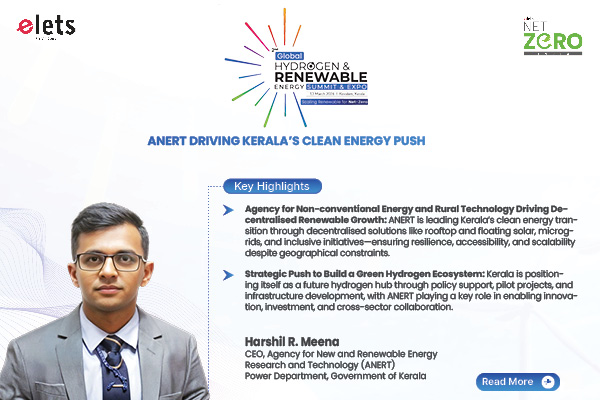
Kerala is emerging as a frontrunner in India’s clean energy transition, with ambitious targets of achieving 100 per cent renewable energy by 2040 and net zero emissions by 2050. Harshil R. Meena, IAS, CEO, Agency for New and Renewable Energy Research and Technology (ANERT), Power Department, Government of Kerala, discusses the state’s renewable energy roadmap, key initiatives to accelerate adoption, and opportunities in the emerging green hydrogen economy in an exclusive interaction with Krishna Mishra of Elets News Network.
Kerala has ambitious sustainability goals. How do you see the state’s renewable energy transition evolving over the next decade? What role does ANERT play in shaping Kerala’s clean energy ecosystem?

Kerala has indeed set ambitious targets of achieving 100 per cent renewable energy by 2040 and net zero by 2050, decades ahead of the national target set by Government of India for 2070. The state’s energy mix already includes a significant share from renewable sources and large hydropower.
To further increase the renewable share while ensuring energy security, the focus over the next decade will be on solar power, decentralised energy systems, energy storage, and emerging technologies such as green hydrogen.

Given Kerala’s limited land availability and high population density, the state’s renewable transition will rely heavily on rooftop solar, floating solar, and other distributed renewable systems.
ANERT serves as the state nodal agency for renewable energy and green hydrogen. It is responsible for implementing both state and national schemes, promoting rooftop solar and decentralised projects, supporting pilot initiatives in emerging technologies, and coordinating with research institutions, startups, and private sector partners to strengthen Kerala’s clean energy ecosystem.
How important is decentralised renewable energy for a state like Kerala with limited land availability?
Decentralised renewable energy is extremely important for Kerala because large-scale land-based renewable projects are difficult due to land constraints.
Distributed systems such as rooftop solar, microgrids, and community solar plants allow electricity to be generated closer to the point of consumption. This also improves resilience, especially during natural disasters.
One example is the Anganwadi solarisation project implemented by ANERT, under which 151 centres in the Chittoor constituency were equipped with solar power systems. Such initiatives help strengthen grassroots energy security while promoting clean energy adoption.
Kerala has made notable progress in rooftop solar and decentralised energy systems. What are ANERT’s key initiatives to accelerate renewable energy adoption across the state?
ANERT is implementing several initiatives to accelerate renewable energy adoption under both state and national solar programmes.
Key initiatives include expanding rooftop solar installations in households, government buildings, and public infrastructure such as schools, hospitals, and local government institutions under the PM Surya Ghar Yojana.
The agency is also promoting solar pumps and renewable energy solutions in agriculture. In addition, Kerala has recently introduced a floating solar policy to encourage investments in floating solar and hybrid renewable projects.
Green hydrogen is another focus area. As an energy carrier, it can store renewable energy for use at a later stage. With funding from the National Green Hydrogen Mission, ANERT is developing the Kerala Hydrogen Valley Innovation Centre to build a pilot-scale hydrogen ecosystem.
The state is also expanding electric vehicle charging infrastructure under the PM e-Drive Scheme to support the transition towards clean mobility.
How is ANERT supporting solar energy expansion in residential, commercial, and public infrastructure? Could you highlight some innovative projects?
ANERT supports solar expansion across residential, commercial, and public sectors by facilitating subsidy schemes, providing technical support, and creating structured project implementation models.
Solar projects are executed through the RESCO model as well as deposit works. Under the RESCO model, ANERT invests in setting up the plant and the institution pays for the electricity generated. In deposit works, the institution bears the project capital expenditure, while ANERT provides consultancy support and vendor facilitation.
Among innovative initiatives, ANERT has implemented a vehicle-to-grid charging demonstration to improve grid stability. In this model, electric vehicles draw power from the grid and can also return electricity during peak demand periods.
The agency has also deployed a grid-interactive renewable- powered battery energy storage system with a capacity of 150 kWh based on similar principles. In addition, pilot projects are underway to develop a hydrogen ecosystem where innovative hydrogen production routes and applications will be demonstrated.
With increasing global focus on hydrogen, what opportunities do you see for Kerala in the green hydrogen economy?
Globally, green hydrogen is emerging as a key solution for decarbonising hard-to-abate sectors.
Kerala has the potential to become an important player in India’s green hydrogen ecosystem. The state could emerge as an export hub for green hydrogen and green ammonia, supported by major ports such as Cochin Port and Vizhinjam International Seaport.
Other opportunities include decarbonising the transport sector and developing strong research and technology systems around hydrogen. ANERT can facilitate this transition by supporting pilot projects, coordinating with industry bodies and research institutions, and enabling integration of renewable power with hydrogen production systems.
What ecosystem—policy, infrastructure, and research—is required to build a green hydrogen hub in Kerala?
Green hydrogen is still a nascent technology and is evolving rapidly. Building a hydrogen hub would require strong state support, industry participation, and demand creation.
A conducive policy environment is essential, including viability gap support, renewable energy integration, and strong linkages with research and development.
A roadmap study has already been undertaken for a hydrogen hub in Kochi. Key demand centres are expected to include refineries and fertiliser plants. The hub will benefit from proximity to Cochin Port, while research and innovation will be supported by leading institutions such as Indian Institute of Science Education and Research, IIT Palakkad, and Council of Scientific and Industrial Research.
How will energy storage, smart grids, and hybrid renewable systems shape Kerala’s energy future?
As renewable energy penetration increases, technologies such as energy storage, smart grids, and hybrid renewable systems will become critical for maintaining grid stability and reliability.
Energy storage solutions will help address the intermittency of solar and wind power, while smart grids will enable efficient demand management and real-time energy balancing. Research institutions can leverage their infrastructure and state support to develop innovative technologies. Startups and technology innovators can then scale these ideas from concept to pilot projects and eventually to commercial deployment.
What policy frameworks are needed to attract greater investment in renewable energy projects in Kerala?
Kerala already has a strong institutional and policy framework for renewable energy. Going forward, the focus should be on reducing risks for private investment.
This can be achieved through measures such as single-window clearances, predictable regulatory frameworks, and well-structured power procurement mechanisms such as take-or-pay contracts. Greater confidence from the private sector can also help expand public-private partnership models for renewable and hydrogen projects. ANERT will continue to play a facilitating role in building a strong ecosystem of stakeholders and technologies, strengthening Kerala’s position in the clean energy domain.

Be a part of Elets Collaborative Initiatives. Join Us for Upcoming Events and explore business opportunities. Like us on Facebook , connect with us on LinkedIn and follow us on Twitter, Instagram.
"Exciting news! Elets technomedia is now on WhatsApp Channels Subscribe today by clicking the link and stay updated with the latest insights!" Click here!