 News
News



Interviews
Energising Viksit Uttar Pradesh: A Green Growth Vision for 2047
Energising Viksit Uttar Pradesh: A Green Growth Vision for 2047
![]() By
eletsnetzerofinal2025 02-January-2026
By
eletsnetzerofinal2025 02-January-2026


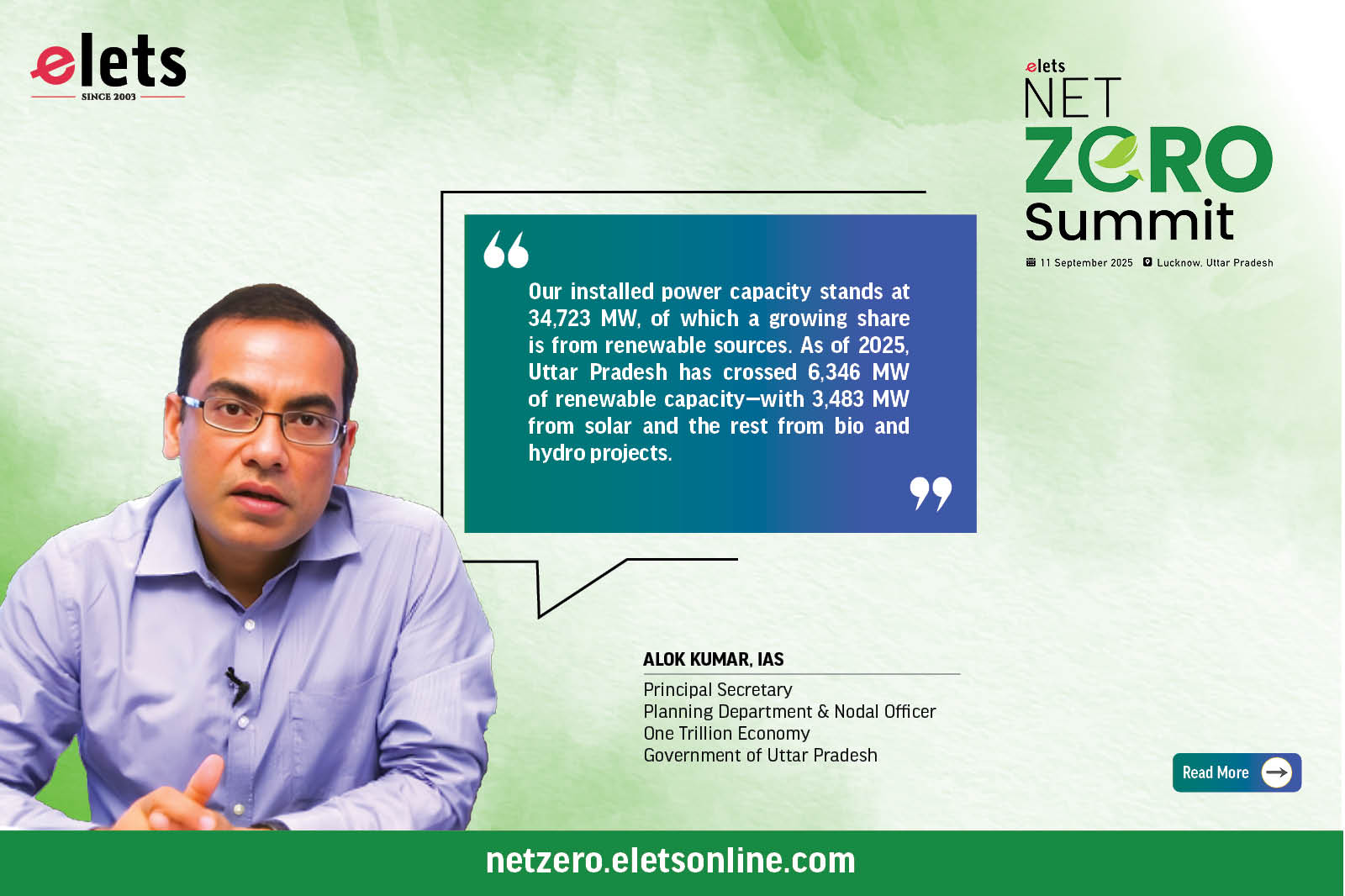
Uttar Pradesh is charting an ambitious path to become a US$6 trillion economy by 2047, with sustainability at its core. Alok Kumar, IAS, Principal Secretary, Planning Department, & Nodal Officer, One Trillion Economy, Government of Uttar Pradesh, in an exclusive interaction with Ritika Srivastava & Abhineet Kumar of Elets News Network (ENN), highlights how the state is embedding clean energy, equity, and inclusivity into its growth journey. Edited excerpts:
Uttar Pradesh has set itself an ambitious target of becoming a US$6 trillion economy by 2047 under the vision of Viksit Bharat @2047. How does sustainability fit into this roadmap?

Under the leadership of Hon’ble Chief Minister Yogi Adityanath, we are aligning ourselves with Hon’ble Prime Minister Narendra Modi’s call for Viksit Bharat @2047. Our vision is for Uttar Pradesh to emerge as a US$6 trillion economy by 2047, contributing nearly 20% of India’s national economic goal.
But this is not just about growth—it is about sustainable growth. We are embedding low-carbon pathways and resilience into our planning. For instance, the special 24-hour Legislative Assembly session on Viksit UP @2047 was dedicated to discussing sustainability and Net Zero commitments. The message is clear: prosperity for Uttar Pradesh must go hand-in-hand with responsibility toward climate and future generations.
The foundation of any Net Zero strategy is economic strength. How has Uttar Pradesh built the capacity to invest in green transitions?
Uttar Pradesh’s economy has been performing robustly. Our Gross State Domestic Product (GSDP) is now close to ₹30 lakh crore, growing faster than the national average. For five consecutive years, we have maintained a revenue surplus, and NITI Aayog ranks us among the front-runners in its Fiscal Health Index. This fiscal discipline creates room for green investments.
Exports have doubled, supported by expressways, industrial clusters, and reliable power supply, while agriculture— contributing 20.5% of India’s food grain output—is undergoing transformation. We are linking agriculture with bioenergy and compressed biogas (CBG), reducing stubble burning and creating cleaner energy. In short, our economic strength is the springboard for a sustainable energy transition.
Energy transition is central to your carbon-conscious vision. Could you elaborate on Uttar Pradesh’s progress in renewables and clean energy adoption?
Our installed power capacity stands at 34,723 MW, of which a growing share is from renewable sources. As of 2025, Uttar Pradesh has crossed 6,346 MW of renewable capacity—with 3,483 MW from solar and the rest from bio and hydro projects
We are leading in several areas:
- Rooftop Solar: Under the PM Surya Ghar Yojana, Uttar Pradesh ranks third nationally with over 2 lakh households solarised, behind Gujarat and Maharashtra, but we lead in monthly growth. In July 2025 alone, we added 27,000 households
- PM-KUSUM: We’ve issued 567 Letters of Award (1,686 MW) for feeder solarisation, and signed 470 PPAs (1,374 MW)—empowering farmers with solar irrigation while reducing subsidy burdens.
- Government Building Solarisation: We are rolling out RESCO-model installations that will make government offices net contributors to the green grid.
- Bioenergy: With 230 TPD commissioned and 860 TPD under development, UP has become India’s leading CBG hub. This links farmers directly to clean energy and reduces emissions from agricultural waste.
Each of these initiatives reinforces our Net Zero commitment, while creating livelihoods and reducing costs.
Beyond numbers, how is Uttar Pradesh ensuring that sustainability is inclusive and equitable for farmers, women, and rural communities?
Our philosophy is that energy transition must also be a social transition. Sustainability, equity, and inclusion are central to our programs.
For example, Bundelkhand farmers using solar pumps are saving costs while selling surplus power. Rural households are shifting to clean biogas for cooking, reducing their dependence on firewood. Women-led self-help groups are managing community biogas plants, generating both income and dignity. Under the Surya Mitra Programme, local youth are being trained and employed in solar installations.
We also ensure that landowners benefit—farmers are earning lease income from barren land that is now used for solar parks. This is not just about reducing carbon intensity; it is about creating equitable prosperity while moving toward Net Zero.
Can you give us a ground-level example that symbolises Uttar Pradesh’s green transition?
A striking example is the Jalaun Solar Park in Bundelkhand. Once barren land is now being transformed into a 1,200 MW clean energy hub by BSUL, supported by the Green Energy Corridor-II for seamless transmission.
The outcomes are multidimensional:
- Clean energy is feeding the grid.
- Local youth are gaining jobs.
- Farmers are receiving lease income.
- Villages nearby are getting reliable electricity.
This perfectly embodies our philosophy of “Transforming Energy, Transforming Lives.” Bundelkhand is fast becoming the solar hub of Uttar Pradesh, and similar models are being scaled elsewhere.
Looking ahead, how do you see Uttar Pradesh balancing rapid growth with Net Zero commitments by 2047?
The path ahead is clear. We are aligning economic planning, infrastructure development, and energy transition into one integrated roadmap for Viksit UP 2047.
Scaling renewables will be central, with distributed solar programs like PM Surya Ghar and PM-KUSUM, and bioenergy projects acting as game changers. We are also prioritising green industry, ensuring that upcoming clusters and industrial parks run on renewable power and, eventually, green hydrogen.
Most importantly, we are building partnerships—with industry, academia, and civil society—to scale innovations and ensure no community is left behind. Uttar Pradesh is India’s most populous state, but it is also becoming its most ambitious in combining growth with sustainability. By embedding clean energy into our economic planning, we are confident UP will be a pillar of India’s Net Zero pathway by 2070.

Be a part of Elets Collaborative Initiatives. Join Us for Upcoming Events and explore business opportunities. Like us on Facebook , connect with us on LinkedIn and follow us on Twitter, Instagram.
"Exciting news! Elets technomedia is now on WhatsApp Channels Subscribe today by clicking the link and stay updated with the latest insights!" Click here!