 News
News





Article
Green Elections: Redefining Democracy With Sustainability
Green Elections: Redefining Democracy With Sustainability
![]() By
eletsnetzerofinal2025 08-January-2026
By
eletsnetzerofinal2025 08-January-2026


India, the world’s largest democracy, thrives on the vibrancy of its elections. Every five years, more than 900 million voters exercise their franchise, creating the largest democratic exercise on the planet. But behind this celebration of democracy lies a challenge rarely discussed—the environmental cost of elections. Plastic banners, synthetic flex boards, paper waste, and the carbon footprint of massive campaigns together leave a staggering ecological impact.

In the 2014 Indian General Election alone, over 8,000 metric tons of non-biodegradable waste was generated, including plastics and paper, according to a study by the Energy and Resources Institute (TERI). Multiply that by successive elections across the states and nation, and the burden on landfills, rivers, and urban ecosystems becomes immense.
It is in this context that the idea of “Green Elections” emerges—not just as an environmental necessity, but as a moral responsibility. At the forefront of this movement is Dr. Heera Lal, who, during his appointment as General Observer in Anandpur Sahib parliamentary constituency, Punjab, pioneered an experiment that blended sustainability with democracy. His journey shows that elections can be free, fair, transparent, and also eco-friendly.

PLANTING THE SEED OF A GREEN ELECTION
When Dr. Heera Lal received his appointment as Election Observer on May 5, 2024, he had no new initiatives in mind. Yet, a seed planted six months earlier during discussions with his team kept nudging him—the idea of a Green Election. Within two days of taking charge, this idea started to germinate.
He dived into guidelines from the Election Commission of India (ECI), contacted the CEO’s office in Uttar Pradesh, the District Election Officer in Banda, and finally the ECI in New Delhi. Soon, the CEO’s office shared with him an important letter dated March 21, 2024, outlining how to conduct ecofriendly elections.
The ECI expected every Returning Officer and election machinery to not just ensure free and fair elections, but also make them eco-friendly. The term “eco-friendly” seemed unfamiliar in the electoral lexicon. To make it relatable, Dr. Lal simplified it into a universally understood phrase—“Green Election”.
This wasn’t just branding. By using the word green, the initiative became instantly visual and accessible. Citizens, officials, and voters alike could understand it without technical jargon. This linguistic innovation made sustainability a shared goal.
Importantly, Dr. Lal was no stranger to climate work. As DEO Banda during the 2019 Parliamentary Elections, he had boosted voter turnout by 10.5% through creative outreach. Over the past year, he had also been deeply engaged with climate change mitigation projects, equipping him with the mindset and tools to merge democratic duty with ecological responsibility.
In just a week of study, discussions, and strategy, he was ready to pilot a Green Election in Anandpur Sahib, scheduled for June 1, 2024.
WHAT MAKES AN ELECTION “GREEN”?
At its heart, a Green Election aims to minimize waste, reduce carbon emissions, and promote sustainability throughout the electoral process. This transformation required not just administrative planning but collective participation.
Dr. Lal engaged a wide network of stakeholders: the Divisional Forest Officer, District Public Relations Officer, SVEEP Nodal Officer, and the Pollution Control Head. Roles were clearly assigned, daily coordination meetings were held, and a comprehensive SoP was drafted to standardise processes.
Within 19 days—from May 13 to June 1—the Green Election gained traction through media, community outreach, and innovative campaigns.
OUTCOMES: A DEMOCRACY THAT BREATHES
The Anandpur Sahib Green Election initiative wasn’t just symbolic—it delivered measurable outcomes across environmental, electoral, and social dimensions.
Environmental Impact
- Plastic minimised across campaign materials and polling booths.
- More than 50,000 trees planted across the constituency, including high-visibility spots like Maharaja Ranjit Singh Park.
- 47,266 plants distributed to voters, turning voting into an act of climate commitment.
Voter Engagement
Despite the intense heatwave of June 1, 2024, Anandpur Sahib recorded a 60% voter turnout. Green messaging tied with SVEEP campaigns created enthusiasm and civic pride.
- 60 model polling booths were established, each designed as a “green booth” with eco-friendly decor, tree saplings, and awareness displays.
- Voters reported feeling part of a collective green mission, not just an electoral exercise.
Quantifiable Electoral Gains
- SAS Nagar saw a 0.06% increase in voting.
- Across three Rupnagar constituencies, turnout rose by 1.8%.
- 251 booths registered higher voting percentages than in 2019.
- High-turnout booths (70–80% voting) increased from 223 in 2019 to 297 in 2024.
- Booth 233 in Manguwal recorded 89.5% voting, surpassing the highest booth turnout of 2019 (77.8%).
Social and Educational Impact
- Schools and colleges integrated Green Election oaths, marathons, and eco-awareness events.
- Media coverage amplified the concept, inspiring replication beyond Anandpur Sahib.
- Communities saw elections not just as political duty but as an opportunity for climate stewardship.
THE FRUGAL INNOVATION MODEL: SUSTAINABILITY WITHOUT COST BURDEN
One of the most remarkable features of the Green Election was its cost-effectiveness. Critics often assume eco-friendly practices require heavy budgets. Dr. Lal proved otherwise through three strategies:
- Convergence – Resources were pooled from existing departments. Saplings came from the Forest Department, cutting costs.
- People’s Participation – Local volunteers, NGOs, and students reduced reliance on paid labor.
No-Cost-Low-Cost Model –
- Biodegradable banners cost the same as plastic.
- Digital campaigns on WhatsApp and social media replaced costly printing.
- Cycle rallies and awareness drives leveraged community energy, not money.
This showed the Green Election is scalable, replicable, and financially viable—a model any constituency, state, or even country can adopt.
WHY GREEN ELECTIONS MATTER FOR INDIA AND THE WORLD
The Anandpur Sahib experiment isn’t just a local story. It offers GloCal lessons—globally replicable from local success.
- Climate Responsibility in Democracy
Elections symbolize the will of the people. If the process itself is wasteful, it sends a contradictory message. Green Elections align democracy with sustainability.
- Voter Turnout Boost
By integrating eco-activities like tree distribution, citizens felt a deeper sense of participation, leading to higher voter turnout—a democratic win.
- Global Relevance
Around the world, countries grapple with making elections digital, paperless, and sustainable. The Anandpur Sahib Green Election provides a tested blueprint, backed by research from IIT Ropar and Delhi University.
- Cultural Shift
Perhaps the most powerful impact is mindset change. By associating voting with environmental duty, citizens are encouraged to adopt eco-friendly practices in daily life.
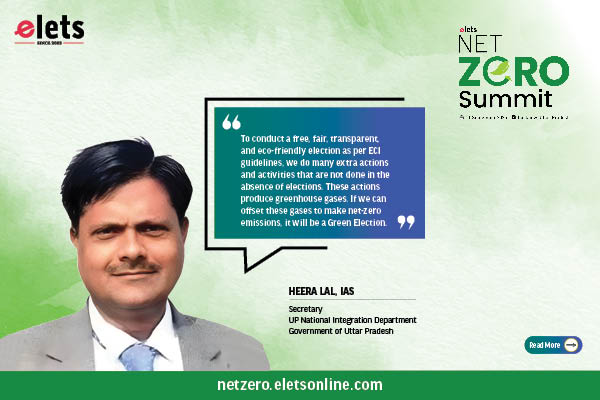
“To conduct a free, fair, transparent, and eco-friendly election as per ECI guidelines, we do many extra actions and activities that are not done in the absence of elections. These actions produce greenhouse gases. If we can offset these gases to make net – zero emissions, it will be a Green Election. We will minimize plastic use to reduce greenhouse gas emission and plant trees to offset the gases produced during election- related activities.” – Heera Lal, IAS, Secretary, UP National Integration Department, Government of Uttar Pradesh
TOWARD A GREENER DEMOCRACY
The Green Election of Anandpur Sahib has already left behind a legacy. Its meticulous documentation, research papers, and community experiences provide a playbook for future elections—both in India and abroad.
As Dr. Lal reflects, the success lay not in grand budgets but in early vision, stakeholder collaboration, grassroots involvement, and relentless communication. Most importantly, it proved that democracy and sustainability are not parallel paths but converging highways.
In an era of climate crisis, integrating ecological consciousness into electoral processes is not optional—it is urgent. Elections must not only decide the future of governments but also safeguard the future of the planet.
The Green Election has shown us the way: a carbon-neutral, participatory, cost-effective model that upholds the sanctity of the vote while honoring the Earth.
And as India moves toward its next democratic exercise, one message stands tall:
“Every vote counts, but so does every tree.”
Views expressed by Heera Lal, IAS, Secretary, UP National Integration Department, Government of Uttar Pradesh

Be a part of Elets Collaborative Initiatives. Join Us for Upcoming Events and explore business opportunities. Like us on Facebook , connect with us on LinkedIn and follow us on Twitter, Instagram.
"Exciting news! Elets technomedia is now on WhatsApp Channels Subscribe today by clicking the link and stay updated with the latest insights!" Click here!